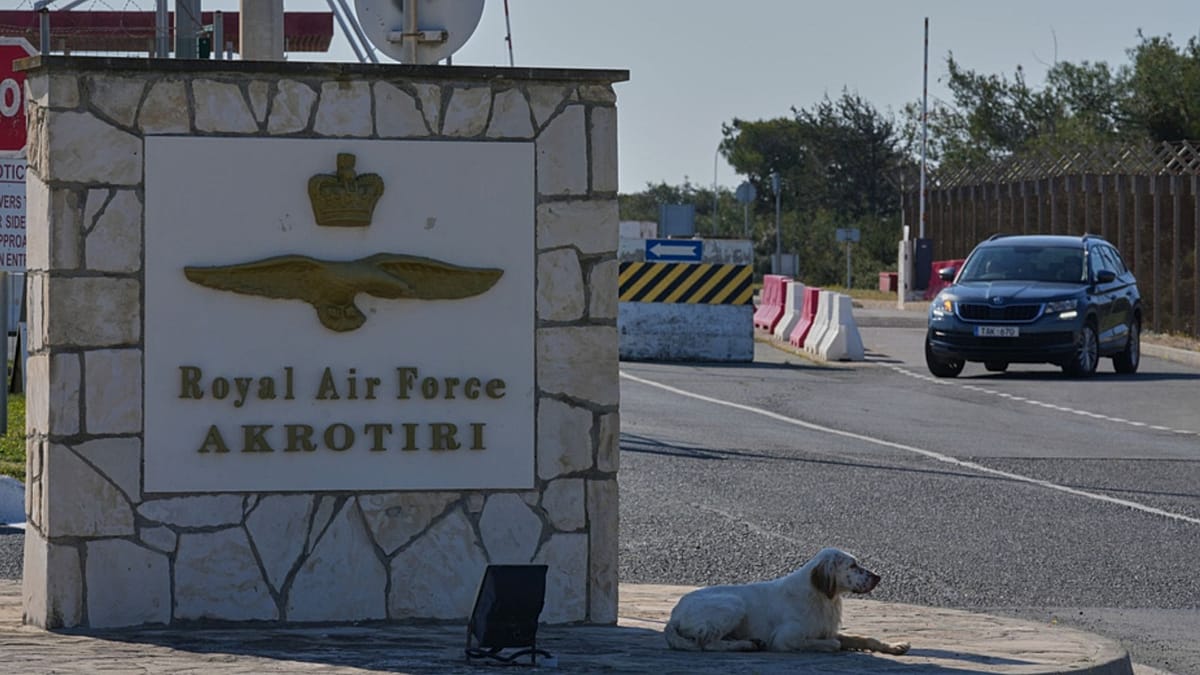
A social media post by French MEP Manon Aubry has reignited debate over the status of the UK's military bases on Cyprus. In a video filmed in Akrotiri, Aubry, of the left-wing France Unbowed party, claimed that the presence of British forces on the island constitutes an occupation and that the bases are used to pass intelligence on Gaza to Israel. Her remarks, originally posted in February, resurfaced online last week and drew sharp reactions.
But legal scholars and political analysts argue that the situation is far more nuanced. The Sovereign Base Areas of Akrotiri and Dhekelia are not occupied territory in the legal sense, they say, but rather a colonial remnant — a term that captures their historical origins while acknowledging the consent of the Cypriot government.
A colonial relic, not an occupation
Peter Clegg, a professor of politics and international relations at the University of the West of England, who specialises in British Overseas Territories, points to the definition of occupation: the presence of military forces without the consent of the territorial government. In this case, he says, consent exists. The Cypriot government has never challenged the legality of the 1960 Treaty of Establishment, which granted the UK sovereignty over the bases.
Under the terms of that treaty, the UK pledged not to develop the bases for non-military purposes and not to establish colonies there. Cypriots living in or near the bases retain full rights, and local laws are meant to mirror those of the Republic of Cyprus as closely as possible. The Cypriot government also oversees civilian matters such as education and social welfare in the base areas.
Costas M. Constantinou, professor of international relations at the University of Cyprus, prefers the term "ingenious development of colonialism" to occupation. He notes that while Cypriots formally agreed to the bases in 1960, that agreement was made under duress. "Decolonisation of the island was made conditional on accepting the sovereign bases," he says, which raises questions about their legitimacy today.
Neophytos Loizides, professor of international conflict analysis at the University of Warwick, echoes that view. "The agreement was signed under duress," he says. "Cypriot leaders did not have the same power as the UK, so the UK could impose its will." He adds that calling the bases an occupation is an "emotive use of words" and that a more accurate label is "colonial remnant."
Different from the north
The distinction from the Turkish occupation of northern Cyprus is crucial. Turkey invaded in 1974 and has controlled about 36% of the island ever since. The self-proclaimed Turkish Republic of Northern Cyprus is recognised only by Ankara, and the vast majority of the international community considers the north to be under military occupation.
Greek Cypriots, Constantinou says, do not view the British bases as equivalent to that occupation. "Those Cypriots who live inside the base areas and may still consider it a colonial remnant don't necessarily or always see it negatively," he explains. Many benefit economically from working on the bases, and some feel the British military presence offers security against the Turkish army, particularly in villages like Achna Forest within the Dhekelia base.
Still, ambivalence persists. "A Cypriot person is unlikely to say the British are occupiers, but they wouldn't necessarily say they're there legitimately either," Loizides notes.
Claims about Gaza and NATO
As for Aubry's assertion that the bases are used to provide intelligence on Gaza to Israel, Clegg says that is incorrect. There have been some surveillance flights in and around the region, he acknowledges, but the UK's role has been limited and does not amount to direct support for Israeli operations. The bases are not under the command of US President Donald Trump, as Aubry claimed; they are sovereign British territory, though they do host NATO assets.
The debate over Akrotiri and Dhekelia is part of a broader conversation about the legacy of European colonialism. Similar questions arise over other British overseas territories, such as Gibraltar, which Spain has long sought to reclaim. The Franco-British bond celebrated at the Bayeux Tapestry viewing last week is a reminder of how deep historical ties run — and how they can still shape modern politics.
For now, the legal status of the bases remains settled, but the political and emotional resonance is far from resolved. As Constantinou puts it, the key word is "ambivalence." The bases are a relic of an empire that no longer exists, yet they remain a visible reminder of the compromises made at Cyprus's birth as an independent state.