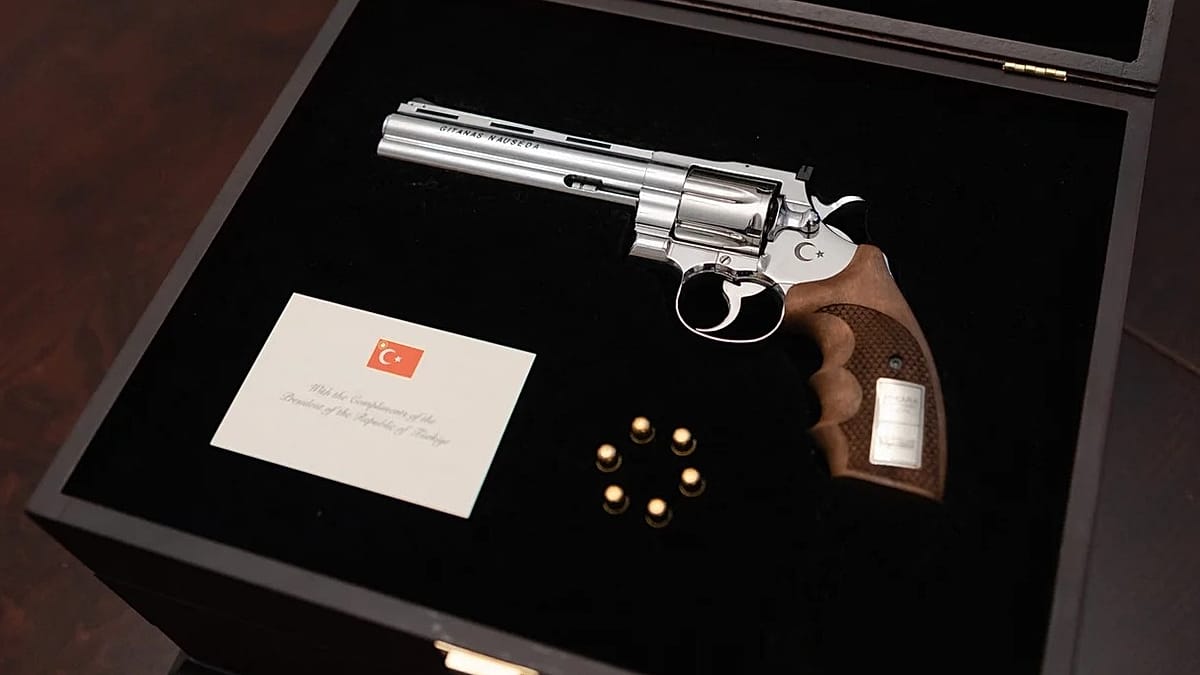
When NATO leaders departed the two-day summit in Ankara, few initially inspected the gift bags handed to them by Turkish President Recep Tayyip Erdoğan. It was only after British Prime Minister Keir Starmer and several other heads of government opened the burgundy wooden boxes that they discovered the contents: a Gümüşay .357 Magnum revolver, the Turkish-made equivalent of the firearm famously wielded by Dirty Harry.
The discovery triggered a flurry of reactions. Belgian Prime Minister Bart De Wever's staff photographed the box on the tarmac at Brussels Airport, having only realized the chrome-plated, personalized pistol was inside after returning home. Security teams scrambled to manage the unexpected firearms, which came with six live rounds. Canadian Prime Minister Mark Carney, by contrast, joked that his gift of maple syrup seemed underwhelming next to the gleaming handgun.
A Tradition Rooted in History
While the gesture may appear unusual to modern sensibilities, presenting heads of state with engraved firearms is a diplomatic custom as old as the industrial arms trade. In the 1850s, Samuel Colt personally gifted a gold-inlaid revolver to Ottoman Sultan Abdülmecid I during a tour of Europe and the Ottoman Empire. Colt pointedly noted that the Russians were already buying his pistols, prompting the sultan to order 5,000. Colt had used the same pitch months earlier on Tsar Nicholas I, supplying both sides during the Crimean War.
Oliver Winchester, Colt's rival, employed similar tactics domestically, presenting a gold-mounted Henry rifle to President Abraham Lincoln to secure wartime contracts. Future U.S. President Theodore Roosevelt, an avid gun collector, gave a gold-plated Winchester Model 1895 to Leonard Wood, the military governor of Cuba. Even Soviet Premier Nikita Khrushchev, during his 1959 visit to Washington, presented President Dwight Eisenhower with elaborately engraved shotguns from the Izhevsk arms works—a gesture that passed through customs without incident amid the Cold War.
Erdoğan's gift fits this historical pattern. Each revolver was engraved with the recipient's name and boxed with the Turkish flag and NATO emblem. Turkish media reported that the president also included a signed copy of his English-language biography, The Politics of Courage: Erdoğan and the Rise of Türkiye, along with a personal letter and a fountain pen. The Turkish presidency's Communications Directorate confirmed the gift but offered no further explanation.
Marketing or Misstep?
The choice of a revolver is not incidental. Turkey has become the world's third-largest small-arms exporter, and the gift doubles as a promotional tool for its state arms maker MKE. The Gümüşay .357 Magnum was originally developed in the 1990s by a now-shuttered manufacturer in Gümüşhane, with remaining stock later absorbed by MKE. By presenting these weapons to NATO allies, Erdoğan signals Turkey's ambitions in the global arms market.
Yet the reaction among European leaders highlights a cultural divide. For many in Western Europe, the gift felt jarring, even threatening. Belgian security protocols were reportedly strained, and the incident sparked debate on social media about Erdoğan's intentions. Some saw it as a strongman's tactic; others recognized it as an old-school diplomatic tradition.
The practice of gifting ceremonial weapons has deep roots in European history. French kings issued swords inscribed Ex Dono Regis (“given by the king”) as battlefield honors, including to allied foreign officers during the American Revolutionary War. In the Ottoman Empire, such gifts were common among sultans and foreign dignitaries. Erdoğan's revolver, then, may be less a faux pas than a continuation of a centuries-old custom—albeit one that clashes with contemporary norms in Brussels or Berlin.
As the story continues to circulate, it raises broader questions about diplomatic symbolism and the evolving relationship between Turkey and its NATO allies. For now, the engraved revolvers sit in the hands of leaders who must decide whether to keep them, return them, or hand them over to security services. The episode serves as a reminder that even in the 21st century, diplomacy can still surprise.