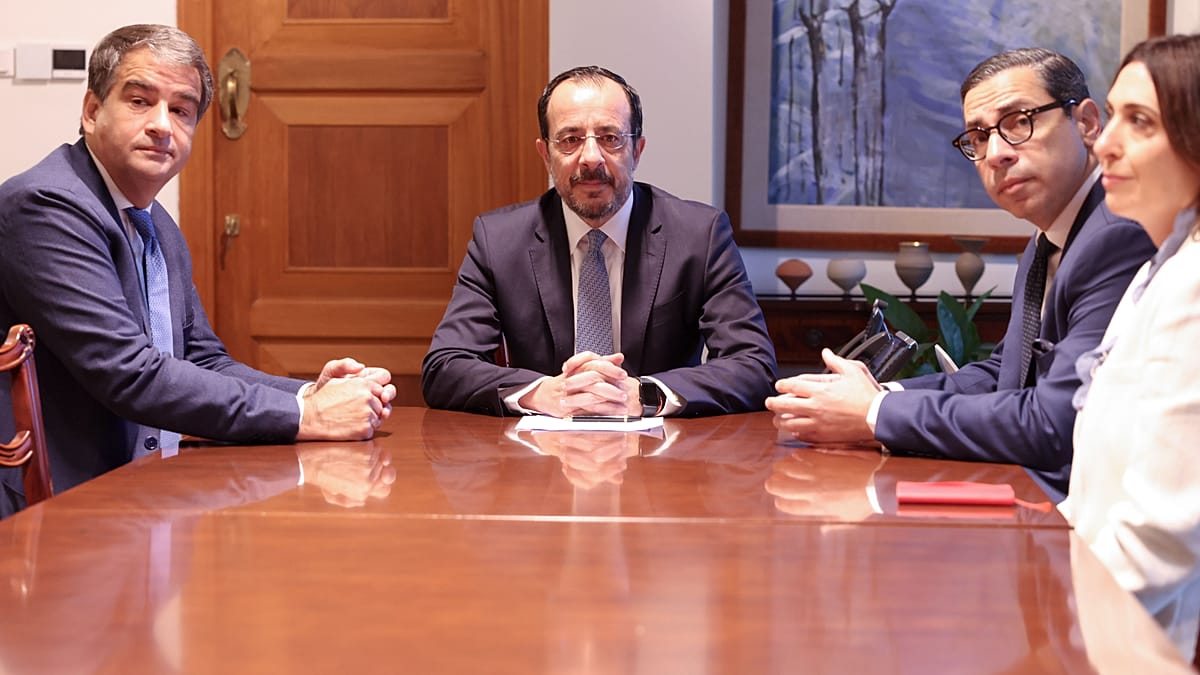
Raffaele Fitto, the European Commission's special envoy on the Cyprus issue, has concluded his first visit to the island, underscoring Brussels' determination to play a substantive role in the United Nations-led peace process. In meetings with both Cypriot leaders, Fitto conveyed a clear message: the European Union is ready to engage actively and constructively.
“The European Union is sending a very clear message: that it wishes to work and to take part with a very significant role in the United Nations process,” Fitto said after talks with Nikos Christodoulides, the president of the internationally recognised Republic of Cyprus. The Italian politician, who also serves as an executive vice-president of the European Commission, later met separately with Tufan Erhürman, the leader of the Turkish Cypriot community.
Fitto stressed that the EU's aim is “to contribute positively to the process,” and that his initial visit was primarily about listening to the positions of all parties involved. He announced plans to return to Cyprus in the coming months, expressing optimism that “very significant results” could be achieved in that timeframe. “We want to follow the UN process clearly, because it is very important for us to make a significant and positive contribution in this way,” he added.
Next steps and the role of Ankara
Cypriot Foreign Minister Constantinos Kombos described the meeting as “particularly useful and constructive,” noting that practical next steps and Fitto's future contacts with the parties were discussed. “We view his visit to Cyprus extremely positively. The timing is also very important, given that only a few days ago we had the Secretary-General here,” Kombos said.
Nicosia believes that the state of EU–Turkey relations could provide leverage to reinvigorate the stalled settlement efforts. “EU–Turkey relations are an issue that can serve as leverage,” Kombos remarked, pointing out that Fitto's position as an executive vice-president gives him direct channels of communication with Ankara. The foreign minister also revealed that the Cypriot side has “thoughts, ideas and proposals” under discussion, including new ideas to accelerate the process before António Guterres's term as UN Secretary-General ends in December. “There is potential for progress. We are working to create the conditions for that progress. But the answer to all these questions lies in Ankara,” he underlined.
The visit comes just days after Guterres held separate meetings with both leaders and expressed his intention to convene a broader gathering in a 5+1 format, provided sufficient preparation is carried out. The EU's special envoy is tasked with assisting the settlement process under UN auspices, in close cooperation with the Secretary-General's personal envoy, María Ángela Holguín, and in contact with both sides and other stakeholders.
Fitto's appointment as EU envoy reflects a broader push by Brussels to assert itself in the Cyprus file, a long-standing issue that remains a key obstacle in EU–Turkey relations. The island has been divided since 1974, and the internationally recognised government in Nicosia represents the Republic of Cyprus in the EU, while the Turkish Republic of Northern Cyprus is recognised only by Ankara. The EU has repeatedly called for a comprehensive settlement that would reunify the island as a bi-communal, bi-zonal federation.
Analysts note that the EU's enhanced engagement could provide fresh momentum, especially as Guterres seeks to leave a legacy of progress on Cyprus before his term ends. However, the fundamental disagreements over sovereignty, security, and territorial adjustments remain formidable. The Turkish Cypriot side has long insisted on equal status and a two-state solution, a position rejected by Nicosia and the international community.
Fitto's visit also signals the EU's willingness to use its institutional weight to facilitate dialogue. As a senior figure in the Commission, he can engage directly with Turkish officials, potentially easing tensions that have often blocked progress. The EU's interest is not merely altruistic: a settlement would unlock significant economic and geopolitical benefits for the region, including enhanced energy cooperation in the Eastern Mediterranean.
For now, the focus is on preparation. The UN is expected to convene a new meeting, possibly in the autumn, and both sides are under pressure to show flexibility. The EU, through Fitto, is positioning itself as a key facilitator, but the ultimate test will be whether Ankara and Nicosia can bridge their differences. As Kombos put it, the ball is in Turkey's court.