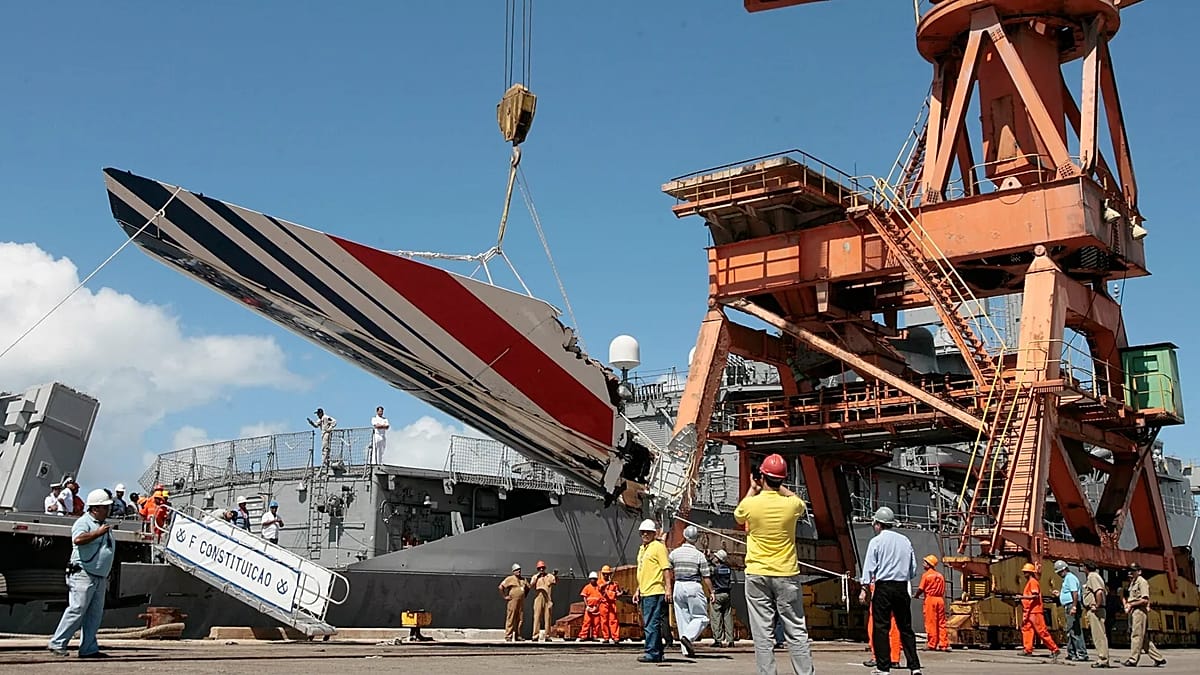
On Thursday, the Paris Court of Appeal delivered a landmark ruling, convicting Air France and Airbus of involuntary manslaughter in connection with the 2009 crash of Flight AF447, which killed all 228 people on board. The decision overturns a 2023 lower court acquittal and marks a dramatic turn in one of France's most protracted aviation disaster cases.
The court found that the French flag carrier and Europe's leading aerospace manufacturer bore sole and entire responsibility for the disaster, ordering each to pay €225,000 — the maximum fine for corporate manslaughter. While the financial penalty is largely symbolic, the reputational damage is substantial for both companies, which have long denied criminal liability and blamed pilot error.
Seventeen-Year Legal Battle
The crash occurred on 1 June 2009, when Air France Flight AF447, en route from Rio de Janeiro to Paris, plunged into the Atlantic Ocean during a mid-flight crisis. The Airbus A330, carrying 216 passengers and 12 crew — including 72 French and 58 Brazilian nationals — experienced a malfunction of its pitot tubes, which became blocked by ice crystals during a storm. This caused the autopilot to disengage and triggered a series of alarms. The pilots, faced with conflicting data, inadvertently put the aircraft into a climb that led to an aerodynamic stall and a fatal descent.
In Thursday's ruling, the presiding judge criticized the lower court for failing to consider the causal chain within which the pilots' actions occurred. The court heard that both companies were aware of the pitot tube issues but did not adequately train crews or inform them of the risks. Airbus was found guilty of underestimating the seriousness of the sensor problems and failing to properly brief operating airlines. Air France was convicted for not providing sufficient pilot training or clear information about the failure.
“The AF447 crash was a disaster waiting to happen and one that could have been avoided if each of the companies involved had fully grasped the seriousness of the failure,” said Sylvie Madec, a lawyer for the victims' families.
Alain Jakubowicz, another lawyer for the civil parties, said he expected the ruling to set a legal precedent after a 17-year struggle. “No fight is unwinnable,” he added.
Mixed Reactions from Families
In Paris, families of the victims welcomed the verdict. Daniele Lamy, head of a victims' association, said the justice system had finally acknowledged “the pain of the families.” She added that “these prestigious firms will no longer be able to hide behind their self-satisfaction and technological pride.”
But in Rio de Janeiro, the mood was somber. Nelson Faria Marinho, who lost his 40-year-old son in the crash, told reporters the ruling brought him no comfort. “I feel as if my son had died today,” he said, expressing outrage that no executives had been held personally accountable.
Both Air France and Airbus announced they would appeal the decision. Air France noted that its criminal liability had been ruled out twice previously and said it was “aware that this appeal prolongs what has already been a lengthy process, particularly for the families.” Simon Ndiaye, a lawyer for Airbus, stated simply: “The legal battle will continue.”
The eight-week appeal trial, which ran from September to December last year, heard detailed testimony about the final moments of the flight. Experts explained that after the pitot tubes failed, the pilots put the plane into a climb that caused the stall. The presiding judge, however, emphasized that the crew had not been adequately prepared for such a complex emergency. “The pilots of AF447 truly tried everything to get out of this absolutely dreadful situation,” he said. “They went as far as their abilities allowed and nothing can be held against them.”
The case has drawn attention to broader issues of corporate accountability in aviation. In a related development, Italy recently chose to replace its Boeing tankers with Airbus aircraft, a strategic shift that underscores the company's continued influence in European defense and aerospace. The ruling also comes amid heightened scrutiny of French institutions, including a widening probe into abuse at a Paris nursery and the controversial sale of an Eiffel Tower staircase segment at auction.