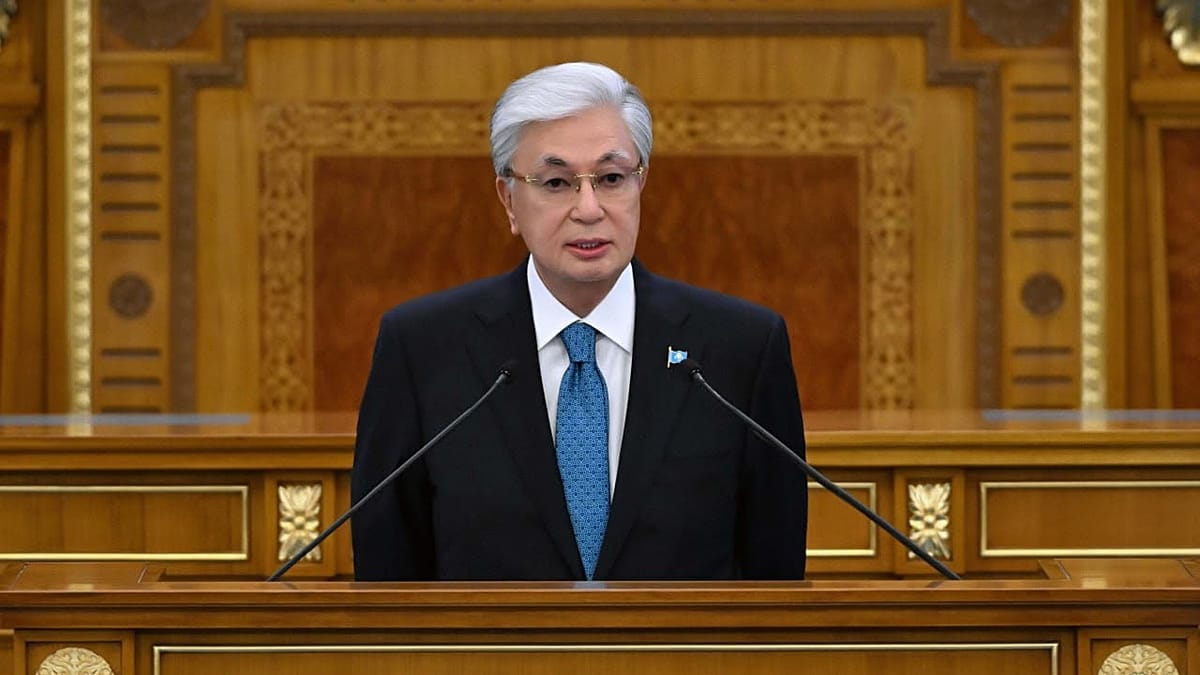
Kazakh President Kassym-Jompt Tokayev used his annual state-of-the-nation address on Wednesday to press for a faster build-out of nuclear power, calling for a long-term national uranium reserve and urging the government to begin construction of the Balkhash nuclear power plant (NPP) as early as next year. He also asked for a comprehensive cooperation agreement to launch the Moyynkum NPP as soon as possible.
“I believe it is possible, and perhaps even necessary, to begin construction of the Balkhash NPP as early as next year, and to sign a comprehensive cooperation agreement with the goal of launching construction of the Moyynkum NPP as soon as possible,” Tokayev said, according to the presidential press service.
The president framed nuclear energy as a route to an electricity surplus, which he described as essential for digitalising the economy and embedding artificial intelligence across public life. Kazakhstan, the world’s largest uranium producer, has long debated the role of atomic power, with a national referendum in 2022 approving the construction of the first NPP.
Sharp criticism of energy sector
Tokayev did not spare his own government. He lambasted inefficiencies and corruption in energy management, pointing to a peculiar trading pattern: during winter shortages, Kazakhstan buys electricity from neighbours at high prices, only to sell it back at much lower rates in summer. “It’s a rather simple sort of ‘business’, and one that has persisted for decades. I’m assured that this is standard practice in the energy sector,” he said.
He added that such practices had also led to the deliberate obstruction of power plant construction and commissioning in several regions, suggesting that vested interests are blocking projects that would undermine their trading profits.
Logistics hub ambition
Tokayev opened his address by noting an increasingly unpredictable geopolitical environment, which he said “did not exist even during the Cold War.” Growing vulnerabilities along maritime routes, he argued, are boosting the importance of overland corridors. “Kazakhstan must seize this historic opportunity to truly become a leading logistics hub for Eurasia,” he said.
He pointed to the Aral-Caspian Highway, which began construction in August. The project is expected to shorten the Trans-Caspian International Transport Route by 1,000 kilometres and cut cargo delivery times to three days. The Bakty–Ayagoz railway line, due to launch next year, will establish a third railway crossing with China and increase freight capacity by 20 million tonnes.
Tokayev said Kazakhstan needs to move beyond being a transit country and become an organiser of international freight flows. He called for developing domestic logistics operators, creating distribution centres, and digitising the transport sector, while also instructing the government to focus on air transit and road infrastructure.
Economic indicators
According to the IMF, Kazakhstan’s GDP will exceed €350 billion this year, making it the world’s 47th-largest economy, with GDP per capita surpassing €17,000. The industrial sector now accounts for more than 14% of GDP, a share Tokayev attributed to diversification efforts. Small and medium-sized businesses contribute 40% of GDP, while their share of fixed capital investment has approached 70%.
Kazakhstan’s gold and foreign exchange reserves, combined with the National Fund’s assets, have exceeded €110 billion. Tokayev said these resources should be used to modernise infrastructure and improve living conditions across the regions. Domestic bank assets have surpassed €130 billion, while savings accounts have reached a record €94 billion, with around 78% held in the national currency—a sign, he said, of the tenge’s growing value.
The president designated next year as the Year of Nationwide Construction, calling on parliament to prioritise building and modernising public infrastructure, including roads, airports, hospitals and cultural centres. The regions plan to build around 70 medical facilities and 50 educational, sports and cultural facilities. The National Fund is expected to allocate approximately €12.8 billion for these and other infrastructure projects by the end of 2029, with nearly €3 billion earmarked for social projects over the next four months.
Tokayev also highlighted Kazakhstan’s demographic profile, noting that the country has around seven million children, accounting for 34% of the population. More than 237,000 children have special educational needs. The education sector grew nearly 6% last year, with total output reaching almost €30 billion.
The address, delivered at a parliament session, came two months later than usual. It reflects a broader push by Astana to position itself as a key link in Eurasian trade, a strategy that has gained traction amid shifting global supply chains. For European readers, Kazakhstan’s nuclear ambitions and logistics plans are worth watching, as they could affect energy markets and trade routes that connect Europe with Asia. The country’s uranium reserves already play a role in Europe’s nuclear fuel supply, and its transport corridors offer alternatives to maritime routes that face disruption.