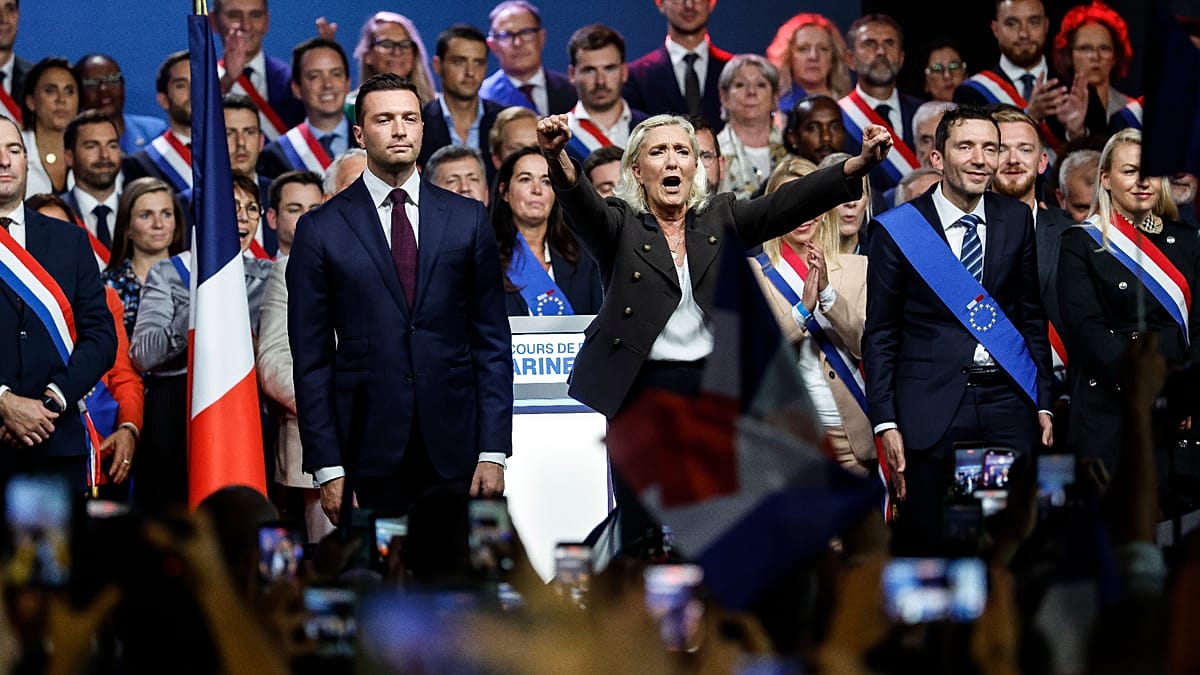
Marine Le Pen chose the former mining town of Hénin-Beaumont in northern France to deliver her first major campaign speech on Sunday, placing housing and the cost-of-living crisis at the centre of her presidential bid. Addressing a crowd in the Pas-de-Calais stronghold of her National Rally party, she promised that French citizens would come “first in their own country”, regardless of skin colour, religion or origin.
“We will guarantee all French citizens a natural and fair right, as is done in every country in the world,” said Le Pen, who has led the party since 2011 and is making her third run for the Élysée. Her remarks were aimed at voters struggling with rising prices and a tight housing market, issues that polls suggest are top of mind for many in France.
Housing and energy at the forefront
Le Pen announced that her policy of “national priority” would extend to housing, meaning French citizens would receive preferential access to social housing. She also criticised the administrative and environmental restrictions that she says slow down construction, and promised to cut VAT on gas, electricity and heating oil from 20% to 5.5%.
“Where is the money going when taxes and levies are getting heavier while the services delivered to French citizens are crumbling?” she asked, tapping into widespread frustration with public services and purchasing power.
The focus on housing and energy reflects a broader trend across Europe, where permanent renting has become the new reality for many, and the EU housing chief has declared the crisis an emergency. Le Pen’s proposals, however, are distinctly national in scope, with an emphasis on favouring French citizens over foreigners.
A stronghold with deep roots
Hénin-Beaumont, a town of about 26,000 people, has been a National Rally bastion for years. Its mayor, Steeve Briois, has held office for 14 years, and Le Pen has represented the Pas-de-Calais department in the National Assembly since 2017. Her political career began in the region nearly three decades ago, when she won a seat as a regional councillor for Nord-Pas-de-Calais in 1998.
“How can I express my gratitude at seeing so many of you this year again, here, on this beautiful patriotic former mining land,” Le Pen told the crowd, evoking the area’s industrial heritage.
Laurent Jacobelli, a National Rally deputy and party spokesperson, explained the party’s appeal in the region. “The Pas-de-Calais region was formerly a mining hub, where people worked hard, paid their taxes, and gave everything to France to support their families and build homes. But they were violently let down by globalisation, by the failure of public services. Here we understood that sovereignty means something, that homeland and the nation are important values,” he told Euronews.
“This is why Marine Le Pen has won over voters: because she is proving that sovereignty and re-industrialisation are achievable.”
Unity on display, but questions remain
Although Jordan Bardella, who is running to become France’s next prime minister, did not address the crowd, Le Pen led supporters in singing “Happy Birthday” to him—a show of unity amid rumours of tensions between the two party figures. Le Pen had spent the previous day in a closed-door meeting with party MPs in the coastal town of Le Touquet.
For locals, Le Pen’s visit coincided with the town’s annual flea market, which she skipped due to “meteorological conditions”. Residents and visitors still turned out, undeterred by rain. One local, Cathy, said that while the party’s positions were once “harder to defend”, she now sees Le Pen as “very brave”.
The party’s efforts to normalise its image have been a long project. Jean-Marie Le Pen, the founder of the National Front, faced repeated legal challenges for racism, hate speech and Holocaust denial. His daughter has sought to distance the party from that legacy, though recent incidents have tested that strategy. Last week, a video emerged showing municipal police officers in Carcassonne making racist, sexist and conspiracy-related comments during a night patrol. The footage, released by the regional newspaper Midi Libre, made headlines across France.
But many supporters in Hénin-Beaumont said they had not heard of the video or did not see it as relevant. “I don’t think that just because we vote for Marine Le Pen that we are racists,” said Antoine, a 19-year-old activist, who declined to comment on the specifics.
Others, like policeman Laurent, said Le Pen fits his ideal presidential profile: “someone who prioritises national interests and fights for the people.” Catherine, who works in Lille, praised local authorities for keeping the town safe and clean, and noted that the council has repeatedly lowered the municipal property tax rate.
When asked about Le Pen’s 2027 presidential bid, many locals expressed support but were vague on policy details. One recent retiree, who has lived in Hénin-Beaumont for 25 years and spoke on condition of anonymity, said the National Rally was doing all it could to “dazzle” locals. “Many businesses here are run by Algerians, Moroccans, and Tunisians. Some people think that if the National Rally is in power, things will change,” he said, reflecting a sentiment that cuts across the town’s diverse population.
Le Pen’s campaign will face scrutiny not only on her policies but also on her party’s ability to shed its past. As she seeks to broaden her appeal, the question of whether she can move beyond her base and win over the wider French electorate remains open. Her focus on bread-and-butter issues may resonate, but the shadow of the party’s history—and the controversies that continue to surface—will not easily disappear.