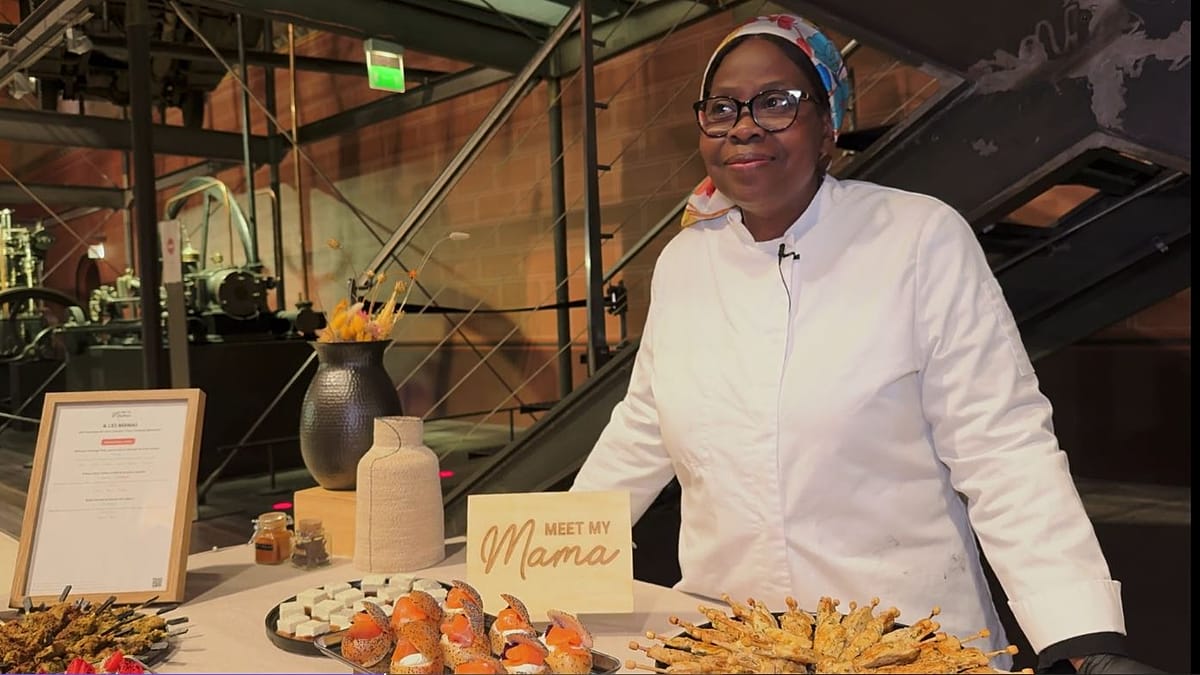
In a professional kitchen at the Cité Fertile, a cultural hub on the outskirts of Paris, Marie-Clarisse Bonzia arranges trays of colourful canapés destined for a corporate event later that evening. Among them are cassava and okra mini-quiches with mango curry sauce, mafé-marinated chicken skewers, and sweet potato bites with cream cheese and Likouala pepper.
“My cuisine is a bridge between Congo, my home country, and France,” says Bonzia, who now runs her own catering company, Maison Kolia. “I learned French culinary techniques to showcase ingredients from back home.”
Bonzia’s journey is emblematic of a broader shift in French gastronomy. She spent much of her career in administration before her life took an unexpected turn. During the civil conflict in Congo, one of her daughters was born with a rare disease requiring specialised medical care. The family fled to France so the child could receive treatment. Balancing a demanding office job with repeated hospital stays became impossible. Seeking more autonomy, she enrolled in culinary training and earned a professional qualification.
Bonzia is one of dozens of women entrepreneurs supported by Meet My Mama, a Paris-based foodtech company that combines high-end catering with social impact. Founded in 2017 by Loubna Ksibi, Donia Souad Amamra, and Youssef Oudahman, the startup helps women of diverse backgrounds—many with immigrant roots—transform culinary talent into thriving businesses.
From Invisible Talent to Professional Chefs
“The idea stemmed from our own stories,” explains Oudahman. “We grew up around women with incredible skills who often remained invisible economically, despite their talent and knowledge. In leadership roles in gastronomy, 90 percent of chefs are still men. We didn’t just want to make room for these women. We want them to access the best positions.”
The startup’s name nods to the Mères Lyonnaises (Mothers of Lyon), cooks of humble origins who, in the late 19th and early 20th centuries, left domestic service to establish their own restaurants in Lyon, considered France’s capital of gastronomy. Several became legendary, such as Eugénie Brazier, who became the first female chef to earn three Michelin stars in 1933. “The Mères Lyonnaises trained the likes of Paul Bocuse. We brought the concept up to date,” says Ksibi.
Meet My Mama has since welcomed women from Peru, Japan, Iceland, Sri Lanka, Morocco, Italy, Congo, and many other countries. “Each one brings a different story, culture and expertise. These are culinary journeys around the world,” Ksibi adds.
Among them is Milena Pecho, founder of the catering company Wankas. Born in France to Peruvian parents, she spent years in financial auditing before realising corporate life was no longer what she wanted. “I wanted to build something of my own and watch it grow,” she says. She travelled to Peru to study at a gastronomic school before returning to France, where she joined a culinary incubator and eventually Meet My Mama. Her cuisine celebrates Peru’s heritage, combining Indigenous traditions with Japanese, European and African influences. One signature dish is a refined Nikkei ceviche; another features black quinoa topped with huancaína cream and cancha, toasted Peruvian corn that evokes childhood memories.
Pecho says the network helped her professionalise every aspect of her business. “They helped me gain efficiency and productivity, but also improve hygiene and quality standards. Now we’re really operating at the highest level.”
Training and Empowerment
Meet My Mama provides much more than visibility. Through its Mama Academy, participants receive training in culinary techniques, entrepreneurship, business management, and leadership. “We give the Mamas the power to have power. And then they’ll pass some of that on to their children, to those around them,” says co-founder Donia Souad Amamra. “The indirect impact is huge.”
Through a partnership with École Ducasse, the culinary school founded by renowned French chef Alain Ducasse, entrepreneurs also have the opportunity to refine their skills. Aminata Kane, who runs her own catering business Au Kassimani, is among the trainees. “I came here to learn how to structure my business and improve my recipes,” she says.
The initiative comes at a time when France’s catering market is increasingly open to fusion cuisine, reflecting the country’s multicultural society. As French hospitals race to adapt to climate pressures, and as the National Assembly passes landmark legislation, the culinary sector is also evolving. Meet My Mama’s model shows how social entrepreneurship can tap into hidden talent, turning home cooks into professional chefs who bring global flavours to French tables.
For Marie-Clarisse Bonzia, the transformation is personal. “My cuisine is a bridge,” she says. “It connects my past and my future, my daughter’s health and my own independence.”