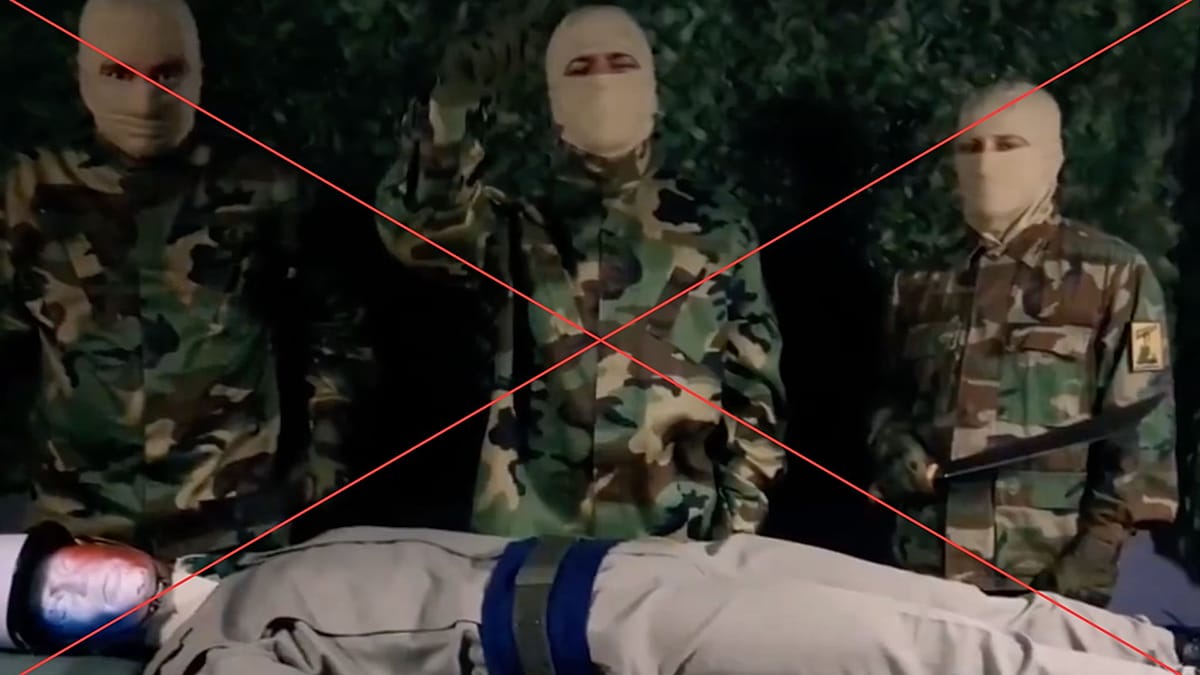
Just ahead of France's Bastille Day celebrations on 14 July, a video surfaced on social media showing three hooded men in military uniforms threatening to "shed blood" on French soil. The clip, which quickly spread across Telegram, X, and Facebook, claimed to be from Hezbollah militants warning France against supplying weapons to Israel. However, fact-checkers and researchers have identified the video as a fabrication, likely part of the Russia-linked disinformation campaign known as Storm-1516.
The video depicts the men posing in front of a dummy of a French Foreign Legion soldier, whose face is painted with the French flag. One of the men uses a knife to decapitate the dummy at the end of the clip. Despite the arm patch resembling Hezbollah's insignia—the group's armed wing is designated a terrorist organization by the European Union—the video lacks the group's official logo, which is typically included in their authentic content.
Linguistic analysis by Euronews's Arabic-speaking service revealed that the speakers used a Levantine Arabic accent, not a Lebanese one, and made multiple grammatical errors. This further suggests the video is not from Hezbollah. Fact-checkers from AFP traced the video's spread to a network of accounts that regularly promote pro-Russian narratives, including those favorable to the Alliance of Sahel States—Mali, Niger, and Burkina Faso—which has ties to Iran and is openly anti-Western.
Storm-1516's Modus Operandi
Storm-1516 is a well-documented Russian influence operation that produces a wide range of fabricated content targeting Europe and the West. Its tactics include impersonating European journalists and news outlets, hiring actors to pose as fake whistleblowers, and increasingly using AI-generated content. Researchers from the Gnida project, an anonymous group tracking Russian influence operations, noted similarities between this fake Hezbollah clip and a January 2025 video in which individuals claiming to belong to HTS—the Islamist group formerly led by Syria's current president, Ahmed al-Sharaa—threatened to burn down Paris's Notre Dame Cathedral unless French authorities released Brahim Aouissaoui, the Tunisian citizen convicted for a 2020 terror attack in Nice.
Another example is a video purporting to show Hamas threatening attacks in France ahead of the Paris 2024 Olympics. Microsoft's Threat Analysis Center examined that clip and deemed it consistent with Storm-1516's tactics, while Hamas denied producing it. These operations are part of a broader pattern of Russian disinformation aimed at sowing discord and undermining trust in European institutions.
The latest fake video gained nearly one million views across X posts, highlighting the reach of such disinformation. It was also picked up by anti-Israel accounts and users who regularly share conspiracy theories. The timing—just before Bastille Day, a symbol of French national unity—is likely intended to stoke fear and division.
European authorities have increasingly focused on countering such influence operations. The EU has imposed sanctions on Russian entities like VK Company for aiding surveillance of Putin critics, and Baltic leaders have warned of Russian plans to strike critical infrastructure in Poland and the Baltics. The Storm-1516 campaign underscores the ongoing threat of hybrid warfare against European democracies.
As France celebrated Bastille Day with a parade that included European troops showing support for Ukraine, the fake video serves as a reminder of the persistent efforts to undermine European solidarity. Researchers continue to monitor Storm-1516's evolving tactics, which now include deepfakes and AI-generated content, making detection increasingly challenging.