KYIV — Ukraine's Deputy Prime Minister for European Integration, Taras Kachka, has defended the country's anti-corruption efforts as proof that its institutions remain effective despite Russia's ongoing invasion. In an interview with Euronews, Kachka described the recent wave of investigations as "the healthiest thing" in a nation of roughly 44 million people now in its fifth year of full-scale war.
"Ukraine is now living through the war and the dramatic change of its political culture," Kachka said on Tuesday. "Something that was a problem for the accession of Ukraine in the past, so 10 years ago, 15 years ago. So corruption, systemic corruption, is now very dramatically and fast going into the past."
Major Probes and Political Fallout
The National Anti-Corruption Bureau of Ukraine (NABU) and the Specialised Anti-Corruption Prosecutor's Office (SAPO) are investigating a scheme allegedly involving the laundering of around €9 million between 2021 and 2025 through the construction of luxury apartments in Kozyn, a wealthy suburb south of Kyiv. Part of the financing is said to have originated from corruption schemes linked to the state energy company Enerhoatom.
Among those detained is Andriy Yermak, President Volodymyr Zelenskyy's former chief of staff, who was released on bail of €2.7 million after four days in custody. The case has sent shockwaves through Ukraine's political elite, but Kachka insists it demonstrates the system's integrity.
"This is exactly what the EU wants us to do, to clear government, to get rid of any corruptions, to ensure that the anti-corruption framework works, and it works," Kachka told Euronews.
He cited statistics from last year: NABU opened 737 cases, SAPO issued 125 indictments against more than 200 people, and the High Anti-Corruption Court of Ukraine delivered 93 sentences against 130 individuals. "It means that it works, this anti-corruption framework works," Kachka said.
Kachka noted that the framework was completed and became fully operational in 2023, when Russia's war was already raging "at fullest scale." While acknowledging that the scandal is "still a scandal" that could damage Ukraine's reputation, he said Kyiv is not "looking for any excuses with the partners."
"We do our homework with fullest accuracy possible," he stated.
Background of the Watchdogs
NABU and SAPO were established in 2015 as part of pro-Western reforms following Ukraine's 2014 Revolution of Dignity, which ousted former pro-Russian President Viktor Yanukovych. NABU investigates top-level corruption, SAPO oversees and prosecutes its cases, and the High Anti-Corruption Court tries them. The institutions were designed to operate independently from political influence, with the chief anti-corruption prosecutor independent of Ukraine's prosecutor general.
Their creation was a key requirement set by the European Commission and the International Monetary Fund for Ukraine's visa liberalisation with the EU. The current investigations come as Ukraine pushes for progress in its EU accession talks; Kyiv has urged Brussels to open all six accession clusters in June, citing delays in the process.
Last summer, Ukraine's state security service, the SBU, conducted raids on NABU as part of an investigation into suspected Russian infiltration. Over a dozen employees were searched, and two detectives were detained. The SBU claimed it had arrested one NABU official on suspicion of being a Russian spy and another over alleged business ties with Moscow. Both anti-corruption agencies rejected the allegations, arguing that the SBU's actions were a prelude to legislative changes that could undermine their independence.
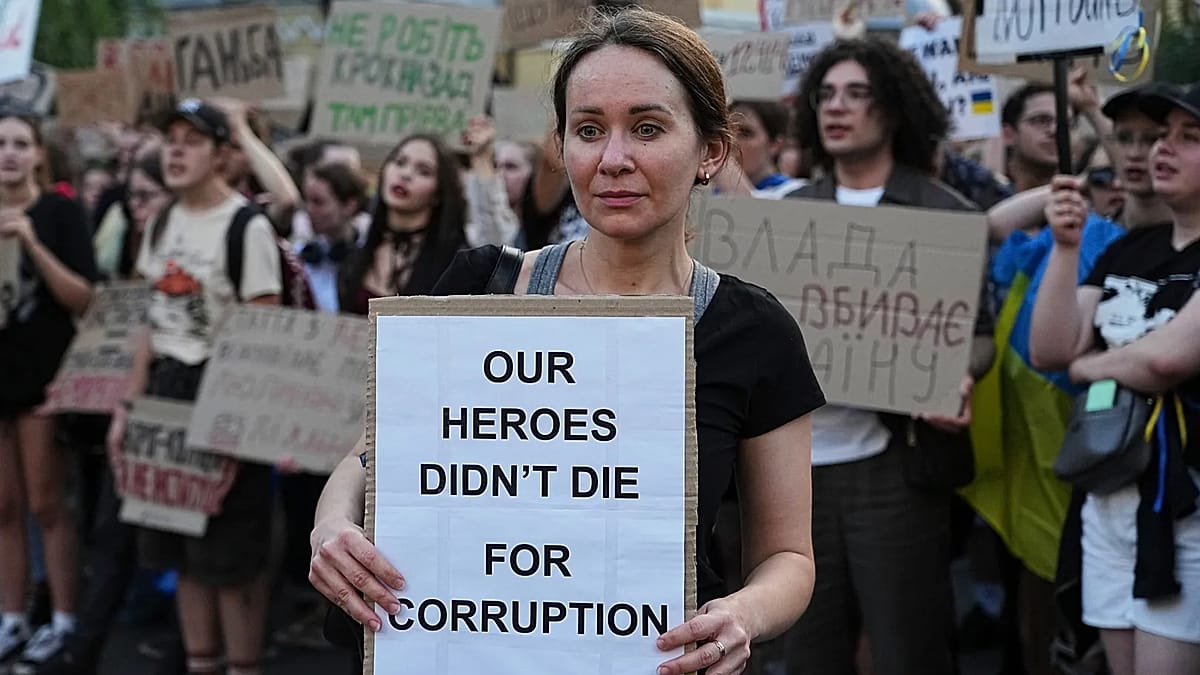
Thousands of Ukrainians subsequently protested in the streets, calling on President Zelenskyy to veto the proposed law. The episode highlighted the ongoing tension between security imperatives and the rule of law in wartime Ukraine.
Kachka's remarks come as Ukraine continues to face scrutiny from international partners. The country's drone warfare has also forced Germany to rethink its battlefield strategy, underscoring the broader security implications of the conflict for Europe.