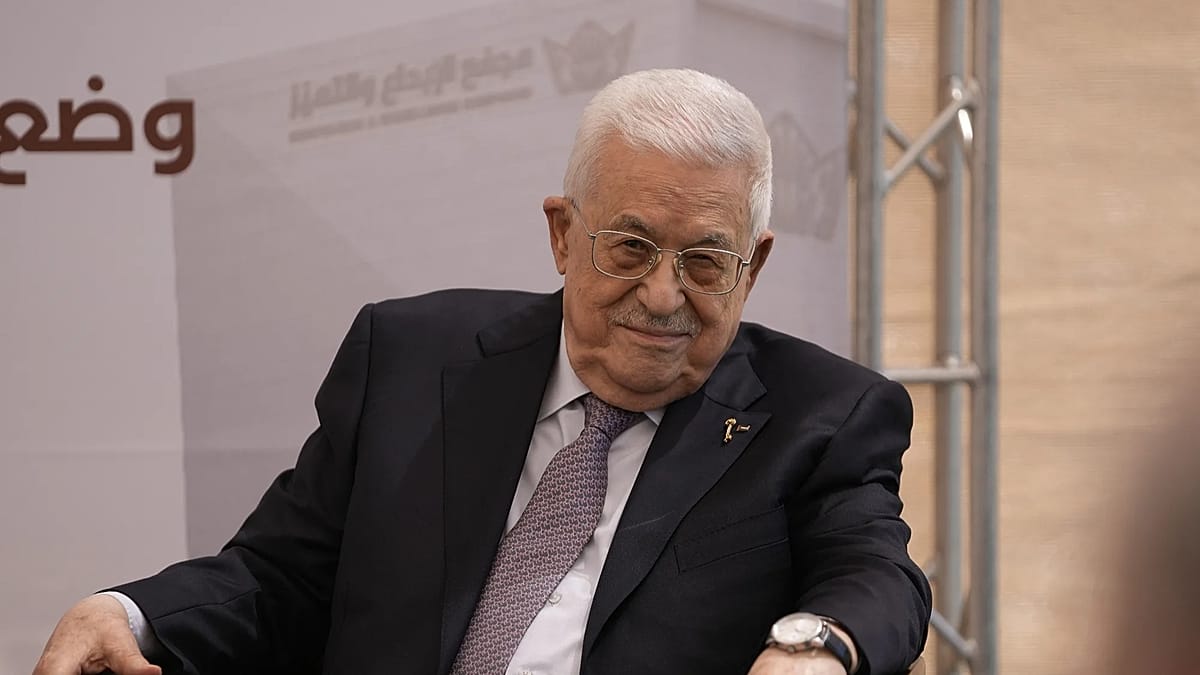
Palestinian President Mahmoud Abbas has again delayed legislative elections, pushing them back to September 2027, according to the official Wafa news agency. The decree, issued on Saturday, sets presidential and legislative polls for 11 September 2027, with the presidency citing "security, logistical and on-the-ground obstacles to establishing the conditions necessary for elections."
The postponement comes just weeks before the previously scheduled vote, which had been set for 28 November this year. The Palestine Liberation Organisation's Executive Committee, which represents the Palestinian people, approved the delay, saying conditions had "changed fundamentally" since the elections were announced.
Brussels had voiced strong support for holding the November elections. Earlier this week, the EU's top diplomat, Kaja Kallas, said the vote "would offer a long-overdue opportunity to renew the legitimacy of Palestinian institutions." She added that "Palestinians have the right to choose their representatives in elections that are credible, inclusive and transparent."
In September, Dubravka Šuica, the EU Commissioner for the Mediterranean, also welcomed the decision to hold elections before the end of the year, calling it "an important democratic moment" and stressing that "ensuring a fair, credible and inclusive electoral process is essential to strengthening Palestinian institutions."
Israeli Foreign Minister Gideon Sa'ar reacted sharply on Friday, accusing Abbas of "fooling the international community by canceling once again promised elections" as rumours of the postponement circulated. The delay is likely to deepen scepticism about the Palestinian leadership's commitment to democratic renewal, particularly among European officials who have long pressed for elections as a step toward institutional legitimacy.
A pattern of delays
This is not the first time Abbas has postponed elections. The last Palestinian legislative elections were held in 2006, and presidential elections in 2005. Repeated attempts to schedule votes have faltered over disputes with Hamas, which controls the Gaza Strip, and over Israeli restrictions in the occupied West Bank and East Jerusalem.
The latest delay comes amid a volatile regional backdrop. The war in Gaza, ongoing Israeli military operations in the West Bank, and the fragile political situation in the Palestinian territories have all complicated any electoral process. The presidency's statement pointed to "security, logistical and on-the-ground obstacles" without providing further detail.
For the European Union, which has consistently backed Palestinian statehood and democratic governance, the postponement is a setback. EU officials have often linked the credibility of Palestinian institutions to the holding of free and fair elections. The bloc's criticism, however, has been muted so far, with Kallas and Šuica stopping short of condemning the delay outright.
Some European diplomats privately express frustration that Abbas has repeatedly used security concerns as a pretext to avoid a vote that could challenge his authority. The Fatah movement, which Abbas leads, has been deeply divided, and elections could expose internal fractures. Hamas, which won the 2006 legislative elections, remains a significant political force, though its role in any future vote is uncertain.
The postponement also complicates EU efforts to engage with Palestinian institutions. Brussels has funded Palestinian Authority programmes and supported civil society, but the lack of electoral legitimacy weakens the PA's standing. The EU has also been involved in efforts to revive the peace process, though those have stalled for years.
Regional dynamics add further complexity. Several Arab states have normalised ties with Israel, and the Palestinian question has slipped down the international agenda. European governments, meanwhile, are divided over how to handle the Israeli-Palestinian conflict, with some pushing for recognition of Palestinian statehood and others prioritising security cooperation with Israel.
The new date of September 2027 gives Abbas more than two years to prepare, but many observers doubt that conditions will be significantly better by then. The Israeli government, led by Benjamin Netanyahu, has shown little interest in facilitating Palestinian elections, and the political landscape in the Palestinian territories remains deeply fragmented.
For now, the EU's response will be closely watched. Kallas and Šuica have both emphasised the importance of credible elections, but they have not threatened any consequences for the delay. The bloc may choose to continue its engagement with the Palestinian Authority, hoping that a future vote can still take place.
The postponement also resonates beyond the immediate Israeli-Palestinian context. It highlights the broader challenges of democratic governance in the Middle East, a region where elections are often delayed or manipulated. European policymakers, who have championed democracy as a cornerstone of their foreign policy, may find it increasingly difficult to reconcile their rhetoric with the reality on the ground.
As the new date approaches, the international community will be watching to see whether Abbas follows through or finds new reasons to postpone. For now, the promise of Palestinian elections remains as distant as ever.



