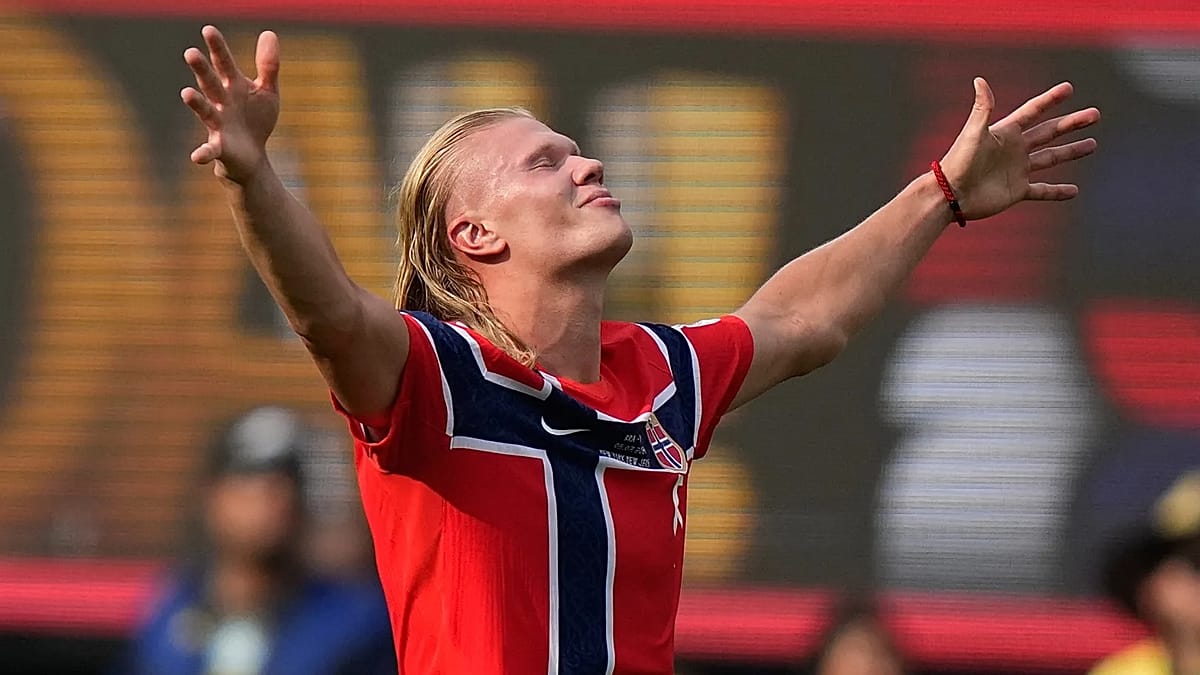
Erling Haaland is having a standout 2026 World Cup, both on the pitch and online. The Norwegian striker’s unfiltered Snapchat posts, with over 3.3 million followers, have turned him into a meme sensation. Yet a significant portion of the content circulating about him is not his own—it is AI-generated, often without his knowledge or consent.
A video that garnered over 31 million views on X in late June showed Haaland mid-meal in a restaurant, flinching at his own reflection. Community notes quickly flagged it as a deepfake: the original footage was a comedic skit by Chinese duo Jin Long and Qiu Qiu, posted on TikTok on 15 June, with Haaland’s face swapped in using AI. Despite the correction, the clip continued to spread rapidly.
On 8 July, the same account posted further AI-altered videos of Haaland, which continued to rack up thousands of impressions. This pattern highlights the challenges of policing manipulated media in an era of viral content.
From Viking Warriors to Chinese Memes
Not all fan content is unwelcome. Ahead of Norway’s last-16 clash with Brazil in New Jersey, fans circulated edited videos superimposing Haaland’s face onto Marlon Wayans’ character in the 2004 comedy White Chicks, with Brazil’s Vinícius Júnior cast as Terry Crews. Haaland spotted one of the edits on Instagram and asked that he and Vinícius recreate it in real life.
However, the most-shared posts depict Haaland as a fur-clad Viking warrior, wielding double-headed axes and commanding a longship. This imagery has roots in a 2023 photoshoot by photographer David Yarrow, who shot Haaland alone, waist-deep in an Oslo fjord, in full Viking dress. Ahead of the 2026 World Cup, the Norwegian Football Federation brought Yarrow back to photograph the full squad. The resulting image, titled “The Vikings are coming,” showed all 26 players armed with swords and shields on the shore of a fjord, a longship looming behind them. Haaland, by Yarrow’s own account, pushed for the squad follow-up himself.
Fans quickly ran with the theme, flooding social media with AI-generated variations—Haaland mid-battle, clad in armour, axe raised—blurring the line between sanctioned mythology and fan-made fiction. Right-wing and far-right accounts, drawn to Haaland as a symbol of white, blonde, and physically imposing masculinity, have been particularly prone to sharing the Viking-themed content.
The phenomenon is especially pronounced in China, where Haaland has become a folk hero. Since joining Weibo and Douyin, China’s version of TikTok, on 6 June, he has amassed 1.6 million followers on Weibo and 5.2 million on Douyin in a month. Hashtags related to the striker have generated more than 490 million views on Weibo alone. Chinese fans have given him two distinct personas: on the pitch, he is the “Nordic Cyborg” or “Robot Striker,” a goal machine of almost inhuman efficiency; off it, he is Habao, roughly “Ha Baby,” a goofy, approachable giant whose exaggerated expressions and off-pitch antics have made him a fixture in Chinese meme culture.
Many of the fan edits circulating on Chinese social media feature a song titled “Haaland (Ha Ha Ha),” set to the tune of Moskau, a 1979 track by German Eurodisco group Dschinghis Khan—recorded more than two decades before the Norwegian striker was born.
This AI-generated content raises broader questions about authenticity and the spread of manipulated media. As Haaland’s popularity grows, so does the challenge of distinguishing real from fake. For more on Haaland’s training regimen, see Erling Haaland's Routine: Ice Baths, Hypoxic Chambers, and the Pursuit of Peak Performance. For updates on the World Cup knockout stage, check Messi, Mbappé, Haaland Dominate as World Cup Knockout Stage Takes Shape.