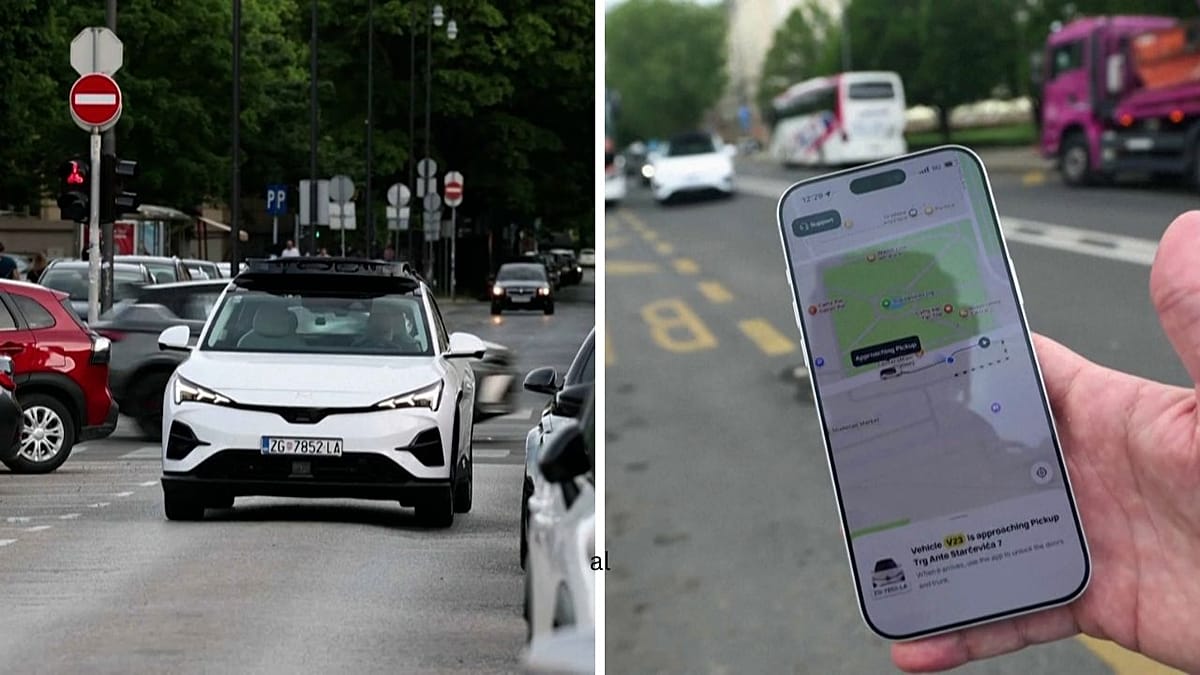
Zagreb has become the first European city to host a commercial robotaxi service, as a Croatian company backed by Uber and Chinese autonomous driving firm Pony.ai begins testing self-driving cars on its streets. The limited rollout marks a significant step for autonomous mobility on the continent, though a human operator remains behind the wheel for now.
The service, operated by local startup Project 3 Mobility, uses a fleet of electric vehicles equipped with Pony.ai's autonomous driving technology. Passengers can hail rides through a dedicated app, with the cars navigating a predefined area of the Croatian capital. The company says it aims to expand coverage and eventually remove the safety driver, pending regulatory approval.
European first, but with caveats
While autonomous vehicle trials have taken place across Europe—from Helsinki to Munich—this is the first time a commercial robotaxi service has been offered to the public on the continent. However, the presence of a human operator means the service is not fully driverless, unlike some trials in the United States and China.
Project 3 Mobility's CEO, Marko Pejković, described the launch as "a historic moment for Croatia and for European mobility." He added: "We are proving that a small country can lead in a technology that will reshape how people move in cities." The company has not disclosed the exact number of vehicles in operation or the pricing model.
The partnership with Uber gives the Croatian startup access to the ride-hailing giant's platform and operational expertise, while Pony.ai provides the core autonomous driving stack. Pony.ai, which already operates robotaxis in Beijing and Guangzhou, has been expanding its European footprint through this collaboration.
Regulatory and safety considerations
The rollout comes as European regulators grapple with how to integrate autonomous vehicles into existing traffic systems. Croatia has been relatively proactive, passing legislation in 2023 that allows testing of self-driving cars on public roads. The country's transport ministry has been closely monitoring the Zagreb trial.
Safety remains a key concern. The company says its vehicles have undergone extensive testing in simulated environments and on closed tracks before hitting Zagreb's streets. The human operator can take control at any moment, and the cars are programmed to pull over safely if a critical system failure occurs.
Local residents have expressed a mix of curiosity and caution. "It's exciting to see something like this in Zagreb, but I'm not sure I'd trust a car without a driver yet," said Ivan Horvat, a 34-year-old software engineer who witnessed one of the test vehicles near the city center.
The launch also raises questions about data privacy and cybersecurity, as the vehicles collect vast amounts of sensor data. Project 3 Mobility has stated that all data is stored on servers within the European Union and complies with GDPR regulations.
Broader implications for European mobility
The Zagreb robotaxi service is part of a wider trend of autonomous vehicle development in Europe. Several countries, including Germany, France, and Sweden, have allowed testing of self-driving shuttles and delivery robots. However, commercial robotaxi services have been slower to materialize compared to the United States and China.
European Pulse has previously covered related developments, including Tesla's pivot to robots and robotaxis, which underscores the growing industry interest in autonomous mobility. Meanwhile, Croatia's recent US-backed gas deal highlights the country's balancing act between energy security and climate goals—a tension that also applies to the electrification of transport.
The success of Project 3 Mobility could influence other European cities to accelerate their own autonomous vehicle programs. If the Zagreb trial proves safe and commercially viable, it may pave the way for similar services in cities like Ljubljana, Budapest, or even Vienna.
For now, the robotaxis remain a novelty in a city better known for its Austro-Hungarian architecture and café culture. But if the technology matures, Zagreb could become a unlikely pioneer in the future of urban transport.