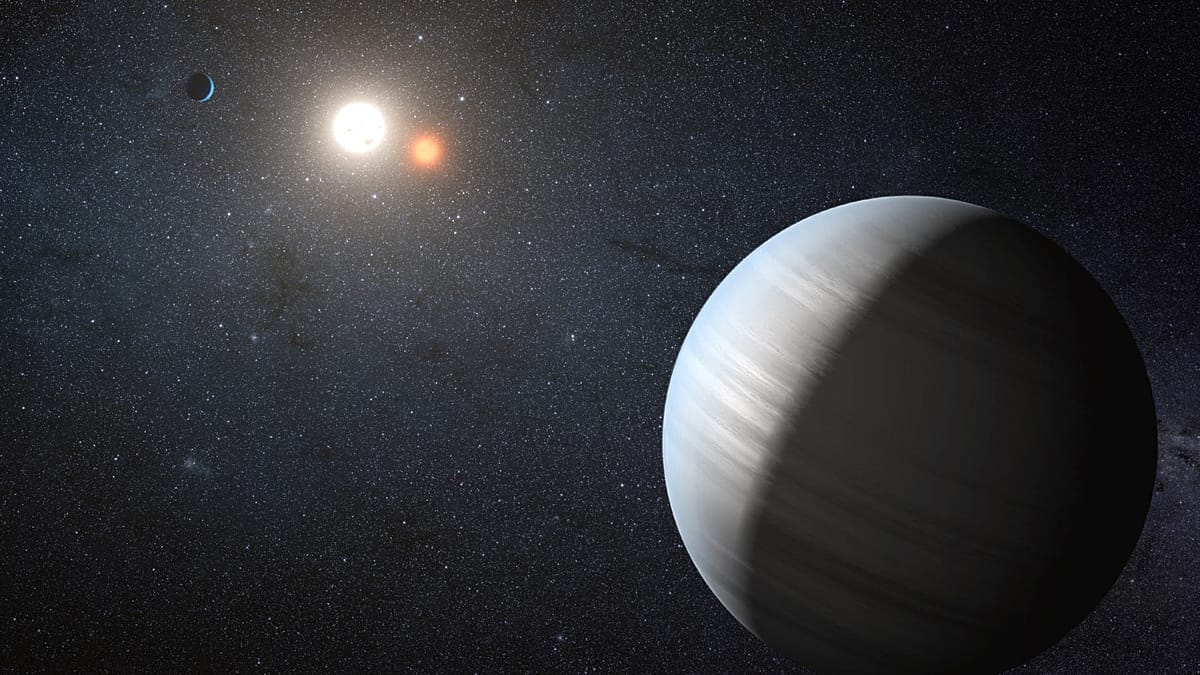
A team of astronomers has identified 27 candidate planets orbiting binary star systems, using a novel detection method that relies on subtle gravitational effects rather than direct observation. The research, published in the Monthly Notices of the Royal Astronomical Society, was led by Margo Thornton, a PhD candidate at the University of New South Wales and a researcher at the SETI Institute.
Most known circumbinary planets—worlds that orbit two stars, reminiscent of the iconic twin-sunset scene in Star Wars: A New Hope—are found when they pass in front of one of their stars, dimming its light. This transit method, however, requires the system to be perfectly aligned with Earth. If it is not, the planet remains invisible.
A Different Way to Find Planets
The new study instead exploits a phenomenon called apsidal precession: a gradual rotation of a binary star's orbital path over time. When a planet orbits a binary system, its gravitational pull causes a subtle but measurable shift in the timing of the eclipses the two stars create as they pass in front of each other. By tracking these tiny timing shifts across years of data from NASA's Transiting Exoplanet Survey Satellite (TESS), the team detected planetary companions without ever directly observing the planets themselves.
“The calculation of precession was based on the change in the argument of periastron over time of the binary star, which can be determined by the exact timing of both primary and secondary eclipses,” the authors explained.
What Researchers Found
The team studied 1,590 eclipsing binary star systems. In 71 of them, they saw signs of orbital changes that could not be explained by known physics effects alone. In 36 cases, something extra seemed to be causing the effect—and in 27 of those, the most likely explanation is a planet-sized object. A few orbit hot, large stars where planets are usually very hard to detect with traditional methods. Before this, only around 18 circumbinary planets had been confirmed, making this a particularly rare discovery.
The findings are significant because they could lead to the uncovering of many more planets that current techniques miss, especially in more complex systems. It also gives scientists a broader picture of how planets form and survive around two-star systems. “The findings of this work will allow us to robustly test formation theories, constrain migration histories, and understand long-term evolution of circumbinary systems,” the study continued.
The researchers note that their sample represents only a tiny fraction of known eclipsing binaries: “the sample we analysed was only a small fraction of the 2 million EBs in Gaia’s catalogue.” They suggest that expanding the search across the full dataset and combining it with longer observational baselines from TESS could reveal many more systems in the future.
This discovery underscores the growing importance of innovative detection methods in astronomy, much like how shifts in complexity are being studied in other fields. It also highlights the role of international collaboration, with researchers from Australia and the United States contributing to the work.