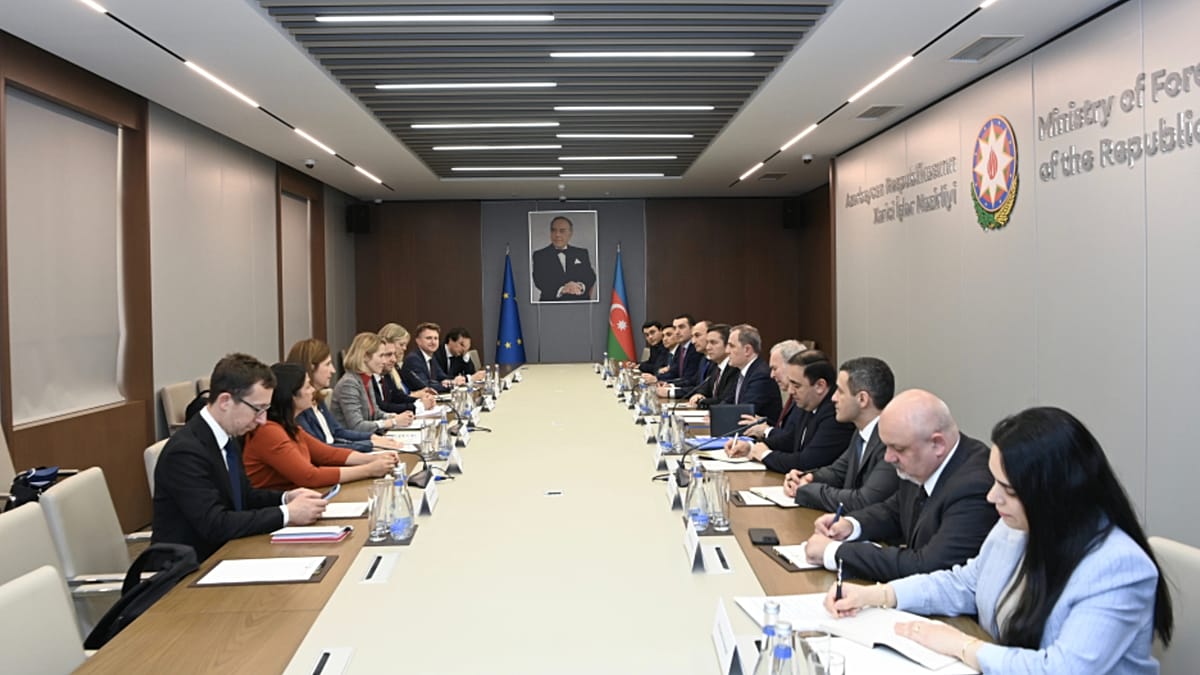
EU High Representative for Foreign Affairs and Security Policy Kaja Kallas travelled to Baku on Tuesday for talks with Azerbaijani President Ilham Aliyev, continuing a tour of the South Caucasus that began with the EU-Armenia summit in Yerevan. The visit aimed to advance what Kallas described as the bloc's shared strategic interest in connectivity between the European Union, the South Caucasus, and Central Asia, while also contributing to the regional peace process between Armenia and Azerbaijan.
Kallas's trip mirrored recent statements by European Council President António Costa, who visited Baku earlier this month. In her remarks, Kallas emphasised that Azerbaijan remains a valued and reliable energy partner for the EU, particularly amid evolving global energy challenges. She noted that discussions covered the full scope of bilateral relations, including trade, transport, digital cooperation, and regional connectivity.
“Strengthening connectivity between the EU, the South Caucasus, and Central Asia is in our shared strategic interest, and we are open to discuss a more structured partnership with Azerbaijan,” Kallas said. The EU foreign policy chief added that there is clear scope to deepen cooperation and that Brussels is ready to explore a new framework for relations.
The European External Action Service (EEAS) also stressed that open and candid dialogue on human rights remains an integral part of EU engagement with Azerbaijan. The visit came a day after Italian Prime Minister Giorgia Meloni held talks in Baku, underscoring Azerbaijan's growing role in European energy security and trade routes, especially given disruptions caused by the war in Iran.
Peace Process and Regional Stability
Kallas described the evolving peace process between Armenia and Azerbaijan as a historic opportunity and urged both sides to sustain momentum. “The EU has a range of tools to support this, from confidence-building measures to demining, where we are already the biggest donor,” she said. Demining remains a major challenge for both countries after decades of conflict.
The visit also highlighted Azerbaijan's strategic importance as a transit hub for the Middle Corridor, also known as the Trans-Caspian International Transport Route (TITR). This rail and maritime network connects China and Southeast Asia through Kazakhstan, Azerbaijan, and Georgia, onward to Turkey and Europe. It is emerging as a key alternative amid supply chain disruptions in the Middle East.
Azerbaijani political analyst Fuad Karimli told Euronews that Kallas's visit reflects the strategic importance of Azerbaijan to the EU, particularly given instability in traditional corridors. “The region stands as a reliable partner in trade routes, especially the Middle Corridor,” he said.
Zoltan Egeresi, a research fellow at Ludovika University in Hungary, described the visit as a signal of continued EU engagement. “Kaja Kallas’s visit demonstrates the EU’s commitment to Azerbaijan and its involvement in peace efforts between Azerbaijan and Armenia,” Egeresi said. He added that Azerbaijan has become an important partner in the South Caucasus and a gateway towards Central Asia, which has gained increasing importance in EU strategic planning.
EU–Azerbaijan relations are currently based on the 1999 Partnership and Cooperation Agreement and structured through the Eastern Partnership framework. During his recent visit, European Council President Costa said Brussels and Baku are working on a new framework for closer cooperation, intended to widen relations beyond existing energy links. The proposed framework would deepen cooperation in security, defence, energy, digital development, and transport.
For further context on the region's evolving dynamics, see our analysis on European and US diplomats assessing Karabakh reconstruction as the peace process solidifies. Additionally, Kallas's stance on EU defence policy was recently outlined in her warning that the bloc must not seek direct talks with Russia, as reported in her remarks on EU-Russia relations.