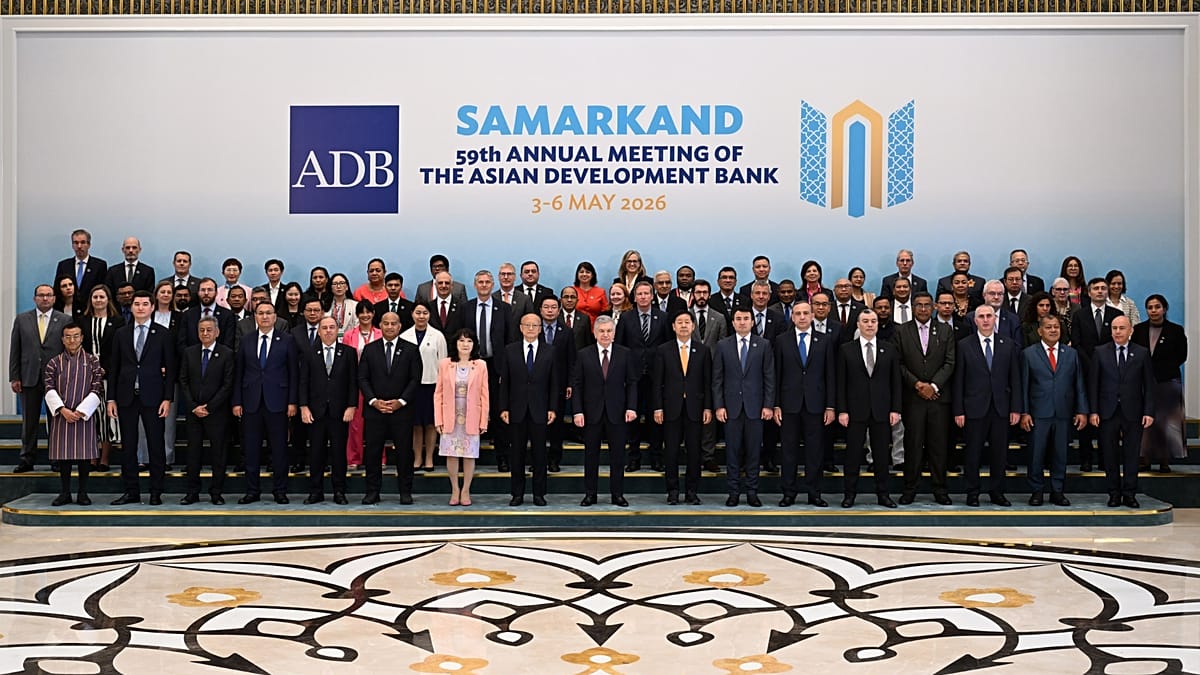
At its 59th Annual Meeting in Samarkand, Uzbekistan, the Asian Development Bank (ADB) unveiled a regional investment programme worth nearly €65 billion, focused on energy systems, digital infrastructure and cross-border connectivity across Asia and the Pacific. The announcement came as more than 4,000 delegates from over 100 countries gathered to assess economic priorities in a period of slower growth and rising costs.
The forum, held under the theme “Crossroads of Development: Advancing a Connected Future,” brought together finance ministers, central bank governors and private-sector representatives. ADB President Masato Kanda opened the meeting by stressing the need for coordinated responses. “The decisions we make at this new crossroads will secure the future for the next generation,” he said. “In this fragmented world, traditional and isolated development responses will fail. To survive and thrive in this new era, we must build deeply connected and resilient systems.”
Energy and Digital Infrastructure at the Core
The €65 billion programme includes a €46 billion allocation for a Pan-Asia Power Grid, designed to connect renewable energy systems across borders and extend transmission capacity. According to the ADB, the project could link up to 20 gigawatts of renewable energy, expand transmission networks by 22,000 kilometres and provide energy access to around 200 million people by 2035. A further €18.2 billion is earmarked for cross-border digital infrastructure, including broadband expansion and network development. The bank says these investments are expected to reduce connectivity costs in remote and landlocked areas and increase access to energy and digital services.
“Energy and digital access will define regional development,” Kanda said, highlighting the role of infrastructure in shaping economic activity across Asia and the Pacific. The focus on cross-border energy grids mirrors similar challenges in Europe, where negative electricity prices have surged, threatening renewables investment and underscoring the need for better grid integration.
Financial Outlook and Cooperation with Uzbekistan
During the meeting, the ADB reported nearly €40 billion in support for the region in 2025, based on its latest financial data. Its Board of Governors approved financial statements that include a €1.34 billion net income allocation for reserves, concessional financing, technical assistance and disaster response. The bank also presented updated economic projections: growth in developing Asia is forecast at 4.7% in 2026, while inflation is projected to reach 5.2%, reflecting higher energy prices and ongoing geopolitical pressures.
Uzbekistan is among the countries expanding cooperation with the ADB through new agreements announced during the meeting. The bank’s project portfolio in the country is approaching €15 billion, covering infrastructure, energy, agriculture and social development. Two agreements were signed: a €92 million programme to modernise 200 schools through science, technology, engineering and mathematics education, and a €275 million initiative to expand financial inclusion. President Shavkat Mirziyoyev confirmed the signing of an €11 billion cooperation programme with the ADB.
“We have identified clear plans to further expand our close cooperation with the Asian Development Bank in key areas such as poverty reduction, human capital development, and modern infrastructure,” Mirziyoyev said. “In today’s turbulent world, where the global economy is undergoing complex changes and new technologies are rapidly advancing, the time itself demands that we introduce new mechanisms and effective approaches together with the Bank.”
Proposals on AI, Transport and Regional Integration
During the meeting, Uzbekistan presented several proposals related to regional development. President Mirziyoyev proposed developing a dedicated ADB programme to scale up artificial intelligence in developing countries. Uzbekistan also confirmed its intention to join the “Digital Highway for Asia” initiative and proposed the establishment of a regional coordination centre in Tashkent. On transport, the China–Kyrgyzstan–Uzbekistan railway was identified as a project expected to increase transit capacity and reduce delivery times to around 10 days, with an estimated capacity of up to 15 million tonnes of cargo per year. The proposal also includes the creation of a “Digital Customs and Logistics Alliance” within the CAREC framework to support trade processes.
The discussion also included proposals related to climate policy and resource management. President Mirziyoyev referred to the “Yashil Makon” programme, which includes the planting of 200 million trees annually, and proposed expanding it through a regional “Central Asia Green Belt” initiative. He also addressed the role of critical minerals in economic development, noting the importance of processing and value-added production within the region. These environmental efforts echo broader trends in Central Asia, where leaders recently signed a landmark environmental pact in Astana, pledging €2 billion for a green transition.
The ADB’s ambitious plan underscores the growing importance of regional cooperation in addressing infrastructure gaps and economic challenges. For European observers, the bank’s focus on cross-border energy and digital networks offers a parallel to the EU’s own efforts to integrate its energy markets and digital single market. As Asia moves to build deeply connected systems, the lessons from Europe’s own integration experience may prove valuable.