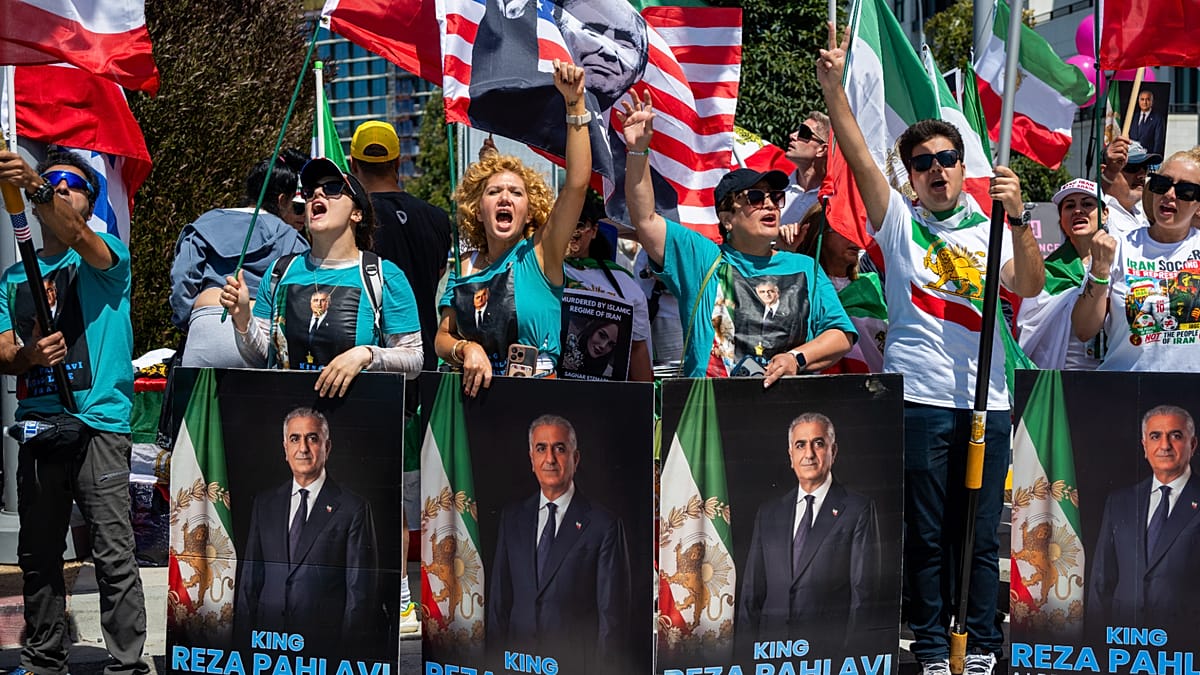
On Sunday, over 200 members of the Iranian diaspora staged a protest outside the Los Angeles stadium where Iran's national football team was set to play its first match of the 2026 FIFA World Cup. The demonstrators waved the pre-revolutionary 'Lion and Sun' flag—a symbol of Iran before the 1979 Islamic Revolution—and chanted slogans against the regime in Tehran.
A Symbolic Act of Dissent
The protest, organized by diaspora groups, aimed to draw global attention to the ongoing human rights abuses and political repression inside Iran. Many participants held signs condemning the government's treatment of women, political prisoners, and ethnic minorities. The choice of the World Cup—a global stage—was deliberate: the protesters sought to ensure that the regime's record was not overshadowed by the sporting event.
Similar demonstrations have occurred at other international events, such as the protests by Pussy Riot and FEMEN at the Venice Biennale, where activists used cultural platforms to challenge authoritarian regimes. The Iranian diaspora has increasingly used such moments to amplify their message.
The 'Lion and Sun' flag, officially used until 1979, has become a potent emblem for opposition groups both inside and outside Iran. Its appearance at the World Cup underscores the deep divisions between the current government and many Iranians abroad.
Context of Wider European Protests
The Los Angeles protest is part of a broader pattern of Iranian diaspora activism across Europe and North America. In recent years, demonstrations have taken place in cities like Berlin, London, Paris, and Stockholm, often coinciding with political anniversaries or international events. For instance, Paris protesters have targeted media outlets over alleged ties to the Kremlin, reflecting a growing concern about foreign influence on European soil.
The Iranian government has consistently dismissed such protests as the work of exiled dissidents with little domestic support. However, the 2022-2023 'Woman, Life, Freedom' uprising—sparked by the death of Mahsa Amini in police custody—demonstrated significant internal opposition, particularly among younger Iranians.
European governments have taken note. The EU has imposed sanctions on Iranian officials for human rights violations, and several member states have offered asylum to Iranian activists. The protests at the World Cup are likely to reinforce calls for stronger European action against Tehran.
Implications for European-Iranian Relations
The timing of the protest is sensitive. Iran's participation in the World Cup, hosted by the United States, Canada, and Mexico, comes amid heightened tensions between Tehran and Western powers over its nuclear program and support for proxy groups in the Middle East. European nations, particularly France, Germany, and the UK, have been key players in nuclear negotiations with Iran.
Some European politicians have argued that sporting events should not be used to whitewash regimes with poor human rights records. The protest in Los Angeles echoes debates in Europe about the role of sport in international diplomacy, similar to discussions around the 2022 World Cup in Qatar.
For the Iranian diaspora in Europe, the protest is a reminder that their struggle continues. Many have family members still in Iran who face arrest for dissent. The 'Lion and Sun' flags waved in Los Angeles are a symbol of a future they hope to see—one where Iran is free from theocratic rule.
As the World Cup progresses, further protests are expected at other venues where Iran plays. The diaspora's message is clear: the world should not look away from the plight of the Iranian people.