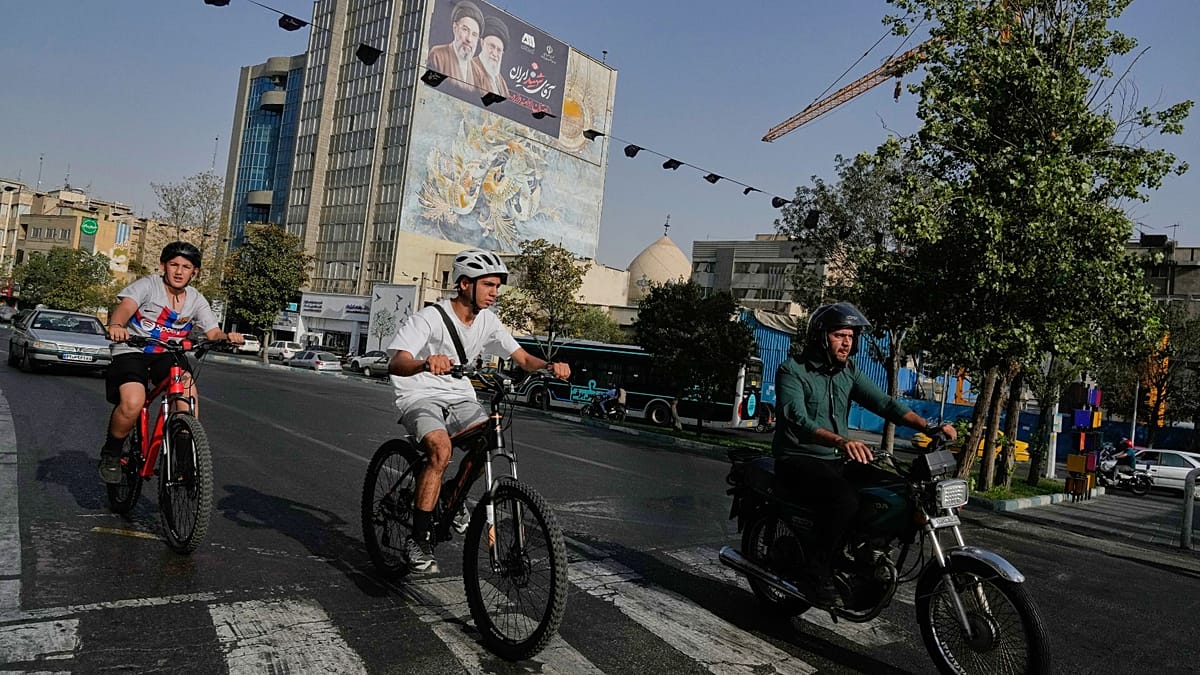
As US military planners reportedly consider options for a ground operation in Iran and President Donald Trump refuses to rule it out, a sharp and deeply personal debate has opened inside the country. For a population that has lived under the Islamic Republic for nearly 50 years and endured months of war, the question of whether foreign boots on Iranian soil would mean liberation or catastrophe has no easy answers.
Iranian army spokesperson Brigadier General Mohammad Akrami-Nia has warned that any US entry onto Iranian territory would trigger a military response. “If the Americans set foot on one of our islands, we will definitely target them on our own soil,” he said. Lawmaker Ahmad Bakhshayesh Ardestani went further, threatening ground operations against US allies in the Gulf, including Kuwait and Bahrain, if US forces entered Iran.
Trump has repeatedly warned that Washington is prepared to go further if Tehran does not change course, threatening an unprecedented “massive attack” after the interim deal between the two sides failed earlier this month, leading to renewed fighting.
Voices from Inside Iran
Euronews spoke to five Iranians about the prospect of a US ground operation — whether they believe it is coming, whether it could topple the Islamic Republic, and whether they would fight to resist it or welcome it. Their names have been changed to protect their safety.
Ali, 36, a construction worker from Karaj, does not believe the US will send ground forces into Iran. “I don’t think America will enter Iran with ground forces. Even if it wanted to do so, it would not be able to seize the islands or the southern parts of Iran,” he said. He opposes war because ordinary Iranians would pay the heaviest price. “People in Iran are already under pressure. War would only increase that pressure.”
Asked whether he would prefer continued sanctions and maritime restrictions or a war that might produce political change, Ali said, “I would choose lifting the maritime blockade, in any way possible.” He noted that opinion among those around him shifted after the initial 40 days of war failed to bring down the Islamic Republic. “Most people I know are against war. Before the 40-day war, some supported military action because they believed it could lead to the collapse of the system. But when that did not happen, many changed their minds.”
Jamshid, 44, who runs a newsstand in Tehran, believes a US entry into southern Iran or its islands is a genuine possibility — though he says it would come at a heavy cost for Iranians regardless of their politics. “As an Iranian I didn’t want things to get to this point, because if the entry of the US army into Iran involves hitting infrastructure, bridges, primary resources, bases and petrochemical plants, Iran will suffer a great deal,” he said. “In that situation it is no longer only to the detriment of the Islamic Republic; the Iranian people will suffer as well.”
He said he could support intervention under narrow conditions. “If the entry of American forces does not mean destroying the country’s infrastructure, and if it leads to the fall of the Islamic Republic or forces it into an agreement with the United States — allowing Iran to become something like China after Mao — then I would prefer American forces entering Iran.” Jamshid argued that any territorial loss would weaken the government politically. “If part of Iran is occupied, this would be devastating and humiliating for the Islamic Republic and could increase the possibility of its collapse.”
Laleh, a high school sociology teacher in Tehran, believes the US could occupy parts of Iran’s southern coast or its islands — and that the Islamic Republic would be unable to retake them. “I think America could occupy parts of the islands or southern Iran. If that happens, I don’t think the Islamic Republic would have the ability to retake those areas,” she said, adding that she does not believe occupation would bring the government down, but thinks it would eventually force talks. “An occupation would not necessarily bring down the Islamic Republic. The government could justify it to its supporters. But ultimately, it would have to negotiate in order to recover the occupied territories.”
Parichehr, 46, a lawyer, said she did not expect a ground operation — “I do not believe the US government would send its army into a country as large as Iran” — but when asked directly whether she would support it, she gave an unexpected answer. “At this moment, I personally support the presence of American forces in Iran.” She was cautious about drawing conclusions from Afghanistan and Iraq. “When we speak with Afghans, many are unhappy with the period of American presence in their country, although a minority are satisfied. I cannot make a definitive judgment based only on their experience.”
The debate reflects a country exhausted by decades of isolation, sanctions, and internal repression. For many Iranians, the choice between war and the status quo is not a choice at all — but a grim calculation of which path might cause less suffering.