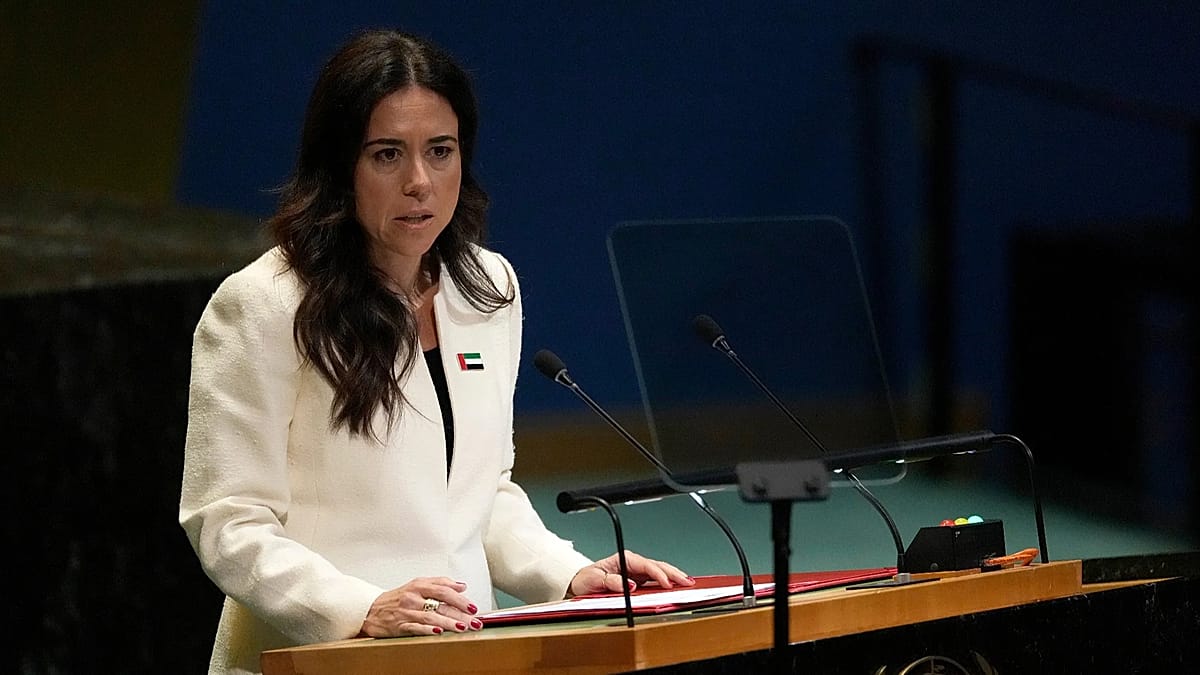
The contest to lead the United Nations has entered a decisive stretch, with the field widening just as the Security Council prepares to narrow it down. The latest entrant, Lana Nusseibeh of the United Arab Emirates, adds fresh momentum to a race that could produce the organisation's first female secretary-general in its eight-decade history.
Nusseibeh, currently the UAE's Minister of State, announced her candidacy this week, joining a crowded field that already includes Costa Rica's former Vice President Rebeca Grynspan, who has held a narrow but fragile lead in informal polls among Security Council members. The council's most recent straw poll gave Grynspan a slight edge over Guyana's Carolyn Rodrigues-Birkett and Argentina's Rafael Grossi, the head of the International Atomic Energy Agency.
However, the race was effectively reopened after two permanent members cast dissenting votes, allowing new candidates to enter. The eventual winner must secure at least nine votes from the 15-member council, with no veto from any of the five permanent members: the United States, the United Kingdom, France, China, and Russia. The council has until the end of December to settle on a nominee, who will then be confirmed by the General Assembly.
A new contender with quiet diplomacy credentials
Nusseibeh, 48, brings a blend of Western education and Gulf political experience. Raised between Abu Dhabi and the UK, she served as the UAE's ambassador to the UN and was credited with elevating her country's diplomatic profile, including a successful bid for a Security Council seat. Her campaign emphasises peace and security, but also promises reform of the UN's bureaucracy to focus on results.
“I have spent much of my professional life working in and around the United Nations, and I have seen first-hand what determined diplomacy can achieve,” she said in her launch statement. “Countries with profound differences finding common ground, and agreement where people said agreement was impossible.”
Her record includes brokering Resolution 2720, which facilitated humanitarian aid deliveries into Gaza during the 2022-2023 conflict. Fluent in Hebrew, she arranged for Security Council members to visit the Rafah crossing, a move that helped secure support for the resolution.
If elected, Nusseibeh would be the first woman to lead the UN, the first of Palestinian descent, and the second Arab secretary-general after Egypt's Boutros Boutros-Ghali. She has downplayed the gender angle, saying, “I am not running because I am a woman, I am running because I am stubbornly optimistic about the future of the United Nations.”
Grynspan's lead under pressure
Grynspan, 70, has built her campaign on a personal understanding of conflict's toll. Born to Jewish parents who fled Poland before the Holocaust, she lost grandparents who stayed behind. “I know exactly what wars take away from you and what peace allows you to do,” she told Euronews in May.
Currently head of the UN Conference on Trade and Development (UNCTAD), Grynspan has welcomed criticism from US President Donald Trump that the UN is underperforming, while arguing that a reformed institution can still deliver. She warns that a multipolar world without strong multilateralism risks fragmentation and instability.
“We need to create again these spaces for the convergence of divergent interests,” she said, while also pointing to technological and scientific breakthroughs as reasons for optimism.
The other candidates include former Ecuadorian Foreign Minister Maria Fernanda Espinosa, Senegal's former President Macky Sall, Uganda's Olara Otunnu, and Ecuadorian diplomat Ivonne A-Baki. The coming weeks will see further straw polls and formal interviews, with the Security Council expected to make its final recommendation by late autumn.
For Europe, the outcome matters deeply. The next secretary-general will shape UN responses to crises from Ukraine to the Middle East, and will set the tone on issues like climate finance and migration. As the race enters its final phase, European capitals are watching closely, aware that their influence in the Security Council—through France and the UK—could prove decisive.