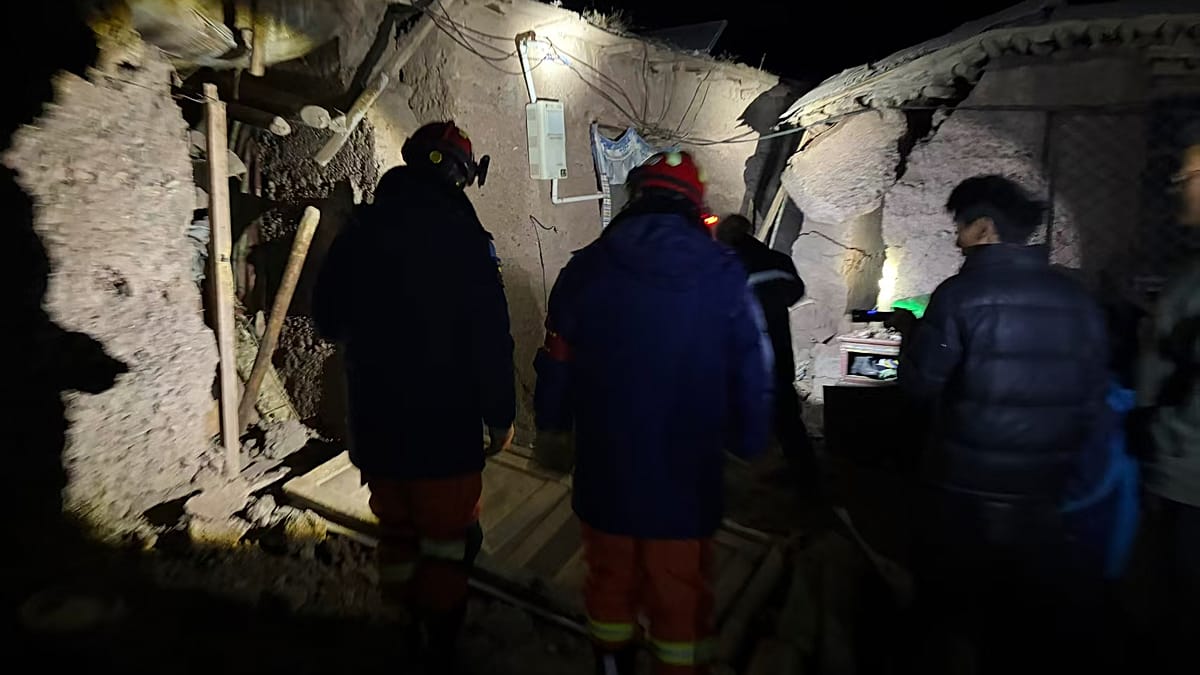
A powerful earthquake of magnitude 7.0 shook the Tibetan plateau on Thursday night, killing at least 16 people and injuring 54, according to Chinese state media. The quake struck at 10:33 p.m. local time, with its epicentre located 191 kilometres east-northeast of the city of Nagqu, in a remote, high-altitude region of northern Tibet. The US Geological Survey recorded the depth at 18 kilometres.
Chinese broadcaster CCTV reported that this was the most powerful earthquake to hit the region in five years. The Nagqu media office said at least 339 homes and 20 livestock sheds collapsed, leaving many families without shelter in freezing conditions. President Xi Jinping has called for an all-out rescue effort, and more than 1,600 personnel have been deployed for search and rescue operations. Emergency supplies, including 1,000 prefabricated housing units, 3,000 tents, folding beds, flashlights, and winter clothing, are being sent to the affected area.
Rescue efforts hampered by aftershocks and weather
The USGS recorded at least seven aftershocks, ranging from magnitude 4.3 to 5.2, all at a depth of 10 kilometres. Rockfalls triggered by the quake forced authorities to close a section of National Highway 317 to all but emergency and rescue vehicles while crews cleared debris. Local railway services were also suspended as a precaution. Xinhua, China's state news agency, reported that communication links have been cut in some of the hardest-hit areas.
Intermittent snow is forecast across the earthquake zone over the next three days, which will complicate rescue operations and increase the risk of hypothermia for those left homeless. Nagqu, a city of about 500,000 people, lies more than 300 kilometres north of Lhasa, the capital of Tibet.
The earthquake is a stark reminder of the seismic vulnerability of the Himalayan region, where the Indian and Eurasian tectonic plates collide. While this quake struck in a sparsely populated area, the destruction of hundreds of homes underscores the fragility of traditional construction in the region. In recent years, China has invested in earthquake-resistant housing in Tibet, but many older buildings remain vulnerable.
For Europe, the disaster carries broader implications. The Tibetan plateau is the source of major Asian rivers, and seismic activity there can have downstream effects on water resources and regional stability. Moreover, the European Union has maintained a cautious diplomatic stance on Tibet, balancing economic ties with China and concerns over human rights. The EU's ambassador to China has previously called for dialogue on such issues, though the bloc has avoided direct confrontation.
As rescue teams work against the clock, the international community, including European nations, has offered condolences and assistance. The European Commission's humanitarian aid department has a track record of responding to earthquakes worldwide, and it may extend support if requested. However, China has historically preferred to handle domestic disasters without foreign intervention, so international aid is unlikely to be accepted.
The earthquake also highlights the broader challenges of disaster management in high-altitude, remote regions. With temperatures dropping below freezing at night, the immediate priority is to provide shelter and medical care to the injured. The Chinese government has mobilised military and civilian resources, but the scale of the destruction suggests that recovery will take months.
For now, the focus remains on saving lives. The death toll may rise as search teams reach isolated villages. The region's rugged terrain and harsh weather make access difficult, but the Chinese authorities have pledged to leave no stone unturned. As the world watches, the resilience of the Tibetan people will be tested once again.