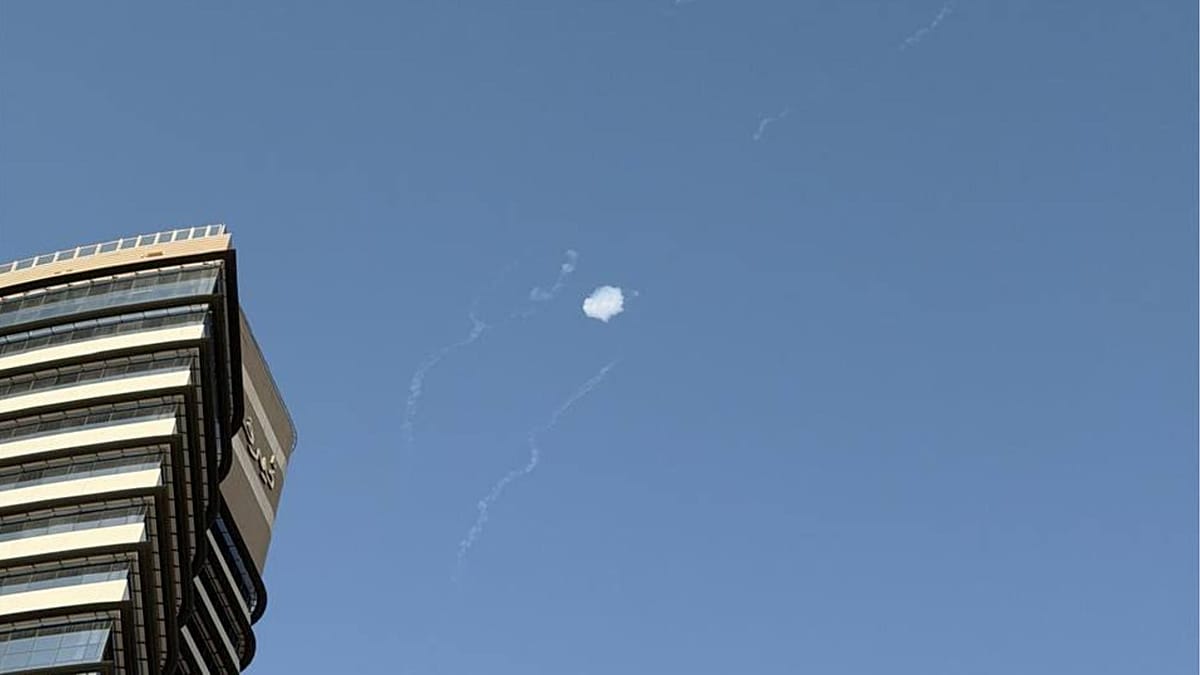
Iran launched a coordinated wave of ballistic missiles and drones against Qatar, the United Arab Emirates, and Bahrain early Sunday morning, hours after the United States announced it had carried out renewed strikes inside Iran. The attacks represent a significant escalation in a conflict that had previously been confined to the Strait of Hormuz and direct US–Iran exchanges.
In Doha, multiple loud explosions shook the capital as Qatari air defence systems intercepted incoming Iranian ballistic missiles. Euronews journalists stationed across the city reported seeing interceptions above the skyline, followed by shockwaves that rattled buildings. Qatar's Defence Ministry confirmed in a statement that its armed forces were “continuing to intercept a number of ballistic missile attacks targeting the State of Qatar.”
Air raid alerts sounded on mobile phones across Doha at 05:36 local time. The Interior Ministry urged residents to take shelter indoors and warned that the national security threat level had been raised to high. The coordinated timing of the alerts suggests that Iranian forces launched multiple salvos aimed at overwhelming defences.
Simultaneously, the UAE announced that its air defence systems were engaging Iranian missiles and drones. Euronews journalists in the Emirates reported that residents in Abu Dhabi and Dubai were told to remain indoors. Bahrain, a small island kingdom that hosts the US Navy's Fifth Fleet, also came under attack, though details of interceptions there remain unclear.
The Iranian strikes follow a US announcement that it had conducted renewed military operations inside Iran in response to what Washington described as “new Iranian military action in the Strait of Hormuz.” That waterway, a chokepoint for global oil shipments, has been a flashpoint in recent weeks. The US strikes appear to have been intended to degrade Iranian capabilities, but instead triggered a broader regional response.
Widening the Theatre of Conflict
Until now, the confrontation had largely been bilateral between the US and Iran, with occasional Houthi-linked attacks in the Red Sea. Sunday's barrage marks the first time Iran has directly targeted Gulf Arab states that are not directly party to the conflict. Qatar, the UAE, and Bahrain all host US military bases, making them legitimate targets from Tehran's perspective, even if their governments have tried to maintain diplomatic distance from Washington's campaign.
Qatar, in particular, has played a mediating role in regional crises, including hosting Taliban negotiations and facilitating humanitarian corridors. The attack on Doha underscores how quickly the conflict is eroding the neutral space that smaller Gulf states have tried to preserve. The Qatari government has not yet commented on whether it will retaliate or seek diplomatic de-escalation.
The UAE, a commercial and tourism hub, has invested heavily in air defence systems, including US-made Patriot batteries and Terminal High Altitude Area Defense (THAAD) systems. Early reports suggest those systems performed effectively, but the sheer volume of incoming projectiles tested their capacity. Bahrain, which hosts the US Navy's Fifth Fleet, is particularly exposed and has limited defensive depth.
European governments are watching the escalation with alarm. The European Union has repeatedly called for restraint and for a return to the 2015 nuclear deal framework, but the current US administration has shown little interest in diplomatic channels. Several EU member states, including France and Germany, have diplomatic missions in the affected Gulf capitals and have urged their citizens to follow local safety instructions.
The attacks also raise questions about the security of global energy supplies. The Strait of Hormuz remains partially disrupted, and any further escalation could push oil prices higher, affecting European consumers already grappling with inflation. The Gulf states targeted on Sunday are among the world's largest oil and gas exporters, and their stability is critical for global markets.
As of Sunday morning, no casualties have been reported, but the psychological impact on residents in Doha, Abu Dhabi, and Manama is significant. Air raid sirens and the sight of missiles being intercepted in the sky are unprecedented for most civilians in these cities. The coming hours will determine whether this is a one-time retaliation or the beginning of a sustained campaign.