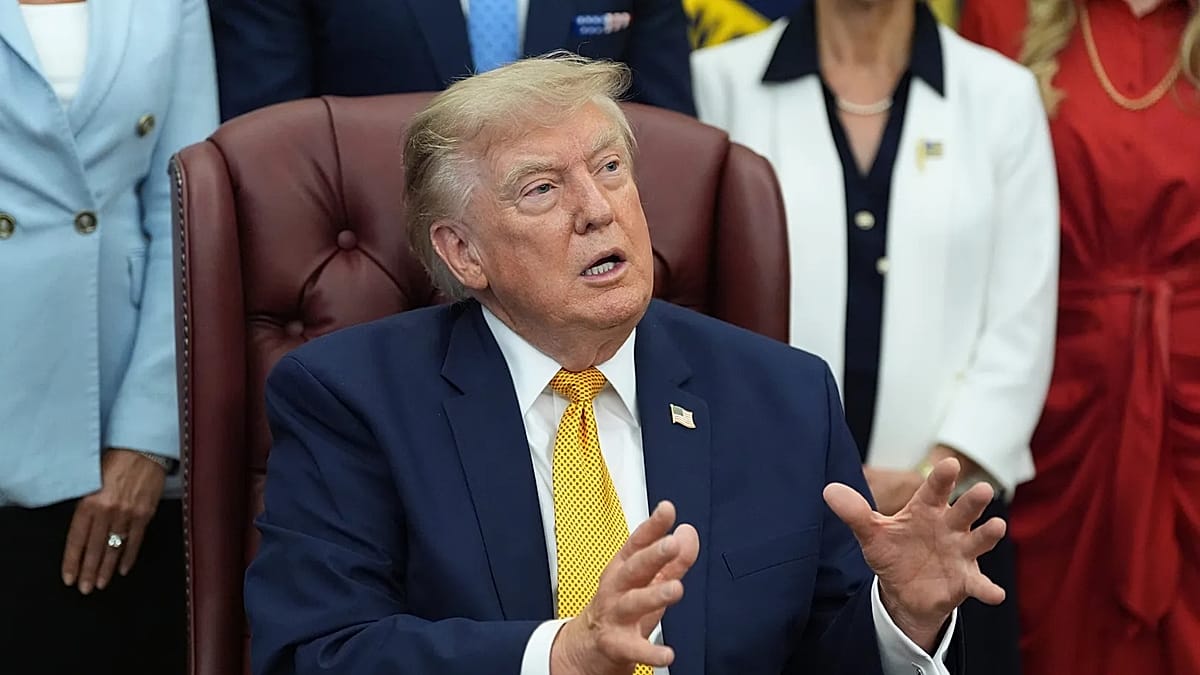
President Donald Trump has issued a stark warning to Tehran, saying it has a "last chance" to sign a peace agreement before facing "decapitation." Speaking from the Oval Office on Monday, Trump said that Washington and Tehran had begun fresh negotiations, despite earlier denials from Iran's Foreign Ministry that talks were taking place.
"We're talking. And we're talking at the request of Iran, backed by Saudi Arabia, backed by UAE and backed by Qatar in particular," Trump told reporters. He added that the talks are focused on two main issues: the reopening of the Strait of Hormuz and limiting Iran's nuclear program.
"We're talking about the Strait, the opening of the Strait, having it open literally by tomorrow, completely open," Trump said. "That's phase one. And phase two is we then will talk about the nuclear capacity," he continued, insisting that "the denuclearisation of Iran has to happen."
Strait of Hormuz: A critical chokepoint
The Strait of Hormuz, through which roughly a quarter of the world's seaborne oil passes, has been effectively closed by Tehran since late February, following US and Israeli strikes on Iran. This has sent shockwaves through global energy markets, affecting prices and supply chains across Europe and beyond.
In June, the US and Iran reached a tentative agreement, including a "memorandum of understanding," aimed at ending the conflict and reopening the strait. However, retaliatory strikes soon resumed, undermining the fragile progress.
On Saturday, Trump announced that he had called off a large-scale planned attack on Iran at the request of Tehran and several Middle Eastern countries, claiming that the "perimeters of a deal" had been agreed. The Iranian military, however, rejected this claim, calling it a "new lie" designed to "blackmail Persian Gulf rulers."
The situation remains highly volatile, with European leaders watching closely. The European Union has repeatedly called for de-escalation and a return to diplomacy, mindful of the potential impact on energy security and regional stability. The bloc's foreign policy chief has urged both sides to exercise restraint, while individual member states, including France and Germany, have maintained diplomatic channels with Tehran.
For Europe, the stakes are high. A prolonged closure of the Strait of Hormuz would disrupt oil supplies, driving up prices and potentially triggering a new economic shock. European companies with investments in the Gulf region also face uncertainty, as do shipping and insurance markets.
Trump's latest ultimatum adds to the pressure, but it remains unclear whether Tehran will heed the warning or continue its defiance. The coming days will be crucial in determining whether a deal can be reached or whether the region slides back into open conflict.