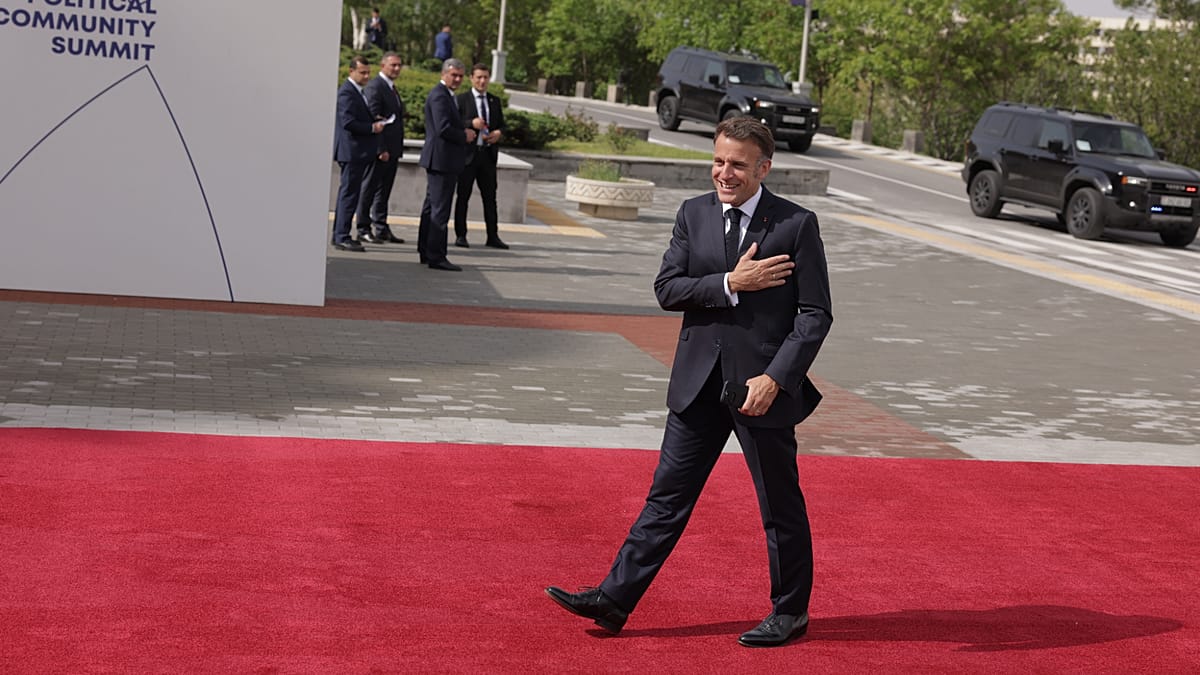
When dozens of European leaders gathered in Yerevan this week for the eighth summit of the European Political Community (EPC), it was France's Emmanuel Macron who dominated the spotlight. Arriving early on Sunday evening, the French president was greeted with an enthusiasm rarely seen at diplomatic gatherings: crowds lining the main avenue broke into an impromptu rendition of La Marseillaise, and Macron was seen posing for photos with babies, a classic gesture of democratic politics that has become less common in recent years.
The scene reflected Armenia's accelerating pivot away from Moscow and toward Europe, a shift that Macron has championed. Walking alongside Prime Minister Nikol Pashinyan, Macron proclaimed that Armenia has chosen a path toward "a Europe which goes from Iceland to the Caucasus." The moment was laden with symbolism: Armenia, long seen as a Russian client state, is now hosting a summit of the EPC — a forum Macron himself conceived in 2022 after Russia's full-scale invasion of Ukraine.
A Hero's Welcome in Yerevan
Macron's reception was not limited to street-level adulation. At a state dinner, he took the microphone and sang Charles Aznavour's La Bohème, accompanied by Pashinyan on drums. Aznavour, a French music icon of Armenian descent, is perhaps the most beloved figure shared by the two countries, making the gesture deeply resonant. The French president also received a medal, further cementing the warmth of the visit.
"Eight years ago, many saw Armenia as a country heavily dependent on Russia, with its security entirely in Russian hands," Macron told summit attendees. "After the Velvet Revolution, its policy of peace, and its turn toward Europe, we are now witnessing the opening of a new era." He added that the EPC enables discussions on drug trafficking, energy solidarity, connectivity, protecting democracies from external interference, and common defence solutions.
This summit was the first EPC meeting held in the South Caucasus, a region historically dominated by Russian influence. Armenia's reorientation has been driven by frustration over Moscow's perceived failure to protect it during conflicts with neighbouring Azerbaijan. The Pashinyan government, which came to power in 2018 through a popular uprising, has since pursued a careful but increasingly explicit turn toward the West. For more on the broader diplomatic context, see Armenia Hosts Zelenskyy and EU Leaders, Signaling Break from Moscow.
Popular Abroad, Struggling at Home
Macron's standing in Yerevan stands in stark contrast to his approval ratings in France. YouGov's January 2026 tracker found that only 16% of French respondents had a favourable view of their president. The Ifop barometer showed a slight uptick to 23% in the same month, but that remains historically low. Yet a Euroscope survey in February 2026 found Macron was the most popular leader in the EU overall, with 46% of respondents across the bloc expressing a positive opinion.
That European popularity owes much to his posture since Russia's invasion of Ukraine. Macron has emerged as one of the most vocal advocates for European strategic autonomy, pushing the EU to shoulder a greater share of its own defence. His approval among EU audiences spiked in early 2025 when he publicly refused to rule out sending European troops to Ukraine, a stance that resonated across the continent despite pushback from some allies. For a deeper look at his domestic challenges, see Macron Revives Eurobonds Push as Energy Crisis Strains EU Unity.
Originally an outsider who won the French presidency at 39 in 2017, Macron embodied Europe's rejection of the populist surge that swept the US and the UK. But a series of crises at home — including the Gilets Jaunes protests and his push for pension reform, which sparked massive demonstrations — saw his domestic stock plummet to levels comparable to those of François Hollande and Nicolas Sarkozy at their lowest points. With his centrist politics now often seen as unimpressive or grating, France's once most promising politician has seen his career nearly peter out. Yet abroad, he remains a force.
In Armenia, Macron has been the driving force behind Yerevan's accelerating pivot. He told members of Armenia's French community on Monday that "Armenia has indeed made the choice ... to break free from this constraint and turn towards Europe." The EPC, a loose grouping of all European states except Russia and Belarus, has met twice a year since its inception. This week's summit in Yerevan underscored the forum's expanding geographic reach and its role in fostering dialogue on security and cooperation. For more on the summit itself, see Yerevan Hosts Eighth European Political Community Summit as Armenia Seeks Closer EU Ties.
As Macron jogged through Yerevan's streets with his security team on Monday morning, he seemed to be living the dream. The EPC is his creation, and seeing it convene in the South Caucasus — a region where Europe's influence is growing — is a personal triumph. Whether that translates into renewed momentum at home remains an open question.