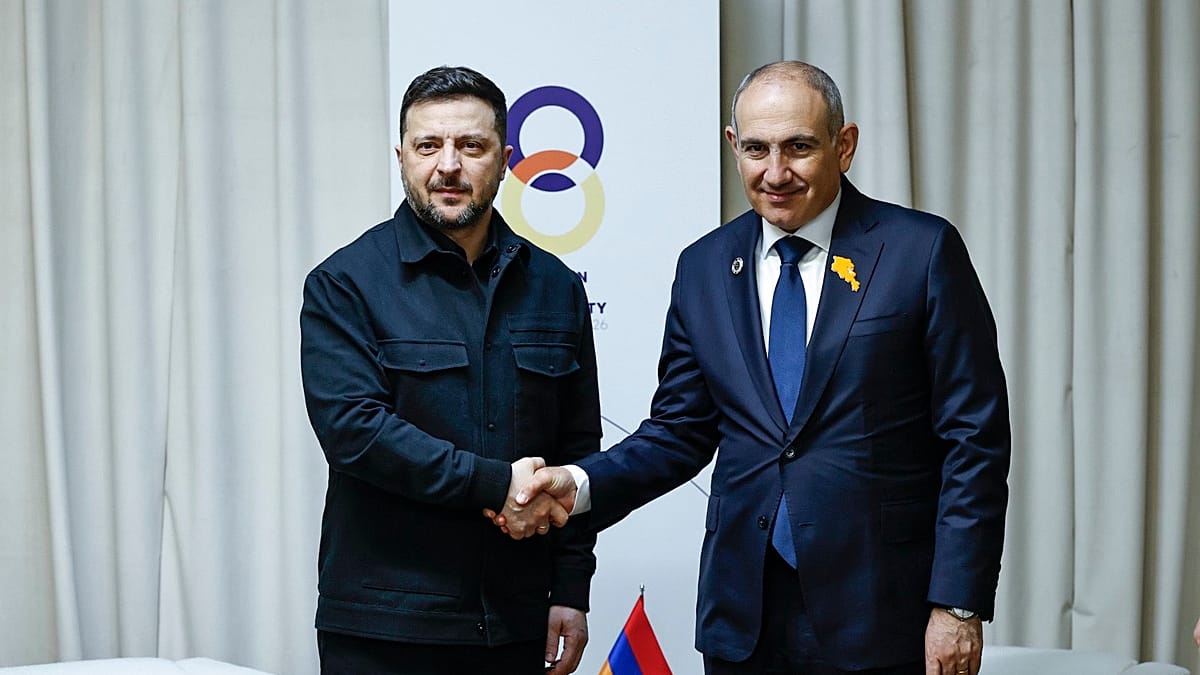
In a move that would have been unthinkable just a few years ago, Armenia’s capital Yerevan became the stage for a diplomatic pivot away from Moscow. Prime Minister Nikol Pashinyan welcomed Ukraine’s President Volodymyr Zelenskyy, along with European leaders and NATO’s secretary general, for the European Political Community summit and an EU-Armenia meeting. The gathering signals a decisive shift in the South Caucasus nation’s foreign policy, long defined by its role as Russia’s closest ally in the region.
French President Emmanuel Macron noted the transformation, saying, “Eight years ago, nobody would come here. This country was seen by a lot of countries around the table as a sort of de facto satellite of Russia.” Macron praised Pashinyan for leading the 2018 Velvet Revolution and for “de-risking this country from Russia,” adding that Armenia “is still attacked on a daily basis because of that.”
Putin’s Warning Over EU Ties
Armenia’s relations with Moscow have deteriorated sharply since Azerbaijan reclaimed the Karabakh region in 2023, ending decades of conflict. In 2024, Yerevan suspended its membership in the Russia-led Collective Security Treaty Organisation (CSTO) after Moscow failed to intervene during the 2022 Karabakh escalation. By 2025, Pashinyan declared Armenia’s intention to seek European Union membership.
Russian President Vladimir Putin issued a stark warning during a tense meeting at the Kremlin in April, stating that membership in both the EU and the Eurasian Economic Union is impossible. “We see that there is a discussion in Armenia about developing relations with the European Union,” Putin said, adding that Moscow treats it “absolutely calmly” but that the incompatibility must be acknowledged. One month later, Pashinyan made his choice clear by hosting the summit.
Zelenskyy’s Historic Visit
Zelenskyy’s presence in Yerevan was particularly provocative for Moscow. It marked the first visit by a Ukrainian head of state to Armenia in 24 years. At a meeting with Pashinyan, Zelenskyy emphasized the importance of restoring active dialogue and proposed resuming the Joint Intergovernmental Commission on Economic Cooperation, with a meeting planned in Kyiv this year.
Security was a key topic. Zelenskyy briefed Pashinyan on diplomatic efforts toward a real peace, including his offer to meet Putin in Azerbaijan after US-led talks stalled. By raising this in Yerevan, Zelenskyy appeared to broaden potential venues for a meeting the Kremlin has repeatedly rejected.
Russian state media reacted with fury. Margarita Simonyan, head of RT, called the visit “a gut punch from Russia’s strategic partner” and suggested Moscow might need to protect Russian interests in Armenia—language used to justify past interventions in Moldova, Georgia, and Ukraine. Military bloggers criticized the Kremlin for not intercepting Zelenskyy’s plane, with one calling it “the most shameful page in history.”
The summit also touched on broader European issues, including EU-US relations and clashes over US troop withdrawals. For Armenia, the event was a turning point, as Macron noted, with the country now firmly charting a course toward Europe despite Russian threats over gas supplies.