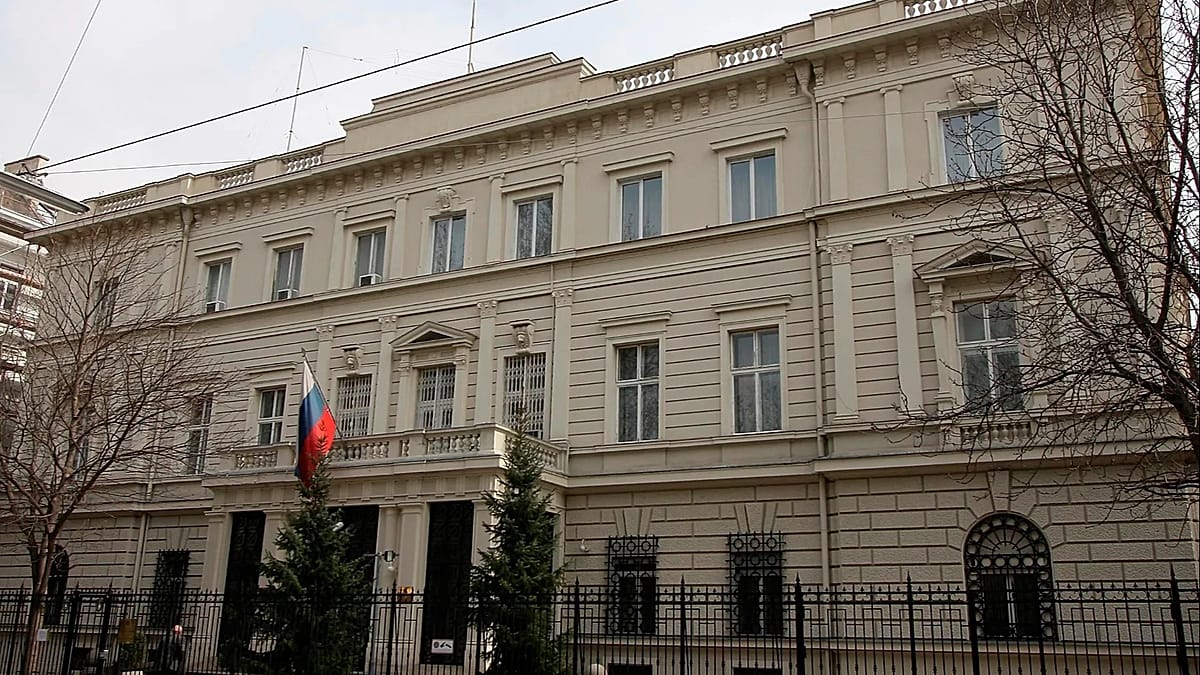
Vienna — Austria’s Foreign Ministry confirmed on Monday that it had expelled three employees of the Russian Embassy in Vienna, accusing them of using antennas on diplomatic rooftops to conduct espionage against international organizations based in the city.
The decision, first reported by Austrian public broadcaster ORF, marks a significant hardening of Austria’s approach to Russian intelligence activities. The three diplomats were suspected of operating antennas on the roof of the Russian Embassy and at a diplomatic compound in the Donaustadt district to intercept satellite internet data transmitted by international bodies headquartered in Vienna.
Vienna hosts a dense network of multilateral institutions, including the International Atomic Energy Agency (IAEA), the Organization for Security and Co-operation in Europe (OSCE), and the Organization of the Petroleum Exporting Countries (OPEC). The alleged surveillance targeted these organizations, raising concerns about the security of sensitive diplomatic communications.
Shift in Austrian Policy
Foreign Minister Beate Meinl-Reisinger, who took office in March 2025, framed the expulsions as part of a broader recalibration of Austria’s security posture. “Espionage is a security problem for Austria. In this government, we have changed course and are taking decisive action against it,” she said in a statement. “We have made this unequivocally clear to the Russian side, also with regard to the array of antennas at the Russian embassy. One thing is clear: it is unacceptable for diplomatic immunity to be used to engage in espionage.”
Historically, Austria has maintained a policy of military neutrality and was initially reluctant to expel Russian diplomats following Moscow’s full-scale invasion of Ukraine in February 2022. However, Vienna has recently taken a firmer line, expelling several Russian diplomats over the past year. The latest expulsions follow a pattern seen across Europe, where Western nations and Russia have engaged in tit-for-tat diplomatic expulsions since the war began.
According to ORF, the Russian ambassador was summoned to the Foreign Ministry in April over the diplomats’ activities. Austrian authorities requested that Moscow lift the diplomats’ immunity to allow a criminal investigation, but Russia refused. The three individuals have since left Austria.
In response, the Russian Embassy issued a statement on Monday calling the decision “outrageous” and warning that Moscow would respond “strongly.” The embassy added, “Vienna bears full responsibility for the further deterioration of bilateral relations, which are already at a historical low.”
Legal Reforms Underway
Meinl-Reisinger also announced that Austria is tightening its espionage laws. Current legislation only criminalizes espionage by foreign services when it targets Austrian interests. Proposed changes, reported by the Austria Press Agency, would extend protections to cover international organizations based in the country, reflecting Vienna’s role as a global diplomatic hub.
The expulsions come amid heightened tensions between Russia and the West. In recent weeks, Russian strikes have killed 10 across Ukraine as Kyiv hit Black Sea oil tankers, and drone and missile attacks have killed two and injured dozens. The diplomatic fallout continues to ripple across the continent, with European capitals reassessing their security arrangements.
For Austria, the decision underscores a departure from its traditional neutrality. While the country remains militarily non-aligned, it is increasingly aligning with EU partners on security matters. The expulsions also highlight the vulnerability of international organizations to state-sponsored surveillance, a concern that resonates beyond Vienna to other European cities hosting multilateral bodies.