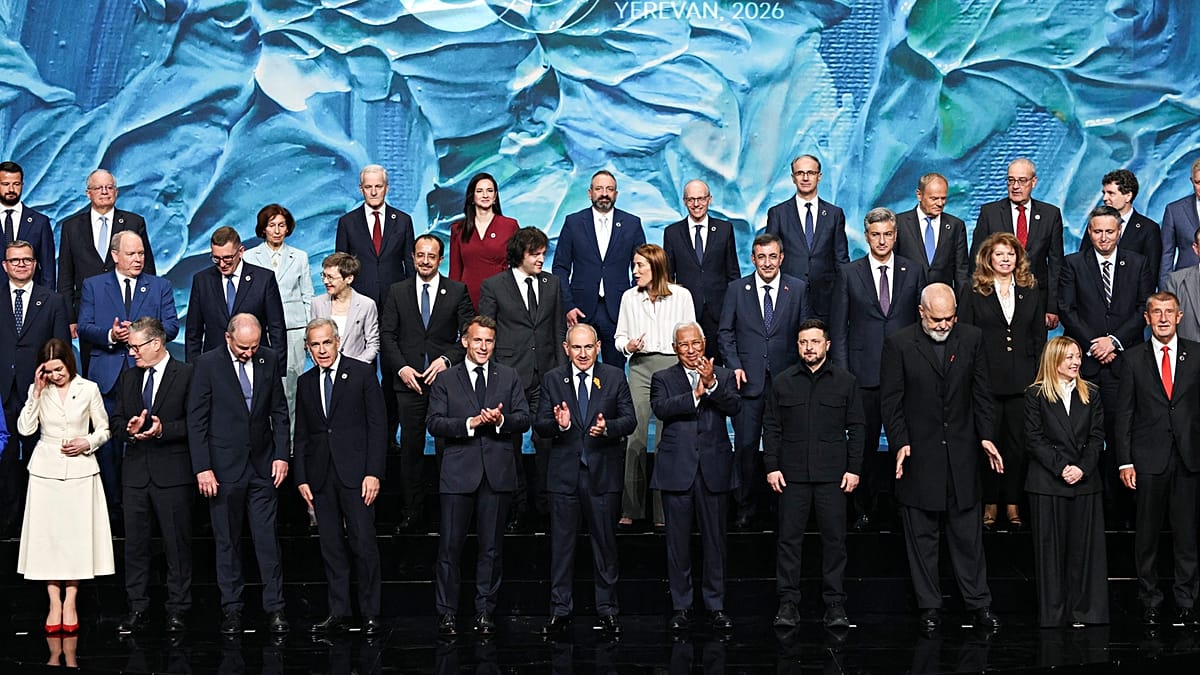
The European Political Community (EPC) held its eighth meeting in Yerevan on Monday, a forum born from the early days of Russia's full-scale invasion of Ukraine. Known for its informal nature—no binding agreements, just bilateral chats and social media moments—the summit nonetheless laid bare the continent's deep anxieties. Here are six takeaways from the gathering.
Merz's Absence Looms Large
German Chancellor Friedrich Merz was the most conspicuous no-show. His absence came after a diplomatic firestorm: Merz had declared that Iran had 'humiliated' the United States in the war, prompting US President Donald Trump to announce the withdrawal of 5,000 American soldiers from Germany and threaten to raise tariffs on EU-made cars from 15% to 25%. The tariff hike could further batter Germany's export-dependent economy, already struggling with automotive sector woes. Merz has since tried to downplay the rift, telling ARD: 'I am not giving up on working on the transatlantic relationship. Nor am I giving up on working with Donald Trump.' In Yerevan, leaders trod carefully. NATO Secretary General Mark Rutte said Europeans had 'gotten the message' about Washington's disappointment, while EU High Representative Kaja Kallas admitted the timing of Trump's announcement was 'a surprise' and that she could not 'see into the head of President Trump.'
Mark Carney Steals the Show
If Merz left a hole, Canadian Prime Minister Mark Carney filled it. His attendance marked the first time a non-European leader joined an EPC meeting, and fellow heads of state eagerly sought face time with the former central banker. Carney positioned himself as Trump's antithesis, championing a rules-based global order built on 'freedom, rule of law, democracy, and pluralism.' He declared: 'We have to actively take on the world as it is, not as we wish it to be. We know nostalgia is not a strategy. But we don't think that we're destined to submit to a more transactional, insular and brutal world.' Carney, who earlier in Davos pitched a coalition of mid-size powers to counter the US and China, added: 'It's my strong personal view that the international order will be rebuilt, but it will be rebuilt out of Europe.'
Zelenskyy's Call for a Common European Voice
Russia's war was the EPC's original raison d'être, and Ukrainian President Volodymyr Zelenskyy made the most of the platform. He held bilateral talks with Britain's Keir Starmer, Finland's Petteri Orpo, Norway's Jonas Gahr Støre, and Czechia's Andrej Babiš, as well as with Slovakia's Robert Fico, with whom he recently clashed over the Druzhba oil pipeline. Zelenskyy pressed for more military aid and the opening of EU membership negotiations, currently blocked by Hungary. He also urged leaders to resist any sanctions relief for Russia, as the US has granted. In the plenary, he addressed the divisive issue of direct talks with the Kremlin: 'We need to find a workable diplomatic format, and Europe must be at the table in any talks with Russia. We're in contact with the US, and we understand their views and positions, but it would be good to develop one common European voice for talks with Russia.'
Metsola's Sharp Rebuke
The summit was mostly cordial, but tensions flared when Azerbaijani President Ilham Aliyev, speaking virtually, attacked the European Parliament for passing 14 resolutions critical of his country, calling it 'a kind of obsession.' European Parliament President Roberta Metsola demanded the floor and fired back: 'The European Parliament is a directly elected democratic body with resolutions that are adopted by majority. The outcome might be uncomfortable for some, but we will never change the way we work.' Despite the clash, leaders noted the significance of Aliyev addressing a summit in Armenia, given the two countries' violent history. They are currently implementing a peace deal signed in August 2025.
Armenia's Pivot Westward
Hosting the EPC was a clear signal from Yerevan of its desire to deepen ties with Europe, a move that has irked Moscow. The summit underscored Armenia's gradual shift away from Russia's orbit, as it seeks security guarantees and economic integration with the EU. This aligns with broader trends in the South Caucasus, where countries are reassessing their alliances amid the war in Ukraine.
The EPC's Enduring Value
Despite its lack of formal outputs, the EPC remains a valuable forum for informal diplomacy. In a continent riven by crises—from the war in Ukraine to transatlantic tensions and internal divisions—the ability for leaders to meet, exchange views, and build personal relationships is not to be underestimated. The Yerevan summit showed that even without binding decisions, the EPC can foster dialogue and, occasionally, produce moments of genuine substance.