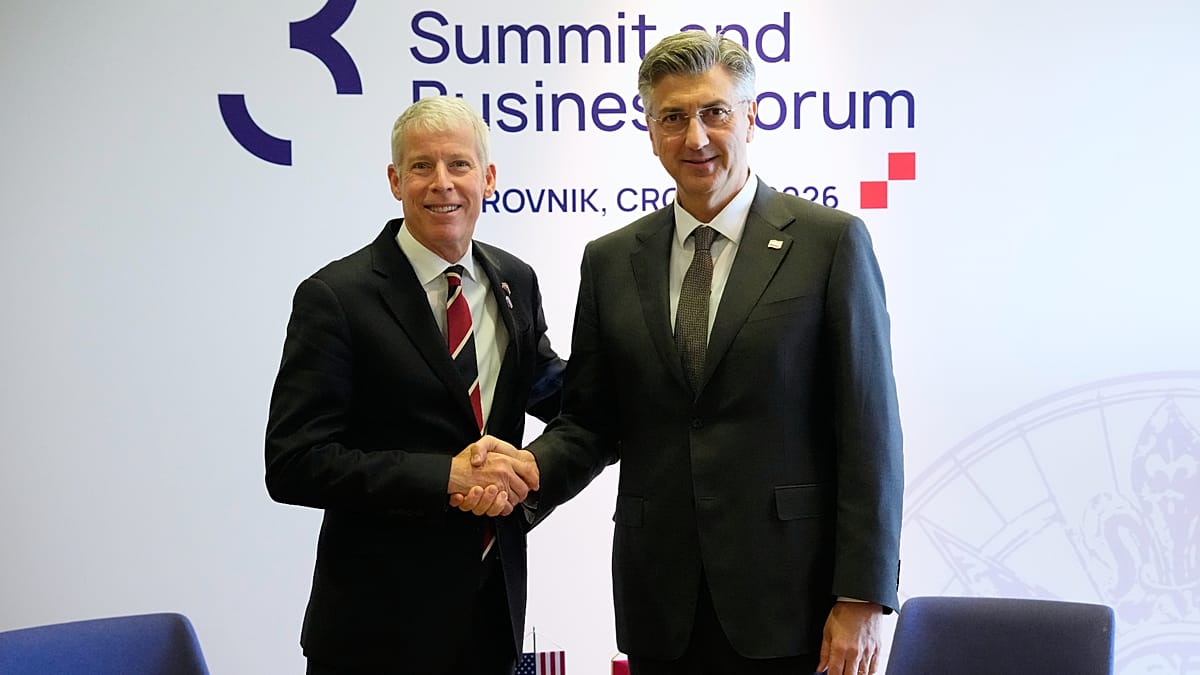
On Wednesday in Dubrovnik, Croatian Prime Minister Andrej Plenković and US Energy Secretary Chris Wright signed an agreement to expand gas pipelines and energy infrastructure throughout the Balkans. The deal, framed as a step toward energy security, could lock Croatia and its neighbours into decades of fossil fuel use, complicating the European Union’s push for decarbonisation.
The agreement comes as Zagreb phases out Russian oil and gas in line with EU requirements to reduce dependence on Moscow, which weaponised energy supplies after its full-scale invasion of Ukraine. Croatia has already invested in a floating liquefied natural gas (LNG) terminal on the island of Krk, inaugurated in 2021, which supplies Italy, Bosnia, Serbia, and other southeast European countries.
Wright hailed the deal as a “new era of cooperation” between the Trump administration and Central and Eastern Europe. “These partnerships are rooted in our mutual support for an energy addition agenda — more jobs, more opportunity, and more investment,” he said, adding that nations pursuing “common sense energy policies” will see an “extremely bright future.”
But critics point to environmental risks to the Adriatic, a lack of transparency in planning, and concerns about the project’s long-term economic viability. The Krk terminal expansion could take at least a decade to build, raising the risk of stranded assets as Europe accelerates its transition to renewables.
US cements dominance in Croatia and the Balkans
Plenković noted that US investment in Croatian energy infrastructure builds on the 67% of LNG that Zagreb already imports from Washington, both for domestic use and for regional operators. “We have diversified the roots of supply of gas and oil to the countries of central and eastern Europe, which was a strategic decision that has completely altered the previously fully dependent energy situation on Russian fossil fuels,” he said in an interview on April 29.
The prime minister justified the deal as a way to “ensure energy security and independence,” citing ongoing geopolitical disruptions, including the war against Iran and the effective closure of the Strait of Hormuz. The agreement also includes a new pipeline linking Croatia to Bosnia, the Southern Interconnection, which was finalised on the sidelines of the Three Seas Initiative summit in Dubrovnik. Officials frame it as a breakthrough that could loosen Bosnia’s longstanding dependence on Russian gas.
The pipeline would connect Bosnia to Croatia’s gas network and the Krk LNG terminal, strengthening Bosnia’s integration into European energy networks. Yet the project’s cost, estimated at well over a billion euros, has prompted questions about long-term viability, particularly as Europe accelerates its renewable energy transition.
The deal has also exposed tensions with Brussels. EU officials have raised concerns that elements of the agreement — including the prominent role granted to a non-European investor — could conflict with EU market rules and complicate Bosnia’s path to accession.
Environmental warnings
Environmental groups warn that such large investments in gas risk entrenching the region’s reliance on fossil fuels at a time when the bloc is pushing for decarbonisation. In a joint statement led by the Aarhus Center and the NGO CEE Bankwatch Network, the groups warned that governments in the Western Balkans are being pushed to expand gas infrastructure, including cross-border interconnectors, LNG terminals, and gas-fired power plants.
“In the midst of yet another fossil fuel crisis, it’s unbelievable that governments are still planning new gas pipelines and power plants. They would cost billions, even before the costs of gas are included, and would likely end up as stranded assets, or be heavily subsidised by taxpayers,” said Pippa Gallop, a campaigner at CEE Bankwatch Network.
The deal underscores a broader tension between Europe’s energy security needs and its climate goals. While the EU has pushed to end new fossil fuel drilling, as highlighted by EU Climate Chief Hoekstra’s recent call, countries like Croatia are turning to US-backed gas projects to replace Russian supplies. The result is a patchwork of policies that may lock in fossil fuel infrastructure for decades, even as the bloc aims for net-zero emissions by 2050.