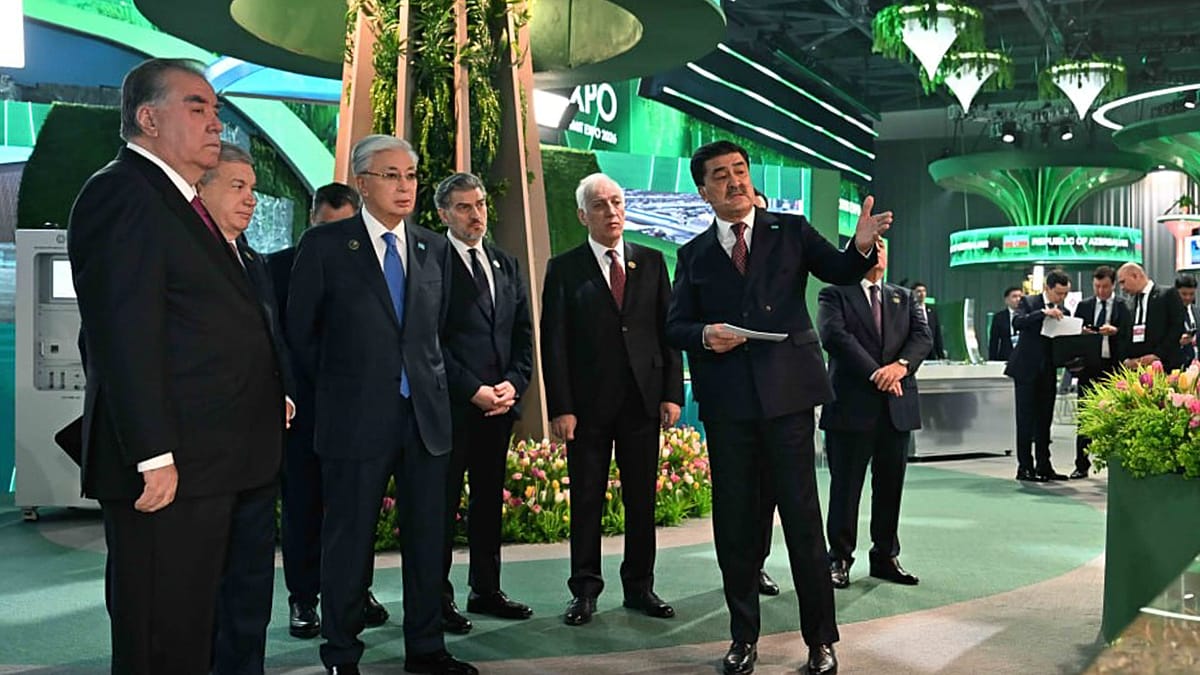
In a significant step for regional cooperation, the leaders of Kazakhstan, Uzbekistan, Kyrgyzstan, Turkmenistan and Tajikistan gathered in Astana for the Regional Ecological Summit, adopting a joint declaration on “Environmental Solidarity of Central Asia”. The summit, held in partnership with the United Nations, secured a €2 billion commitment for green transition projects across the region.
President Kassym-Jomart Tokayev of Kazakhstan set the tone in his opening remarks, emphasising that environmental cooperation should be a tool for unity. “Environmental cooperation must serve as a reliable instrument of unity and should not divide us. It should be based on partnership, trust and shared responsibility – with no naming, no shaming and no blaming. As partners, we must work pragmatically and responsibly in support of peace and sustainable development,” he said.
The summit also hosted the Central Asia Climate Change Conference, which aimed to align regional priorities with the global COP process. Yerlik Karazhan, head of the Central Asia Climate Foundation, noted the timing: “The summit comes at a key moment — allowing countries to reflect on the last COP in Brazil and prepare for the next round in Turkey later this year.”
Key Outcomes and Commitments
Participating countries agreed to develop joint positions across multilateral environmental negotiations, including biodiversity, chemicals and waste management, plastic pollution, air quality, land degradation, and desertification. Among the most notable outcomes was the endorsement of President Tokayev’s proposal to establish an international water organisation under the United Nations. Regional leaders also backed the creation of an international biodiversity fund and a programme addressing the challenges of the Caspian Sea.
The declaration includes the establishment of an International Day of Greening the Planet and the rollout of cooperation through the Central Asia Project Office platform on climate change and green energy in Almaty. A five-year regional environmental action plan, developed with the United Nations, was approved. It features a joint climate investment portfolio, a regional Environmental Performance Review, a framework on nature-based solutions, a partnership programme on the circular economy, and the “Green School” regional platform.
National delegations participated in 58 side sessions focusing on key environmental priorities. Among the signed documents was a Regional Declaration on Biodiversity Conservation, aimed at developing ecological corridors to protect vulnerable ecosystems and rare species. Kazakhstan also advanced its “Greenshield of Central Asia” initiative, which focuses on creating protective forest belts and green barriers to tackle land degradation and dust storms. Another key development was the endorsement of a proposal to establish a regional centre under the Stockholm Convention in Kazakhstan, strengthening institutional capacity in chemical safety and hazardous waste management.
Regional Leaders Highlight Pressing Challenges
Water security remains a critical concern for Kazakhstan and the wider region, said President Tokayev. “Our future depends on managing this vital resource wisely and fairly. The Aral Sea remains a stark reminder of the consequences of unsustainable policies, but also of what determined, science-based action can achieve. Another pressing concern for my country is the Caspian Sea. Its protection is essential for ecological balance, biodiversity and regional sustainability.”
President Sadyr Japarov of Kyrgyzstan highlighted his country’s role as Central Asia’s main “water tower”, generating around 50 billion cubic metres of water annually, with most flowing to neighbouring states. “For decades, we have maintained water allocation limits while providing storage and release services. Kyrgyzstan ensures the safety of hydraulic infrastructure and invests significant resources in water management. However, we do not receive compensation in the form of fossil fuels,” he said.
President Shavkat Mirziyoyev of Uzbekistan emphasised the need for fair climate finance. “Countries that have contributed the least to global climate change are once again left to face its consequences alone. We believe international solidarity must be reflected in ensuring timely, fair and unhindered access for developing countries to climate finance, advanced technologies and innovation.”
The summit drew senior UN officials, including Under-Secretary-Generals Li Junhua, Inger Andersen, and Tatiana Molcean. Li Junhua warned that the world remains off track to meet the 2030 sustainable development goals, calling for stronger action. The international presence lent political weight to the region’s environmental agenda, underscoring the importance of multilateral cooperation in addressing shared ecological threats.