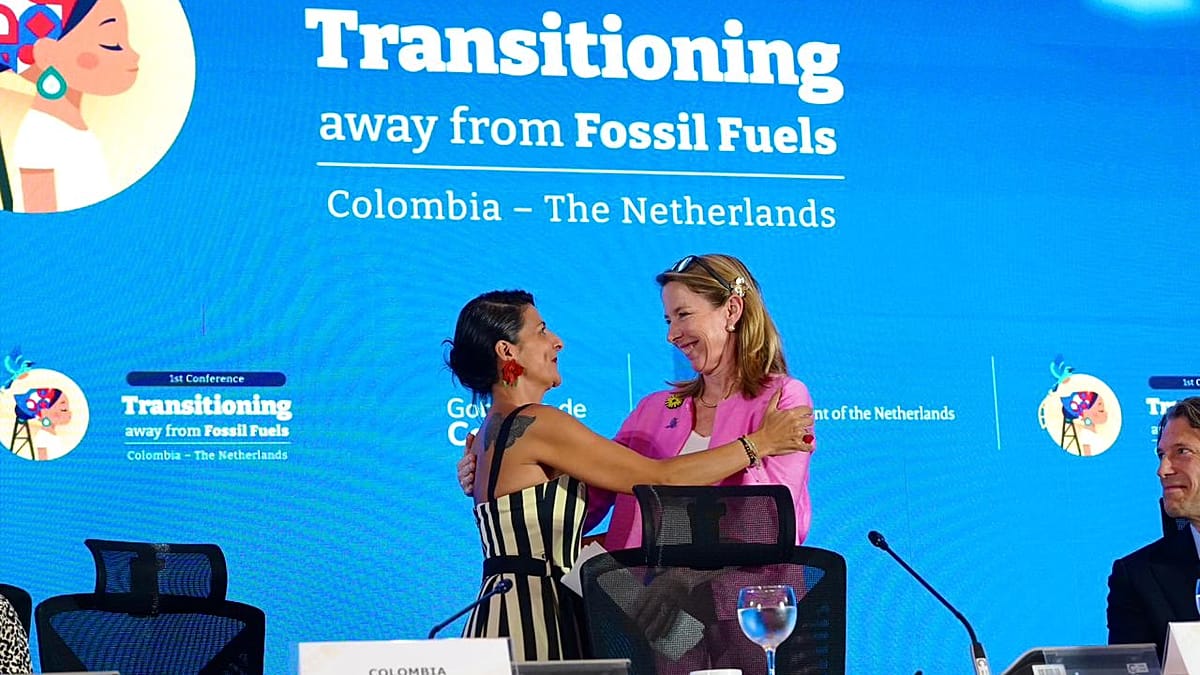
Fifty-six countries gathered in Santa Marta, Colombia, for the first international conference focused on orchestrating a just and orderly exit from fossil fuels. European governments formed the largest bloc, accounting for 30 percent of participants. Notably absent was the United States, whose administration was not invited due to its repeated efforts to undermine the clean energy transition. Major producers such as Australia, Türkiye, Canada, and Norway did attend, signaling a growing divide in global climate diplomacy.
The summit, held ahead of the official UN climate talks (COP31) scheduled for November 2026 in Antalya, Türkiye, under a Turkish presidency with Australia leading negotiations, aimed to establish new norms. Edward Maibach of the Global Climate and Health Alliance told Euronews Earth: “The actions of the coalition of the willing in Santa Marta will almost certainly inspire more phase-out actions. They are establishing a new social norm that signals it’s time for all nations to move forward – or risk being left behind.”
Civil Society Takes Centre Stage
Unlike traditional climate summits, Santa Marta gave unprecedented prominence to civil society. The conference opened with a four-day ‘People’s Summit’ that brought together over 1,000 civil society organisations, scientists, Indigenous representatives, social movements, and youth groups. Milena Sergeeva of the Global Climate and Health Alliance noted: “The children who spoke during the conference brought us back to what should be the most powerful argument for transition. They talked about friends made sick by coal dust and urged governments to protect them.”
The breadth of participation expanded the conversation beyond energy policy, framing the transition as a wider economic and societal shift with implications for industries ranging from agriculture to law and finance.
France Sets Out a National Fossil Fuel Exit Plan
France took a major step forward by publishing its national roadmap to transition away from fossil fuels. The plan commits to ending coal use by 2030, oil by 2045, and gas for energy by 2050, as part of its broader goal to reach carbon neutrality. It consolidates existing measures—including a ban on gas boilers in new buildings from 2026 and a target for two-thirds of new cars to be electric by 2030—while reaffirming commitments to support the transition in other countries.
Fossil Fuel Phaseout Framed as a Legal Obligation
Legal experts at the conference argued that moving away from fossil fuels is no longer simply a political choice. In an open letter, more than 250 lawyers and scholars said governments have a legal duty to phase out fossil fuels and prevent climate harm, regardless of their participation in specific international agreements. Rebecca Brown, President and CEO of the Center for International Environmental Law, stated: “For decades, fossil fuels have been treated as inevitable or too difficult to confront. That era is over.” The legal experts called on governments to take concrete measures and cooperative action to end fossil fuel expansion, eliminate subsidies, and advance a just and equitable phaseout.
Scientists Map a Path Out of Fossil Fuel Dependence
More than 500 scientists contributed to a new advisory body designed to guide the transition away from fossil fuels. The panel will feed into the conference’s final report, identifying practical pathways to keep the Paris Agreement’s 1.5°C target within reach—from global policy frameworks to sector-specific solutions. Rather than starting from scratch, researchers are working to consolidate existing evidence while developing benchmarks for how quickly fossil fuels must be phased out to avoid dangerous warming. Their work focuses not only on emissions reductions but on the broader systems needed to enable the transition, including financial mechanisms, governance structures, and scalable clean technologies.
Who Pays for the Transition?
If Santa Marta made one thing clear, it is that ambition alone will not deliver a fossil fuel phaseout—financing remains the central challenge. This is particularly acute in the Global South, where high borrowing costs and limited access to capital continue to constrain the shift, even as renewable energy becomes cheaper than fossil fuels. Some governments are exploring whether revenues from fossil fuels themselves could help fund the transition. In Brazil’s Espírito Santo state, for example, oil and gas income is being channelled into clean energy projects and investment funds aimed at attracting private capital. But such approaches have clear limits, given the volatility of fossil fuel revenues and their expected long-term decline.
At the same time, Indigenous groups warned against relying on carbon markets and offset schemes, arguing they fail to address the root causes of the crisis and risk prolonging fossil fuel dependence. Luene Karipuna, Executive Coordinator of the Association of Indigenous Organizations of Amapa & Northern Para (APOIAP) in the Brazilian Amazon, warned: “No amount of money can pay for the spirit of the territory.”
The summit underscored that Europe’s leadership in this area is not just about setting targets but about demonstrating that a fair transition is possible. As the continent grapples with its own energy security—highlighted by the ongoing crisis and the need to reduce reliance on imported fuels—the outcomes in Santa Marta may serve as a blueprint for future negotiations. For more on Europe’s climate strategy, see our coverage of Colombia and Netherlands leading a new climate coalition excluding Trump and the EU Climate Chief’s call to end new fossil fuel drilling.