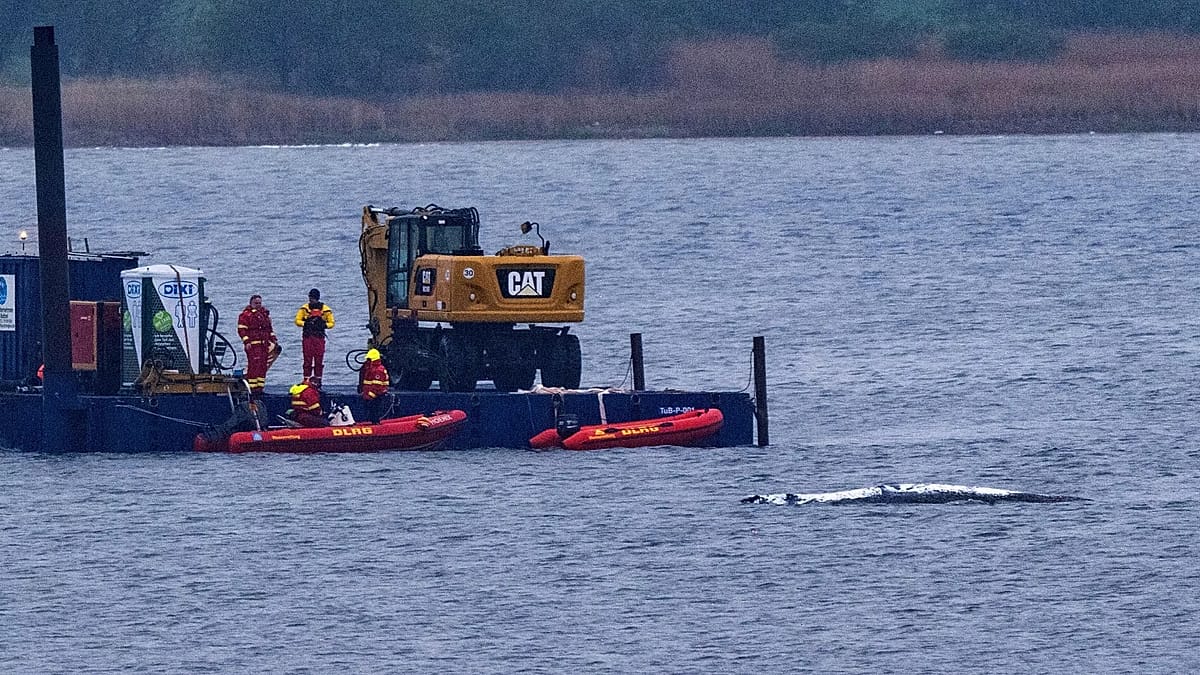
A complex and emotionally charged rescue operation for a humpback whale stranded on Germany's Baltic coast has encountered a significant setback. The whale, which had been stuck for approximately three weeks near the island of Poel off Wismar, unexpectedly swam free on Monday only to become stranded again on a different sandbank nearby.
The 13.5-metre animal, affectionately dubbed "Timmy" by sections of the German press, has captured national attention since it was first observed on a sandbank near Lübeck on 23 March. Its struggle for survival has become a daily narrative, punctuated by brief moments of freedom followed by renewed entrapment.
A Rescue Plan Paused
Authorities in the state of Mecklenburg-Western Pomerania, led by Environment Minister Till Backhaus, had prepared an elaborate rescue attempt. The strategy involved using inflatable cushions to lift the whale from the seabed, then transporting it via pontoons to deeper waters—potentially as far as the North Sea or Atlantic Ocean. Specialised equipment, including sections of the pontoon system, had already been deployed to the port of Kirchdorf.
"The plan was to lift the whale from the seabed using inflatable cushions and transport it with pontoons back to the North Sea or possibly as far as the Atlantic Ocean," a spokesperson outlined. This ambitious operation represented a last-ditch effort, approved by local authorities after a proposal from two entrepreneurs, one of whom founded the major electronics retailer MediaMarkt.
However, the whale's own movements on Monday pre-empted the human intervention. After rescuers cleared sand from around it, the humpback swam off under its own power, only to halt shortly after on another shallow bank.
Conflicting Assessments of Health
The whale's condition has been a subject of debate. As recently as 1 April, regional officials expressed a grim prognosis, convinced the "badly injured and distressed animal was going to die and could no longer be saved." The latest development, however, has injected a note of cautious optimism.
Minister Backhaus, speaking at the scene, insisted the animal's new position did not constitute a full stranding, suggesting it was merely "resting." Rescue teams and media, including Bild, interpreted the escape attempt as a positive sign of the whale's residual strength and vitality.
This incident highlights the broader environmental pressures on marine life in European waters, where shipping, pollution, and changing ecosystems create complex challenges. The dedication of resources to a single animal's survival also reflects a broader German propensity for large-scale humanitarian and environmental efforts, seen in other contexts from refugee hosting to energy transitions.
The ongoing saga underscores the unpredictable nature of wildlife rescue. The team now must reassess the situation, with the whale's new location potentially requiring a modification of their intricate pontoon strategy. Public interest remains high, as the fate of "Timmy" continues to unfold against the backdrop of the Baltic Sea.
Such environmental stories, while localized, connect to wider European concerns about biodiversity and conservation. They occur alongside continental debates on issues like energy security, where external factors can lead to disruptions, as seen when Kazakhstan halted oil shipments to Germany via Russia, citing technical problems.
The coming days will be critical for the rescue team as they determine the next steps for the humpback whale, whose repeated strandings have turned it into an unlikely symbol of resilience and the complexities of human intervention in the natural world.