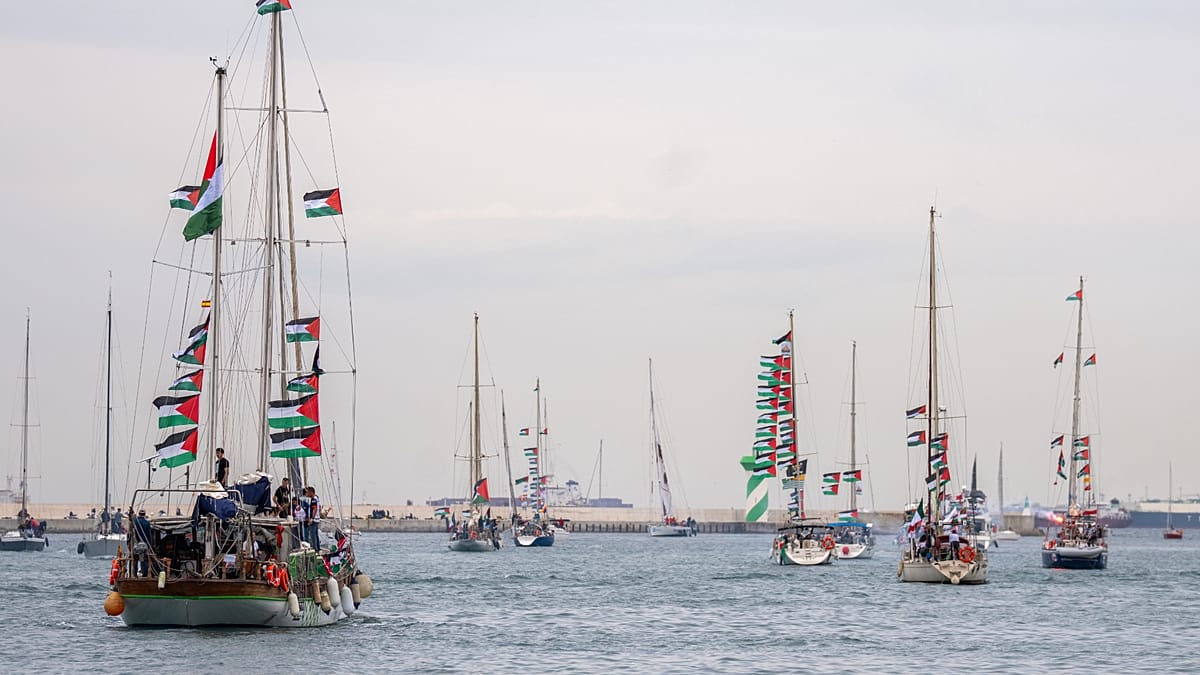
The 'Global Sumud Flotilla' has embarked on a new maritime mission to deliver humanitarian aid to Gaza, setting sail from several European ports in what organisers describe as the largest civilian effort of its kind. This initiative comes after a previous attempt in October 2025 was halted by the Israeli navy, which detained activists including Swedish climate campaigner Greta Thunberg. With the Middle East conflict ongoing, the current mission is considered even more perilous.
A European-Led Departure
The final vessels departed on Saturday from Augusta in Sicily, joining others that set off from Barcelona and Marseille. The flotilla, coordinated by a network of students, trade unionists, and pro-Palestinian associations, plans to converge with additional ships from Greece and Türkiye en route to the eastern Mediterranean. In a prelude to the main voyage, participants recently attempted to obstruct a cargo ship they claimed was carrying raw materials for Israeli military industry.
Navid Lari, a Belgian activist aboard one of the vessels, acknowledged the risks. “It is a fear that we have. We know what we are going against,” he told reporters. However, he expressed a belief that Israel's interception capabilities have limits, citing the logistical challenges faced during the interception of 45 ships last autumn. Lari argued that the subsequent wave of protests across Europe influenced the stance of some EU governments.
The flotilla's stated ultimate goal is to breach the maritime blockade Israel imposes on Gaza, which the activists label an illegal siege. Israel maintains the blockade is a necessary security measure against Hamas, which it designates a terrorist organisation. A government statement has characterised the flotilla not as a humanitarian mission but as a “political provocation,” alleging past financing links to Hamas—a claim the organising group vehemently denies.
Precedent and Political Backing
The shadow of the October 2025 interception looms large. On that occasion, the Israeli navy boarded the flotilla in international waters north of Egypt, seizing vessels and detaining all on board. Those detained, which included journalists and politicians from various nations, were released after one or two days in Israeli custody and repatriated. The incident sparked demonstrations in numerous European cities, from Berlin to Brussels.
Ahead of this latest launch, the flotilla's organisers sought to bolster its political legitimacy. They convened a congress in Brussels, drawing members of the European Parliament, politicians from EU and non-EU states, and UN officials. Among attendees was Francesca Albanese, the UN Special Rapporteur on human rights in the occupied Palestinian territories. This gathering underscores the mission's aim to operate within a framework of international advocacy, even as it directly challenges Israeli policy.
The mission's scale—nearly double the size of the last one—and its timing during ongoing regional instability make a peaceful conclusion unlikely. Israeli authorities have consistently warned such vessels not to approach Gaza's coastal waters, and they are expected to enforce the naval blockade rigorously. The confrontation highlights the complex intersection of humanitarian action, civil disobedience, and international law, with European citizens and ports playing a central role.
This maritime standoff occurs against a backdrop where the EU's energy chief has warned of prolonged economic repercussions from the Middle East conflict, illustrating the broader European stakes in regional stability. Furthermore, the activism reflects a persistent strand of European civil society engagement with the Israeli-Palestinian issue, distinct from official EU diplomacy.
As the flotilla sails, its fate rests on a precarious balance between the activists' determination and the Israeli military's resolve. The outcome will be closely watched in European capitals, where governments must navigate between supporting humanitarian principles and maintaining crucial diplomatic and security partnerships. The voyage also echoes other global crises where European actors are involved, such as the enduring tragedy in Darfur, reminding observers of the continent's interconnected role in international human rights debates.