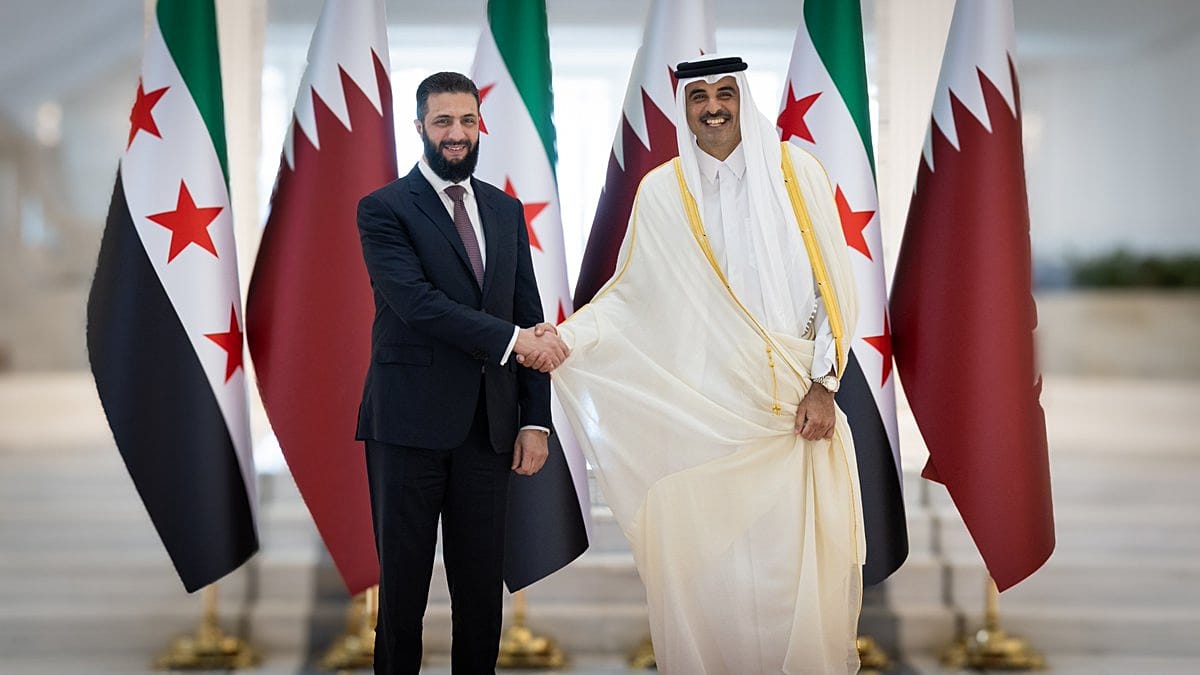
Syrian President Ahmed al-Sharaa arrived in Doha on Wednesday for a summit with Qatar's leadership, marking the second leg of a Gulf diplomatic tour aimed at bolstering economic partnerships and advancing Syria's regional reintegration. The visit to Qatar came a day after al-Sharaa met with Saudi Crown Prince Mohammed bin Salman in Jeddah, signalling a continued thaw in relations between Damascus and key Arab capitals.
Upon arrival at Doha International Airport, al-Sharaa was received by senior Qatari officials. He later held discussions with Qatar's Emir, Sheikh Tamim bin Hamad Al Thani, at the Amiri Diwan. According to a statement from Qatar's foreign ministry, their talks centred on enhancing economic cooperation and exploring new investment opportunities between the two nations.
Solidarity and Strategic Partnerships
The Qatar News Agency (QNA) reported that President al-Sharaa used the meeting to reiterate Syria's "solidarity with Qatar regarding any threats to its security and sovereignty." In a post on the social media platform X, al-Sharaa described the encounter as a "fraternal meeting," underscoring the personal diplomacy characterising this new phase of Syrian-Gulf relations.
This outreach follows the precedent set earlier this year when Emir Sheikh Al Thani visited Damascus in January 2025, becoming the first Arab leader to meet with al-Sharaa after he assumed the presidency following the ouster of long-time dictator Bashar al-Assad in December 2024. Qatar has positioned itself as an early advocate for re-engagement, announcing plans in early 2025 to provide 200 megawatts of electricity to Syria as part of broader infrastructure rehabilitation efforts.
The discussions in Doha and the preceding talks in Jeddah reflect a concerted effort by Syria's new leadership to secure economic lifelines and political normalisation. For European observers, the shifting alliances and investment flows in the Middle East have direct implications, particularly for energy security and regional stability. As the EU Energy Chief has warned, prolonged conflict in the region can lead to sustained price volatility, affecting European markets.
Deepening Ties with Riyadh
Al-Sharaa's meeting with Saudi Crown Prince Mohammed bin Salman in Jeddah on Tuesday appears to have laid significant groundwork. According to Syria's state news agency SANA, the leaders discussed strengthening bilateral relations and expanding economic and investment partnerships. Al-Sharaa praised the "warm reception and generous hospitality" he received.
The talks also covered regional linking projects and international developments, indicating a broader strategic alignment. Relations between Riyadh and Damascus have strengthened considerably since the fall of the al-Assad government, with Saudi Arabia actively backing Syria's return to the Arab fold. This was al-Sharaa's fourth visit to Saudi Arabia since becoming president, highlighting the priority placed on this relationship.
This diplomatic activity occurs against a backdrop of complex geopolitical manoeuvring. The rehabilitation of Syria, a nation devastated by years of conflict, presents both challenges and opportunities for external powers. European policy, which has historically been closely aligned with US positions on Syria, may require recalibration as Arab states take the lead on reintegration. The situation echoes other regional crises where European interests are at stake, such as the water security issues driving the proposal for a UN Water Agency advanced at a recent Central Asian summit.
The Gulf states' engagement with Syria also intersects with European security concerns, including migration and the fight against extremism. A stabilised Syria could potentially reduce migratory pressures on Southern European states like Greece, Italy, and Cyprus. However, the political and security landscape remains fragile, and Europe's approach will need to be carefully coordinated, perhaps integrating hard-learned lessons from other conflicts. As former Finnish Prime Minister Sanna Marin has urged, the EU must adapt its defence and strategic thinking based on contemporary battlefield realities.
Furthermore, the methods of modern conflict, including information warfare, have evolved. The Syrian context has long been a testing ground for hybrid tactics, a trend also visible in the war in Ukraine, where AI-generated deepfakes are being used to target morale. European security agencies will be watching how regional stability efforts in the Middle East interact with these broader threat vectors.
For now, President al-Sharaa's tour represents a tangible step in Syria's diplomatic and economic comeback. The focus on investment and infrastructure, exemplified by Qatar's power commitment, suggests a pragmatic, economically-driven path forward. The continued warmth in meetings with Gulf leaders indicates a shared interest in turning the page on the previous decade's hostilities. How this realignment influences the broader balance of power in the Middle East, and consequently Europe's strategic environment, will be a key story to follow in the coming months.