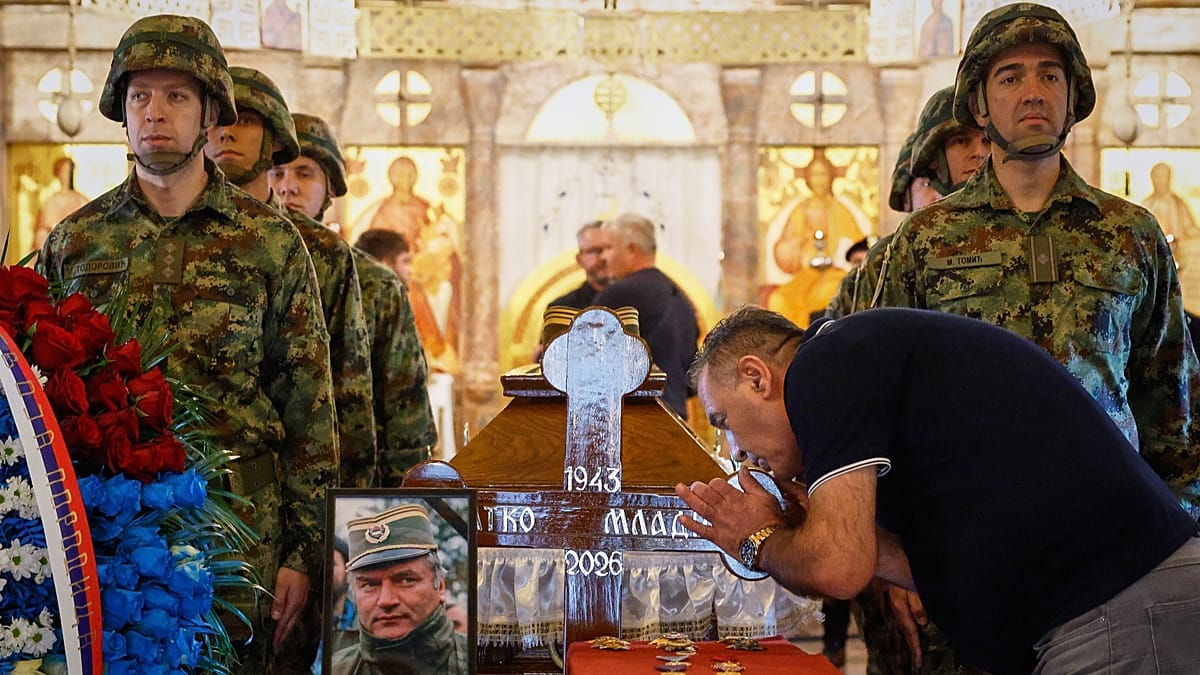
Belgrade witnessed a mass outpouring on Monday as thousands gathered for the funeral of Ratko Mladić, the former Bosnian Serb military commander convicted by a United Nations tribunal of genocide, war crimes, and crimes against humanity. The event proceeded despite renewed warnings from Brussels that honouring a man responsible for some of the worst atrocities in Europe since the Second World War undermines Serbia's stated path toward European Union membership.
Mladić's body had lain in state since the morning at the Church of St Luke in central Belgrade, where mourners queued for hours to pay their respects. His coffin, draped in the Serbian national flag, was flanked by men in military fatigues, with his officer's cap, sabre, and medals displayed nearby. A military orchestra played and a gun salute rang out as the cortege moved toward the Košutnjak cemetery, accompanied by hundreds of football fans and former soldiers carrying banners bearing his image.
The Serbian Orthodox Patriarch Porfirije, who led the funeral service, said Mladić's name would remain "deeply etched in the memory and prayers" of Serb Orthodox people who "feel and nurture a deep sense of gratitude towards him."
Despite earlier assurances that no serving officials would attend, Serbia's ministers of justice, culture, defence, and public investments were present, along with the Russian ambassador to Serbia, Alexander Botsan-Kharchenko, and Danilo Vučić, the son of President Aleksandar Vučić. Political representatives from the Bosnian Serb entity Republika Srpska also attended.
The Serbian government had sent a plane to bring Mladić's remains from The Hague, where he died in 2021 while serving a life sentence. Justice Minister Nenad Vujić initially announced that Serbia would grant Mladić "all the military and state honours," a decision that President Vučić later tempered. In the end, the funeral was formally organised by the family, but the state's involvement—including the use of an official plane, a police escort, and a military commemoration at an army venue on Saturday—has drawn sharp criticism.
State honours or private farewell?
Marko Milosavljević, head of research and advocacy at the Youth Initiative for Human Rights in Belgrade, argues that the pomp surrounding the funeral effectively amounts to state honours, which he says are contrary to Serbian law. "After he was found guilty, he lost his rank in the army, and with that he lost the right to any state or military honours," Milosavljević told European Pulse. "But as we can see in practice, in Serbia the same rules don't always apply."
Milosavljević also noted that one of the funeral's organisers is Svetozar Andrić, a wartime associate of Mladić who is wanted on several criminal indictments, including for ordering the expulsion of Bosniaks from eastern Bosnia in 1992. "This wave of celebration of Ratko Mladić absolutely encourages people like him who are still at large that they will never be held accountable for war crimes despite existing evidence," he said.
The EU's enlargement commissioner, Marta Kos, cancelled an upcoming visit to Serbia in protest, stating that "the glorification surrounding his death is incompatible with the values on which the EU path is built." A European Commission spokesperson added: "Any glorification of war criminals, genocide denial and revisionism contradict the most fundamental European values and have no place in the EU or in EU candidate countries."
President Vučić, who did not attend the funeral, described the event as an "emotional outpouring" that "has nothing to do with whether Vučić allowed something or not." He has repeatedly accused the West of anti-Serb bias, saying, "We have been persecuted and harassed for 30, 40 years ... always guilty whatever happens."
The funeral has cast a shadow over Serbia's EU accession prospects, which were already strained by Belgrade's refusal to align with EU sanctions on Russia and its continued ties with Moscow. The EU's warning that such events could derail talks is a clear signal that Brussels is watching closely. For many in the Western Balkans, the scene in Belgrade was a stark reminder of the unresolved legacies of the 1990s wars, and of the distance still to travel on the road to reconciliation.