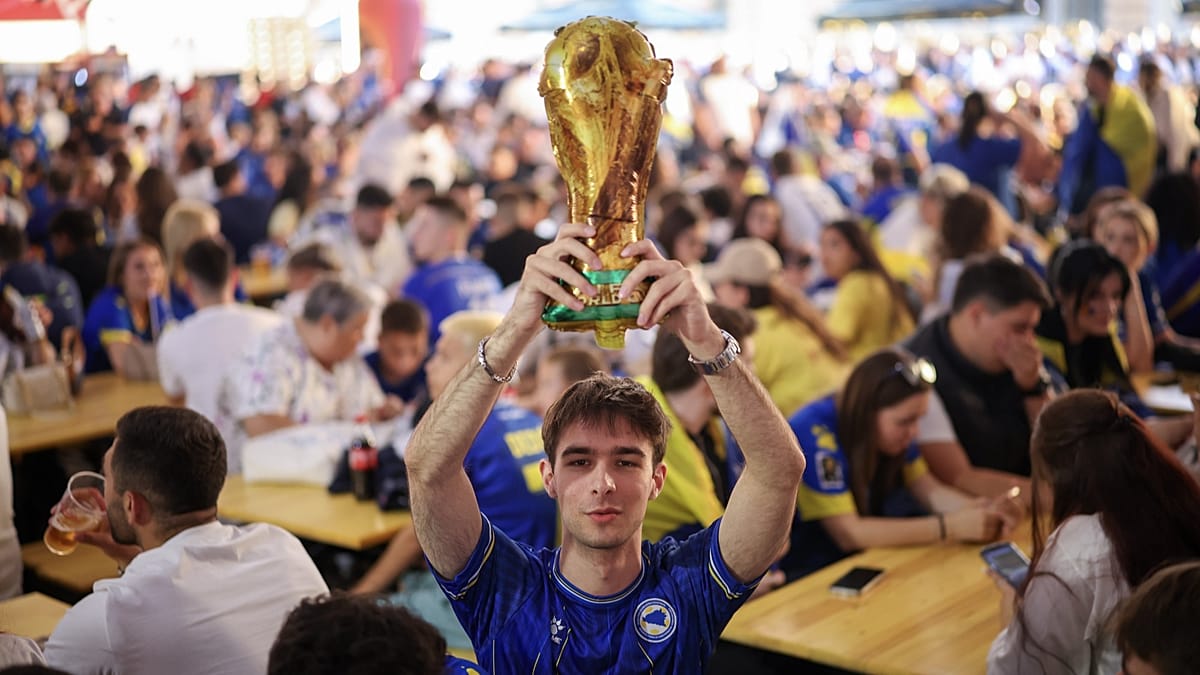
When stand-in forward Jovo Lukić headed in a corner kick in the 21st minute of Bosnia and Herzegovina's World Cup opener against Canada on Friday, a small but fervent group of Bosnian fans erupted in the stands of Toronto Stadium. The goal, scored against a host nation backed by celebrities like Ryan Reynolds and Mike Myers, sparked tears of joy among the blue-clad supporters in the upper deck.
For a nation of roughly three million people, this tournament appearance is only its second since independence from Yugoslavia in 1992, a move that triggered a devastating four-year war. Bosnia secured its spot by eliminating four-time champion Italy in a penalty shootout during European playoffs. Ranked 64th in FIFA's standings—the lowest in Group B, behind Switzerland (19), Canada (30), and Qatar (56)—the Dragons were not expected to hold their own. Yet they set a record with over 70 defensive clearances in a single match, ultimately drawing 1-1 after Canada equalized in the 78th minute.
The match resonated far beyond the pitch. Many Bosnian fans are part of a large diaspora displaced across western Europe and North America by the war and its aftermath—a period marked by stalled EU accession, ethnic tensions among Bosnian Serbs, Bosnian Croats, and Bosniaks, and one of the world's most convoluted government systems. For these supporters, the team's resilience mirrors their own experiences.
A 15-Year-Old Song Becomes a World Cup Anthem
The unofficial anthem of this campaign is a 15-year-old track by the beloved Bosnian band Dubioza Kolektiv. Originally titled "USA," the song opens with the line, "I am from Bosnia, take me to America." It went viral on social media as Bosnia neared qualification, with fans singing it louder at every match and emblazoning its lyrics on banners and t-shirts.
But the song is not a simple ode to emigration. As bassist Vedran Mujagić explained, "It evolved from this satirical take on immigration and the American Dream and it was translated into an American football dream for the entire nation." The lyrics later pivot: "I want to start all over, return to no man's land, send greetings to your leader, don't want your green card, I want to fly back like a rocket to the Balkans."
Keyboardist Brano Jakubović added, "This is the best thing for the band or for the song: when people take over and load new meaning and then it becomes theirs. It's not ours anymore." The anthem's reach extended to the broadcast booth, where superstar commentators Thierry Henry and Zlatan Ibrahimović—both with Bosnian connections—sang the line live on TV.
The song's journey reflects a broader European story of migration and identity. Bosnia's diaspora, scattered across Germany, Austria, Sweden, and beyond, has long grappled with the tension between seeking opportunity abroad and longing for home. The World Cup provides a rare moment of unity, as fans from Sarajevo to Stockholm rally behind the team.
Yet the backdrop remains challenging. Bosnia's EU membership path has stalled amid ethnonationalist infighting. An estimated quarter of the population lives in relative poverty, unemployment remains high, and the healthcare system is plagued by corruption. The country's complex governance structure, designed to balance ethnic interests, often paralyzes progress. Open denial of war crimes and genocide persists despite international court rulings.
For now, the Dragons' performance offers a reprieve. The draw against Canada, followed by upcoming matches against Switzerland and Qatar, keeps hope alive. As the anthem echoes in stadiums and fan zones across Europe and North America, it encapsulates a nation's defiant spirit: underdog status notwithstanding, Bosnia refuses to roll over.