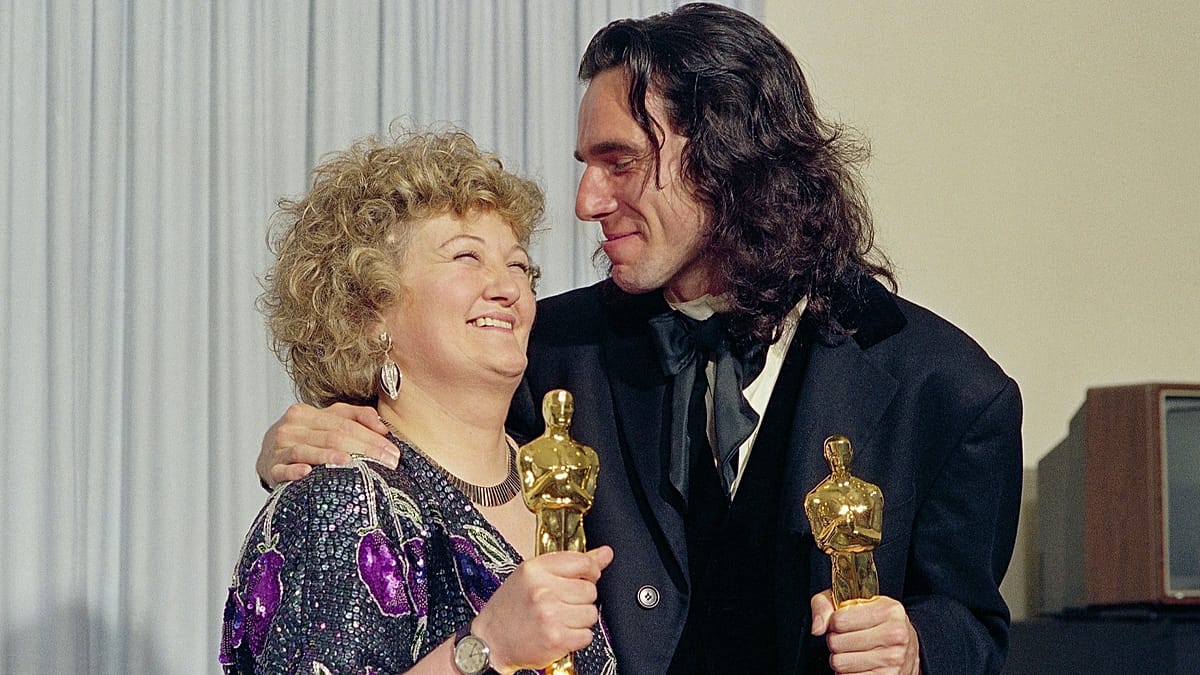
Brenda Fricker, the Dublin-born actress who became the first Irish woman to win an Oscar, has died at the age of 81. Her agent, Phil Belfield, confirmed that she passed away after a period of ill health, describing her as irreplaceable and noting that “the world is lesser for the lack of her.”
Fricker won the Academy Award for Best Supporting Actress in 1990 for her portrayal of Bridget Brown, the mother of Christy Brown, in the biographical drama My Left Foot. The film also earned Daniel Day-Lewis the Best Actor Oscar. Her performance was widely praised for its warmth and grit, capturing the resilience of a working-class Dublin family.
Over a career spanning six decades, Fricker appeared in a range of films, including So I Married an Axe Murderer (1993), A Time to Kill (1996), Veronica Guerin (2003), and Albert Nobbs (2011). However, for many viewers, she remains most fondly remembered as the eccentric “pigeon lady” in Central Park who befriends Kevin McCallister in Home Alone 2: Lost in New York (1992).
From Dublin to Hollywood
Born in Dublin on 17 February 1945, Fricker began her acting career on Irish television before gaining widespread recognition in the United Kingdom. She was a familiar face to British audiences through her long-running role as Nurse Megan Roach on the BBC medical drama Casualty, a part she played from the 1980s into the 1990s, and reprised in 2007 and 2010.
Her death has prompted tributes from across the political and cultural spectrum. Edward Walsh, the US ambassador to Ireland, called her “a giant of Irish film” and praised her “unforgettable” performance in My Left Foot. In a post on X, he wrote: “From Dublin to Hollywood, her work brought Ireland's stories to the world and inspired generations on both sides of the Atlantic.”
Fricker’s legacy is also a reminder of the enduring strength of Irish cinema and its ability to connect with global audiences. Her Oscar win in 1990 came at a time when Irish film was gaining international recognition, and she helped pave the way for later Irish talent. In a related vein, the recent opening of The Dean Munich in Westend shows how Irish cultural and business influence continues to expand across Europe.
Beyond her film work, Fricker was known for her down-to-earth personality and dedication to her craft. She often spoke about the importance of portraying ordinary people with dignity, a principle that guided her performances. Her death marks the loss of a distinctive voice in European cinema, one that bridged the gap between small-screen storytelling and Hollywood acclaim.
Fricker is survived by her family and a vast body of work that will continue to inspire actors and audiences alike. As Belfield put it, “I was honoured to know, love and work with her and she will always have a place in my heart and in the heart of so many film and TV fans the world over.”