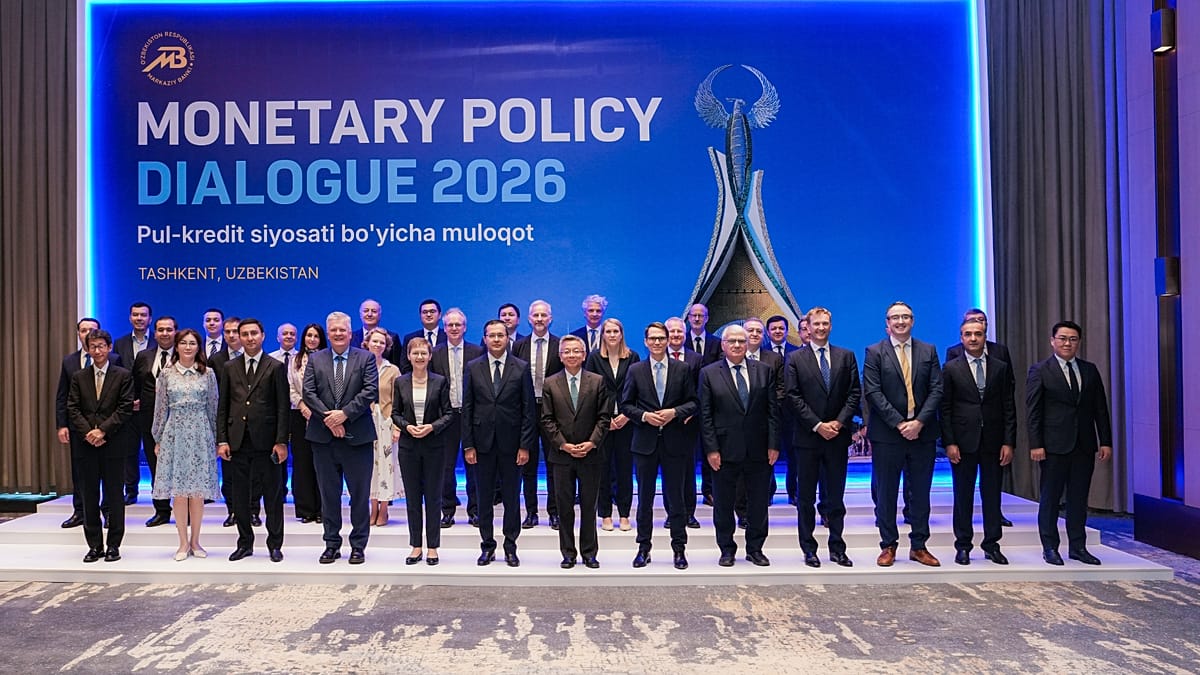
Central banks across Europe and beyond are entering a delicate phase: having brought inflation down from multi-decade highs, they now face the risk that premature interest-rate cuts could reignite price pressures and damage the credibility built over years of tight policy. That warning came from economists and policymakers gathered in Tashkent for the first Monetary Policy Dialogue, co-hosted by the International Monetary Fund and the Central Bank of Uzbekistan.
Athanasios Orphanides, a professor at the Massachusetts Institute of Technology and former governor of the Central Bank of Cyprus, argued that the post-pandemic period had exposed the cost of misreading inflation. “If we look at the post-pandemic experience, many central banks around the world did not calibrate policy correctly and ended up with inflation that was significantly higher than the definitions of price stability that they were aiming for,” he told Euronews. “The risk, I fear, remains that for many central banks, policy easing is contemplated too early.”
Repeated shocks test policymaker resolve
The challenge is not merely one of timing. For institutions such as the European Central Bank in Frankfurt, the Bank of England in London, or the Swiss National Bank in Zurich, the broader test is maintaining credibility when shocks to prices, supply chains and demand are harder to predict than in the pre-pandemic era. Koba Gvenetadze, the IMF’s resident representative in Uzbekistan, stressed the importance of learning from recent crises. “There have been repeated shocks for the last five years and that is why lessons learned from those shocks and the sharing of experiences are absolutely very important,” she said.
Gvenetadze pointed to the COVID-19 pandemic as a case in point: supply disruptions that initially appeared temporary can have lasting effects on inflation. “We have learned from the COVID experience, for example, that even if there are supply shocks which impact inflation, maybe in the beginning they don’t impact inflation, but at a later point they may start impacting inflation,” she added. This insight is particularly relevant for European central banks that must now weigh the risk of cutting rates against the possibility that supply-side pressures—from energy prices to labour shortages—could resurface.
The debate in Tashkent also touched on the broader European context. As the ECB orders Eurozone's largest banks to fortify defenses against AI cyber threats, the financial system's resilience is under scrutiny from multiple angles. Meanwhile, central banks warn AI investment surge risks financial crash, adding another layer of complexity to the rate-setting calculus.
Inflation targeting as a compass
Orphanides defended inflation targeting as one of the most effective frameworks for guiding monetary policy when economic conditions become harder to read. “A framework that works very well in my view, and this is the framework that has been adopted in recent years in Uzbekistan as well, is inflation targeting,” he said. “By focusing on stabilising inflation and maintaining price stability, the central bank simply provides the foundation for all of the other adjustments that need to take place when shocks hit the economy.”
Uzbekistan’s own experience offers a striking example. The Central Bank of Uzbekistan presented figures showing inflation falling from nearly 20% in 2018 to 5.5% in May 2026. Inflation expectations among households and businesses also declined, from an average of 20% to about 10%. These numbers are critical for the transition to full-fledged inflation targeting, which depends not only on lower headline inflation but also on whether businesses and households believe price growth will remain under control.
Samigjon Inogamov, director of the Central Bank of Uzbekistan’s Monetary Policy Department, outlined a sequence of reforms that includes deepening domestic financial markets, liberalising the financial account, and developing a more robust capital market. The success of these measures is already visible in the declining dollarisation of the economy. Foreign-currency deposits now account for around 20% of banking deposits, compared with nearly 50% previously, while dollarised lending stands at 37%, down from 54%. For investors and businesses, lower dollarisation signals greater confidence in the domestic currency and makes monetary policy more effective through local financial markets.
The lessons from Tashkent resonate well beyond Central Asia. As European central banks navigate the final stretch of the inflation cycle, the credibility they have built—or lost—will determine whether they can ease policy without undoing the progress of the past two years. The risk, as Orphanides put it, is that the temptation to cut rates too soon could prove costly. For now, the message from Tashkent is clear: patience is not a weakness, but a prerequisite for lasting price stability.