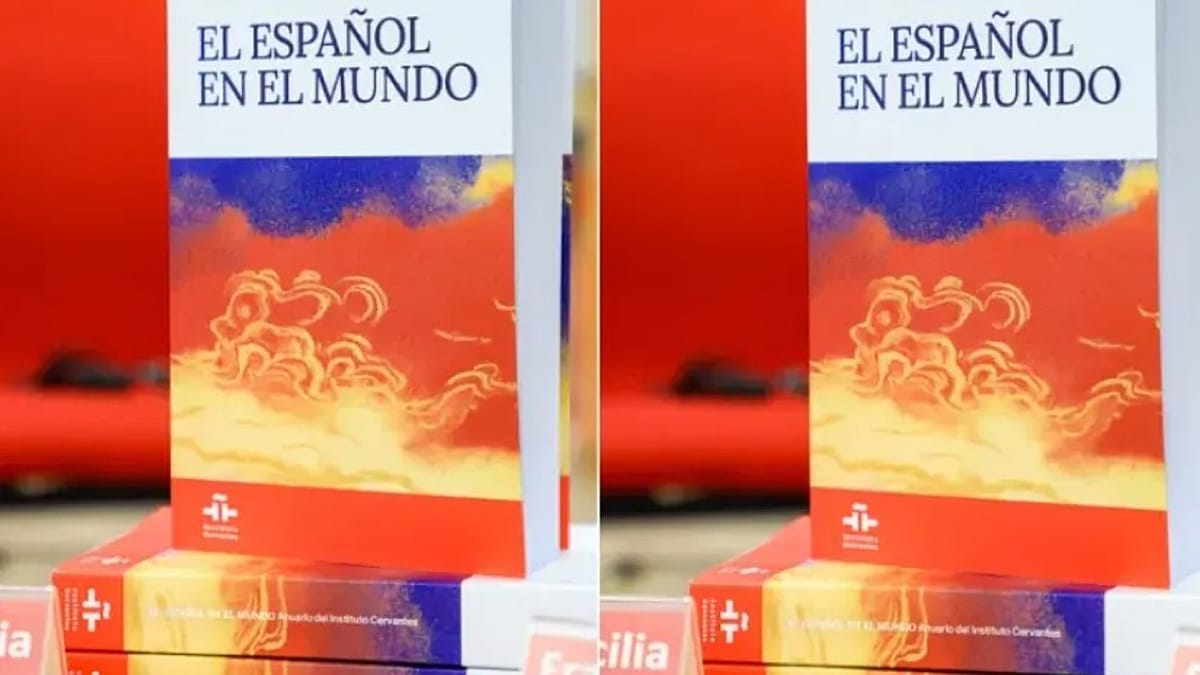
Spanish is spreading through China's classrooms at a pace that has caught even language experts off guard. New figures from the Cervantes Institute show enrolments in Hispanic philology degrees, optional courses, and Spanish-as-a-foreign-language programmes jumped 12.6% between 2023 and 2025. But this post-pandemic surge has collided with a persistent shortage of qualified teachers.
Speaking in Beijing at the launch of the institute's Spanish in the World 2026 yearbook, director Luis García Montero stressed the urgency: "Teachers tell us that demand for Spanish keeps rising in the wake of the pandemic, which is why we are prioritising teacher training: quite simply, more teachers are needed."
The yearbook was presented at a symposium titled 'Spanish in China: Evolution and new dynamics', held to mark the Cervantes Institute's twentieth anniversary in the Chinese capital. The second part of the report is dedicated to this milestone, offering analyses of how the language has evolved, its impact, and its reach within China's education system.
Between the market and the humanities
China now counts nearly 98,000 potential Spanish speakers, a group that includes more than 18,000 native residents and some 66,000 students of the language. According to the Global Spanish Observatory, Spanish is taught in 31 Chinese cities, and up to 98% of universities in the country offer a degree in Hispanic Philology.
García Montero spoke of an "essential dialogue between China and the Spanish-speaking world", driven decisively by Latin America. Yet he voiced concern about the growing commercialisation of language teaching. While Spanish is gaining ground in business, engineering, and science, he warned that philology is losing weight: "In the current dynamic of commercialisation, the humanities are in decline, and that is something that worries us."
The expansion has been rapid. Yang Ming, vice-dean of Shanghai International Studies University (SISU), noted that China now has 55,000 university graduates in Spanish. But he highlighted a shift in what employers want: the market no longer seeks only translators, but multidisciplinary professionals who can combine Spanish with law, accounting, or business management.
Spanish worldwide: growth and challenges
Globally, Spanish now has 640 million users with some degree of proficiency, an increase of 1.5% over the past year, adding 10 million speakers. The yearbook also underscores the role of migration: one in ten native speakers now lives in a non-Spanish-speaking country.
With more than 520 million native speakers, Spanish ranks second only to Mandarin Chinese and Hindi. An additional 95 million people have limited skills, up 3.3%. The report counts around 460 million native speakers within the Spanish-speaking world and more than 20 million with partial knowledge.
Outside countries where Spanish is official, there are over 137 million potential users, not counting students. The United States leads this group, driven largely by its native Spanish-speaking community.
In Europe, the language has nearly 50 million potential speakers. The yearbook also draws attention to the fragile state of creole and contact varieties, which together account for less than one million people, just 0.2% of the global total.
Among the more than 24 million students of Spanish worldwide, up 7% in two years, regional contrasts are stark. Brazil has seen a 46% decline due to legislative changes affecting public schools, while Africa is experiencing vigorous growth, with formal teaching expanding in Cameroon, Ivory Coast, Benin, Morocco, and Tunisia.
Digital and AI frontiers
Spanish is the second most used language on websites and has 72 million learners on Duolingo, two-thirds of them English speakers. Digital reading is most prevalent in Spain (31.7%), Mexico (21%), and Argentina (20%), while audiobooks are gaining popularity.
In artificial intelligence, Ibero-America accounts for 14% of global traffic for AI solutions, above its 11% share of internet users. This growing demand, the yearbook notes, is reshaping how information is consumed and securing Spanish's place in the era of virtual assistants.
Two decades in Beijing
The programme opened with a debate around the exhibition 'Truths and Lies. The power of fiction', featuring journalists, curators, and artists such as Xu Bing and Zhang Peili. Round tables focused on teaching methods, textbook updates, and the pedagogical use of AI.
Following the yearbook presentation, Inmaculada González Puy, director of the Cervantes Institute in Beijing, and Hispanist Lu Jingsheng discussed 'Spanish in China'. The sessions closed with contributions from ambassador Marta Betanzos Roig, education official Chang Fuliang, and academics Carme Riera and Darío Villanueva.
The teacher shortage in China is part of a broader global challenge. As Spanish grows in strategic markets, the need for trained educators becomes more acute. The Cervantes Institute's focus on teacher training is a direct response, but the gap between demand and supply remains wide.