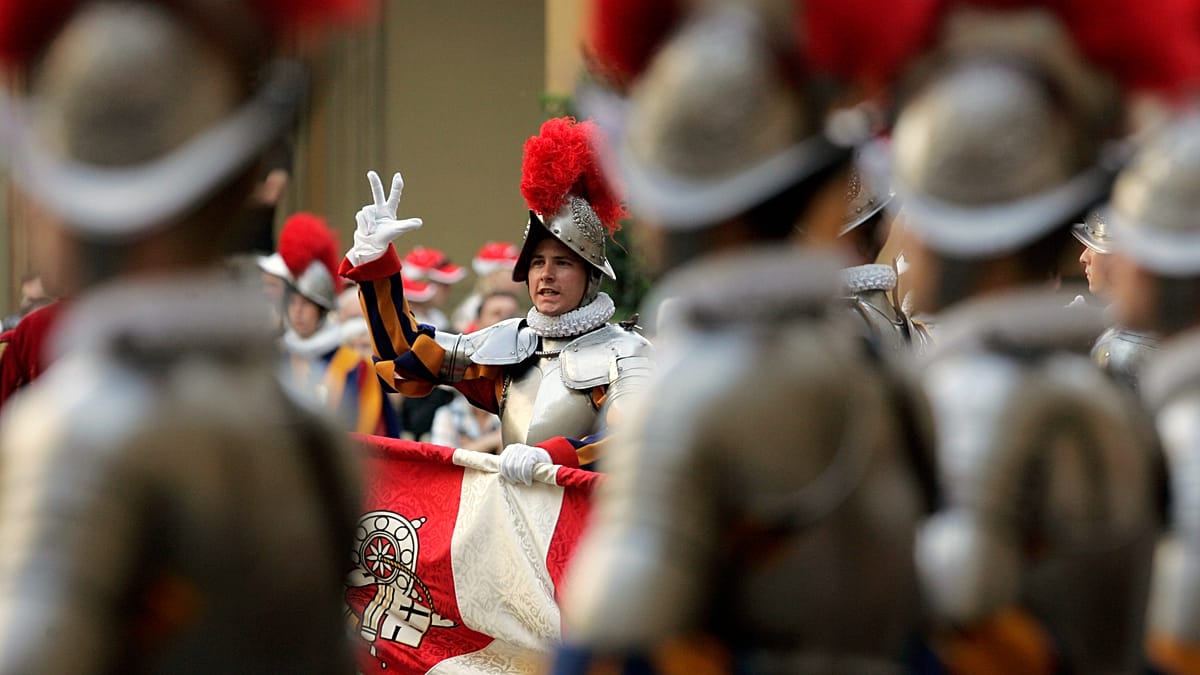
Vatican City witnessed a time-honored tradition on Wednesday as Pope Leo XIV presided over the swearing-in of 28 new members of the Pontifical Swiss Guard. The ceremony, held in the San Damaso Courtyard, marked the formal induction of recruits who have completed months of rigorous training in Rome.
The Swiss Guard, founded in 1506 under Pope Julius II, remains one of the world's oldest military units still in active service. Its members, all Catholic Swiss men, are tasked with protecting the pope and securing the Apostolic Palace. The oath of allegiance, recited in German, Italian, and French, binds them to defend the pontiff “even at the cost of my life.”
A Ceremony Steeped in History
The swearing-in traditionally occurs on May 6, commemorating the 1527 Sack of Rome, when 147 Swiss Guards died defending Pope Clement VII. This year’s date, however, shifted to accommodate the papal schedule. The recruits, dressed in the guard’s iconic blue, red, and yellow uniforms, knelt before Pope Leo XIV as he blessed their halberds and swords.
In his address, the pope emphasized the spiritual dimension of their service. “Your duty is not merely ceremonial; it is a vocation of fidelity and courage,” he said, according to Vatican News. “You are guardians of a mission that transcends national borders.”
The new guards hail from 14 of Switzerland’s 26 cantons, with the largest contingent from Valais. Their training included marksmanship, unarmed combat, and protocol for high-profile events such as papal audiences and state visits.
Broader Context: The Vatican’s Security and Diplomatic Role
The ceremony comes amid heightened scrutiny of the Vatican’s security apparatus. The Swiss Guard, which numbers around 135, works alongside the Vatican Gendarmerie, a civilian police force. Recent years have seen debates over modernizing the guard’s equipment and recruitment, though its core traditions remain unchanged.
Pope Leo XIV, elected in 2023, has maintained the guard’s ceremonial prominence while quietly expanding its role in cybersecurity and counterterrorism coordination with Italian authorities. The new recruits will undergo additional training in digital surveillance and emergency response.
The event also carries symbolic weight given ongoing tensions between the Holy See and certain political figures. Earlier this year, former U.S. President Donald Trump escalated a public feud with Pope Leo XIV over migration policy, a dispute that has strained Vatican-U.S. relations. The Swiss Guard’s visible presence serves as a reminder of the Vatican’s sovereign status and its ability to navigate global diplomacy.
Swiss Guard Recruitment and Modern Challenges
Recruiting for the Swiss Guard remains a niche endeavor. Candidates must be Swiss males aged 19 to 30, at least 174 cm tall, with a secondary school diploma and Swiss citizenship. They serve a minimum of 26 months, with many extending their contracts. The guard offers a salary of roughly €1,500 per month, plus accommodation and meals.
In recent years, the guard has faced challenges in attracting recruits, partly due to Switzerland’s low unemployment and the demanding nature of the role. The Vatican has responded by promoting the guard’s unique blend of tradition and modern security work. “It is not just a job; it is a life of service,” said Colonel Christoph Graf, the guard’s commander, in a statement.
The ceremony also highlighted the guard’s multilingual character. Recruits must be fluent in at least one Swiss national language (German, French, Italian, or Romansh) and learn Italian during training. This linguistic diversity reflects the guard’s role as a microcosm of Swiss federalism within the Vatican.
For the families and friends who traveled from Switzerland to witness the oath, the event was a source of pride. “My son has dreamed of this since he was a boy,” said a mother from Lucerne, who asked not to be named. “To see him serve the pope is an honor for our whole canton.”
The 28 new guards will now take up their posts at the Vatican’s gates, the Apostolic Palace, and during papal audiences. Their presence ensures that a tradition spanning over five centuries continues to adapt to the demands of the 21st century.