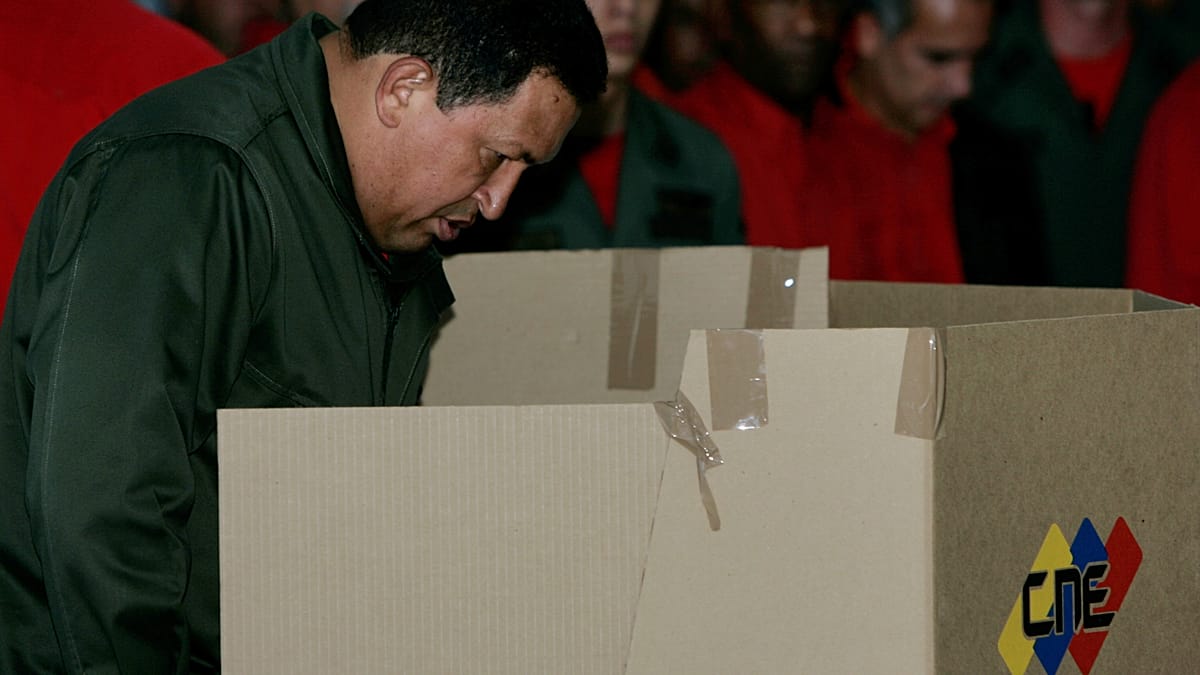
Documents declassified by the White House have confirmed what Venezuela's opposition long alleged without official proof: the Bolivarian regime maintained a technical infrastructure capable of manipulating election results. The CIA reports, released under Donald Trump's declassification order, detail a system that could shift at least 1.5 million votes in pro-Chávez strongholds.
The files trace the machinery back to the 2012 elections, when an already ill Hugo Chávez defeated Henrique Capriles after a year of massive public spending estimated at $70 billion. Three bodies—the General Directorate of Military Counterintelligence, the Bolivarian Intelligence Service, and the National Electoral Council—were implicated in operating pre-programmed voting machines. However, the CIA does not confirm that the mechanism was actually activated in that election; Capriles himself acknowledged his defeat at the time.
From Maduro's Rise to the 2017 Constituent Assembly
After Chávez's death in March 2013, Nicolás Maduro beat Capriles by a narrow margin, and the opposition filed complaints of irregularities. The CIA found no conclusive evidence that vote-rigging was necessary in that contest. The picture changed with the 2017 National Constituent Assembly election, boycotted by opposition parties. Smartmatic, the company that supplied the voting system, warned that turnout figures had been inflated by at least one million votes. That assembly, initially chaired by Delcy Rodríguez, was convened to quell street protests and ultimately failed to draft a single article of the new constitution it claimed to pursue.
The same scheme, the agency notes, was available for the 2020 parliamentary elections, though it was not needed: the opposition chose not to participate after the Chavista movement seized registration papers of several parties and disqualified various leaders. Neither Washington nor Brussels recognised that process.
The most serious episode, in July 2024, required no technical sophistication: the Chavista camp directly altered the figures to overturn Edmundo González Urrutia's victory over Maduro. Tally sheets showed 7 million votes for Maduro against 3 million for González, leaving no room for doubt. The opposition documented the result using QR codes on electoral records, now a key reference for reconstructing that election.
More than six months after the regime's fall and with a new government under international supervision, none of the three bodies singled out by the CIA has been dismantled. This raises questions about the durability of democratic reforms in Venezuela, a topic of concern for European policymakers who have closely followed the country's trajectory. The European Union, which has imposed sanctions on Maduro-era officials, now faces the challenge of supporting a fragile transition while ensuring accountability for past abuses.
For European readers, the declassification underscores the importance of electoral integrity in international contexts. The CIA's findings echo concerns raised by European observers in other regions, including the Balkans and Eastern Europe, where similar manipulation techniques have been alleged. The documents also highlight the role of technology in elections—a subject of growing debate in Brussels as the EU prepares new regulations on digital voting and disinformation.
As Venezuela's interim government seeks to rebuild, the legacy of these revelations may influence how European nations engage with Caracas. The Portuguese airlift of 8.7 tonnes of medicines to earthquake-stricken Venezuela earlier this year demonstrated Europe's humanitarian commitment, but political support will require credible guarantees against future electoral fraud.