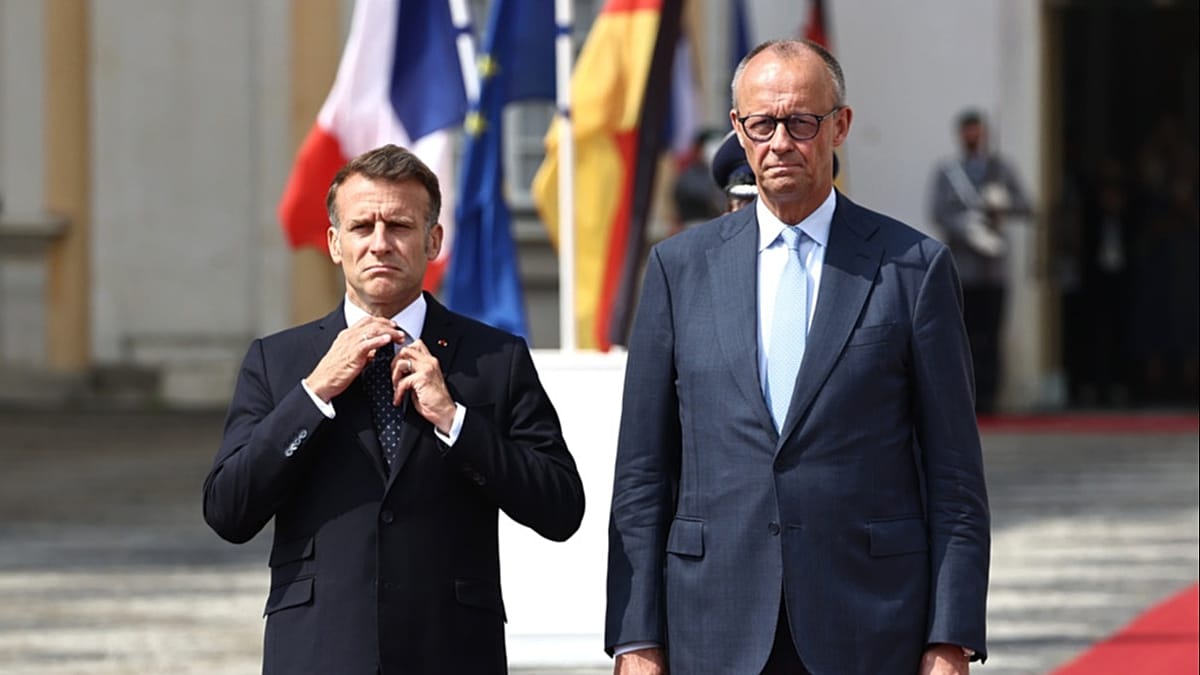
German Chancellor Friedrich Merz welcomed French President Emmanuel Macron at the Noervenich air base near Cologne on Friday for a joint defence and security council, one month after the collapse of the flagship Future Combat Air System (FCAS) project. The meeting, held next to a French Rafale jet and a German Eurofighter, symbolised the strained but essential partnership between Europe’s two largest economies.
The two leaders emerged from a Super Puma helicopter—a rare example of successful Franco-German industrial cooperation—before leading their full cabinets into talks at the Augustusburg Palace in Brühl, near Cologne. It was in this same castle that French President Charles de Gaulle and German Chancellor Konrad Adenauer met in 1962 to lay the groundwork for the Élysée Treaty, the cornerstone of post-war reconciliation.
Defence cooperation under pressure
The urgency of Friday’s meeting is driven by multiple pressures. For Macron, progress on defence is essential before the French presidential election next spring, where Marine Le Pen’s far-right Rassemblement National is a frontrunner. A Le Pen presidency would inject further uncertainty into European security arrangements already strained by Russia’s war in Ukraine and the unpredictable stance of US President Donald Trump.
Berlin and Paris are expected to launch a joint “steering group” to deepen cooperation on radar systems, long-range strike capabilities, and defence missiles. Macron stated on Thursday that he wanted the talks to give a “new dynamic” to defence cooperation as part of building “a powerful Europe which unites our strengths.”
The aim is to “bounce back” from the implosion of the FCAS project, which fell victim to persistent bickering between Airbus and France’s Dassault Aviation. Another joint venture, the Main Ground Combat System (MGCS) to replace battle tanks, is also under strain after Germany’s Rheinmetall entered the project, creating internal tensions.
Air defence and nuclear deterrence
Air defence remains a major point of contention. Germany has pushed its European Sky Shield Initiative (ESSI), which relies heavily on the American Patriot and Israeli-American Arrow-3 systems. France has refused to participate, arguing that ESSI would increase Europe’s dependence on the US and that the continent should instead bolster its own defence industry.
One area of potential convergence is a French-led nuclear deterrence scheme. Macron said earlier this year that Germany was among eight countries that had agreed to participate. However, he stressed that Paris—one of Western Europe’s two nuclear powers alongside the United Kingdom—would retain tight control over nuclear decision-making. A German government source emphasised that any such project must remain “complementary” to NATO and avoid creating “different security zones” within Europe.
The talks also cover European competitiveness, the EU budget, digital regulation, and initiatives to combat disinformation. Macron and Merz are expected to discuss how Europe can compete with the US and China in artificial intelligence by pooling computing capacity and creating a European structure to recruit top researchers.
The meeting comes as the EU’s defence commissioner pushes for a military mobility plan with a 2028 deadline, a topic that has gained urgency amid the war in Ukraine. Meanwhile, Ukraine’s dismissed defence minister Fedorov has accused the army chief of blocking reforms, adding to the complexity of European security discussions.
For now, the Franco-German engine—once the motor of European integration—is being tested like never before. Whether the two capitals can translate symbolic gestures into concrete progress will determine not only their bilateral relationship but also the continent’s ability to defend itself in an increasingly hostile world.