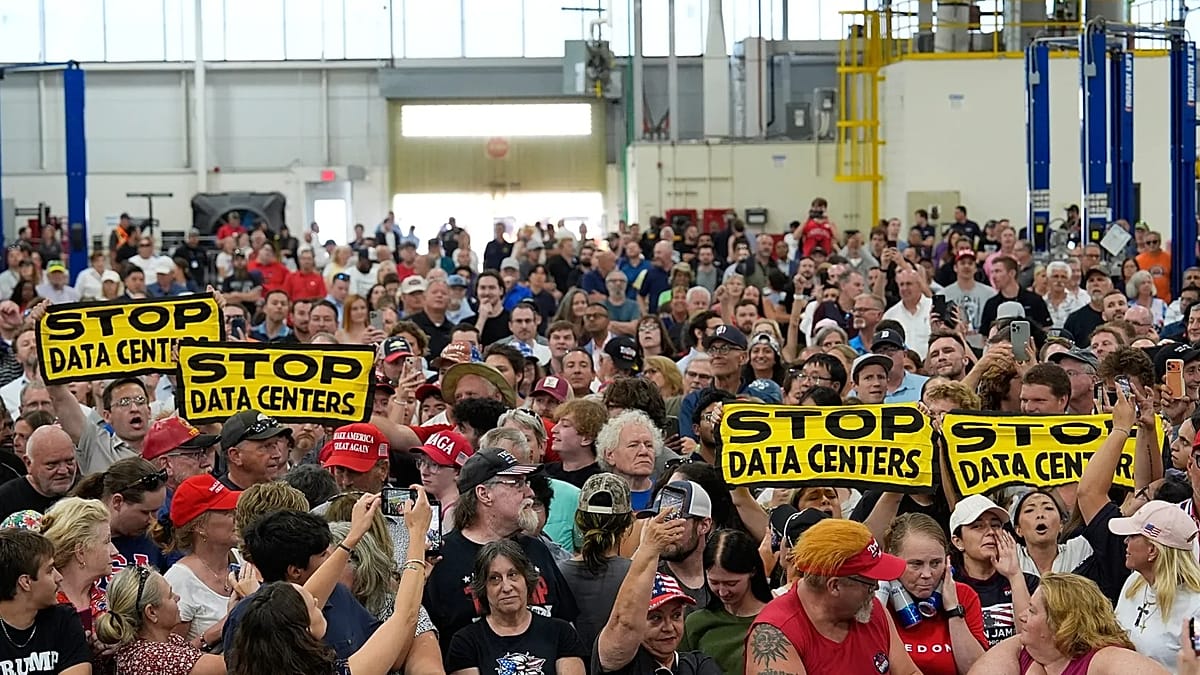
With the US midterm elections less than three months away, Republicans are confronting an unexpected political liability: the data centres powering the artificial-intelligence boom. Once a niche zoning issue, the construction of these massive facilities has become a flashpoint in several competitive races, putting GOP candidates on the defensive as they try to balance support for President Donald Trump's technology agenda with the concerns of local voters.
Trump has been unambiguous in his backing of data centre expansion, framing it as essential to outcompeting China in the global AI race. In a recent interview, he dismissed community resistance, saying that governors and mayors should welcome the facilities for the jobs, investment, and tax revenue they bring. He also downplayed the enormous electricity demands, boasting that developers are building power plants "the likes of which you have never seen."
But that enthusiasm is proving awkward for Republican candidates in states like Ohio and Michigan, where voters are asking a more basic question: who pays for the grid upgrades, water use, and environmental impact? Data centres consume vast amounts of electricity and water, and residents worry about higher utility bills, noise, and the loss of farmland. The economic benefits are real, but so are the costs, and the backlash is no longer confined to the left.
A recent Gallup survey found that roughly seven in ten Americans oppose having a data centre built in their own community, including a majority of Republicans. That has transformed the issue into a national political problem, cutting directly across the party's traditional pro-business, anti-regulation stance. A Republican who says "build it" risks being seen as a tool of Big Tech; one who says "stop it" risks contradicting Trump and undermining his administration's central economic and national security narrative.
Ohio and Michigan: the front lines
The tension is most acute in Ohio, home state of Vice President JD Vance. The National Republican Senatorial Committee has privately warned AI companies that the public image of data centres has become so toxic that it could threaten the party's hold on the crucial Ohio Senate seat. Democratic candidate Sherrod Brown has seized on the issue, portraying incumbent Republican Senator Jon Husted as too close to the industry. A Republican campaign memo reportedly described the issue as a potential "sleeper" problem for the entire election cycle.
In neighbouring Michigan, Republican Senate candidate Mike Rogers recently announced support for a one-year moratorium on data centre construction, a striking reversal for a party that has championed deregulation. The irony is not lost on observers: Trump's AI strategy may be creating a political headache for the very candidates who need his support most.
The administration has tried to defuse the issue. In March, the White House brought major AI companies together to sign a voluntary "Ratepayer Protection Pledge," aimed at ensuring households do not bear higher electricity costs from data centre expansion. Trump has also acknowledged that Americans should not be forced to shoulder the costs of the AI boom. But politically, that may not be enough.
Voters are not necessarily opposed to AI itself; many are attracted to the promise of jobs and technological leadership. Their objection is increasingly about distribution: who benefits and who absorbs the costs. That distinction is giving Republican candidates a narrow escape route. Rather than opposing data centres outright, many are now calling for developers to pay for their own electricity, protect local communities, and obtain local consent.
Texas Governor Greg Abbott, once a strong champion of the state's AI expansion, has become increasingly critical, accusing developers of having "dug their own grave" by failing to win public support. But even that position puts Republicans in uncomfortable opposition to Trump, who has made clear he does not want local resistance to derail America's AI ambitions. The White House has pushed to accelerate permitting and construction of AI data centres and the transmission infrastructure they require.
This creates a potentially explosive political conflict, one that could resonate beyond US borders. As Europe watches the American debate, it may draw lessons for its own digital infrastructure planning. The question of how to balance technological ambition with community consent is not unique to the United States, and the outcome of this midterm battle could shape the global conversation on AI governance and energy policy.