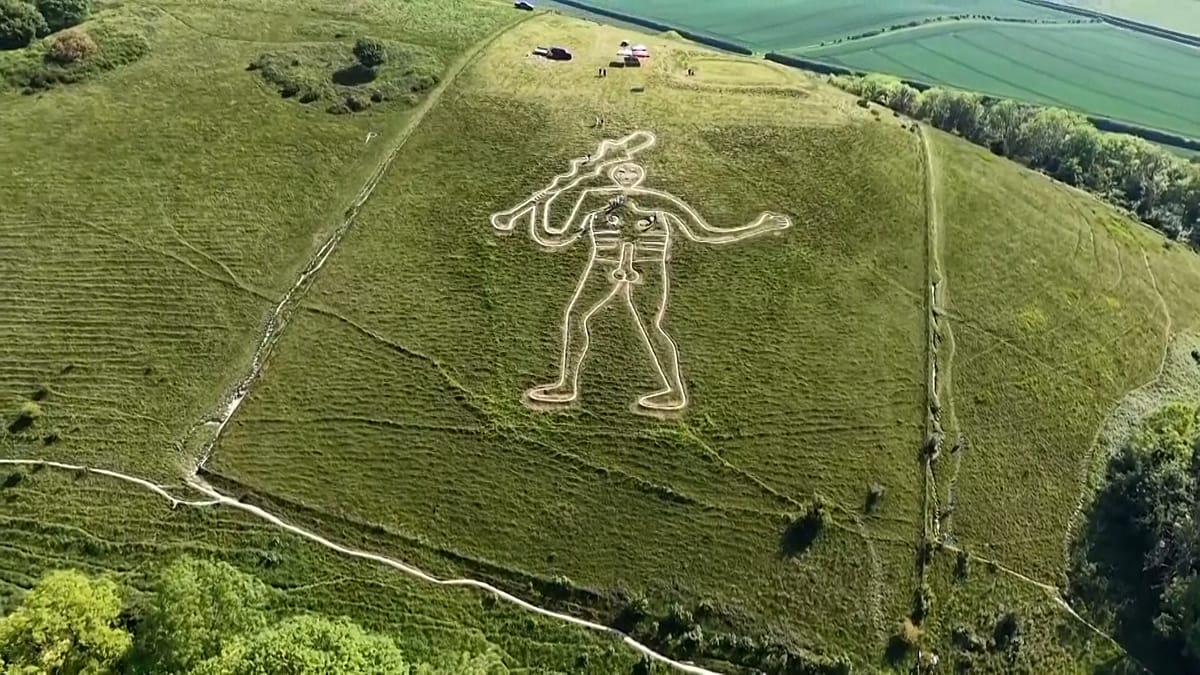
Conservation teams in Dorset have completed the first major restoration of the Cerne Abbas Giant in decades, applying 17 tonnes of wet chalk to refresh the ancient hill figure's fading outline. The work, carried out over several days, aims to preserve one of the United Kingdom's most recognisable prehistoric landmarks for future generations.
The giant, a 55-metre-tall figure carved into a chalk hillside near the village of Cerne Abbas, is believed to date from the Anglo-Saxon period, though its exact origins remain debated. The figure, which depicts a naked man wielding a club, has long been a subject of fascination for historians and tourists alike.
Preserving a National Icon
The restoration involved carefully applying a mixture of chalk and water to the figure's outline, which had become increasingly faint due to weathering and vegetation growth. The National Trust, which manages the site, said the work was essential to maintain the giant's visibility and structural integrity.
"This is a delicate operation that requires precision and care," said a spokesperson for the National Trust. "The giant is not just a local landmark but a piece of our shared heritage, and we want to ensure it remains a striking feature of the Dorset landscape."
The project has drawn attention from across Europe, highlighting the continent's rich tapestry of ancient art and archaeology. Similar chalk figures, such as the Uffington White Horse in Oxfordshire, have also undergone restoration in recent years, underscoring the ongoing efforts to preserve these fragile monuments.
While the Cerne Abbas Giant is a distinctly British icon, its restoration resonates with broader European efforts to protect cultural heritage. From the Centre Pompidou's recent expansion in Seoul to the meticulous conservation of Roman frescoes in Pompeii, the continent continues to invest in preserving its past.
The giant's exact age has been a matter of scholarly debate. Some historians suggest it was created in the 10th century as a representation of the Anglo-Saxon god Helith, while others argue it may be a 17th-century political caricature. Recent archaeological surveys have leaned toward an earlier date, but no definitive conclusion has been reached.
"The giant is a mystery that continues to captivate us," said Dr. Eleanor Harris, an archaeologist at the University of Exeter. "Its restoration is not just about maintaining a tourist attraction but about keeping a conversation with our ancestors alive."
The restoration comes at a time when the UK is increasingly focusing on cultural heritage as a driver of tourism and local identity. The giant attracts tens of thousands of visitors each year, contributing to the local economy in Dorset. Similar initiatives across Europe, such as the preservation of the Reichenbach Falls in Switzerland—where Sherlock Holmes fans recently recreated a famous scene—show how heritage sites can foster community engagement.
Environmental factors have also played a role in the decision to restore the giant now. Climate change has led to more extreme weather patterns, including heavy rainfall and drought, which can accelerate erosion of chalk figures. The National Trust has implemented measures to protect the site from future damage, including improved drainage and vegetation management.
"We are seeing the effects of climate change on our heritage sites across Europe," said Dr. Harris. "From the melting of Alpine glaciers to the erosion of coastal chalk cliffs, we need to adapt our conservation strategies."
The restoration of the Cerne Abbas Giant is a reminder of the enduring power of ancient symbols in modern Europe. As the continent grapples with issues of identity and unity, such landmarks serve as touchstones for shared history and cultural continuity.