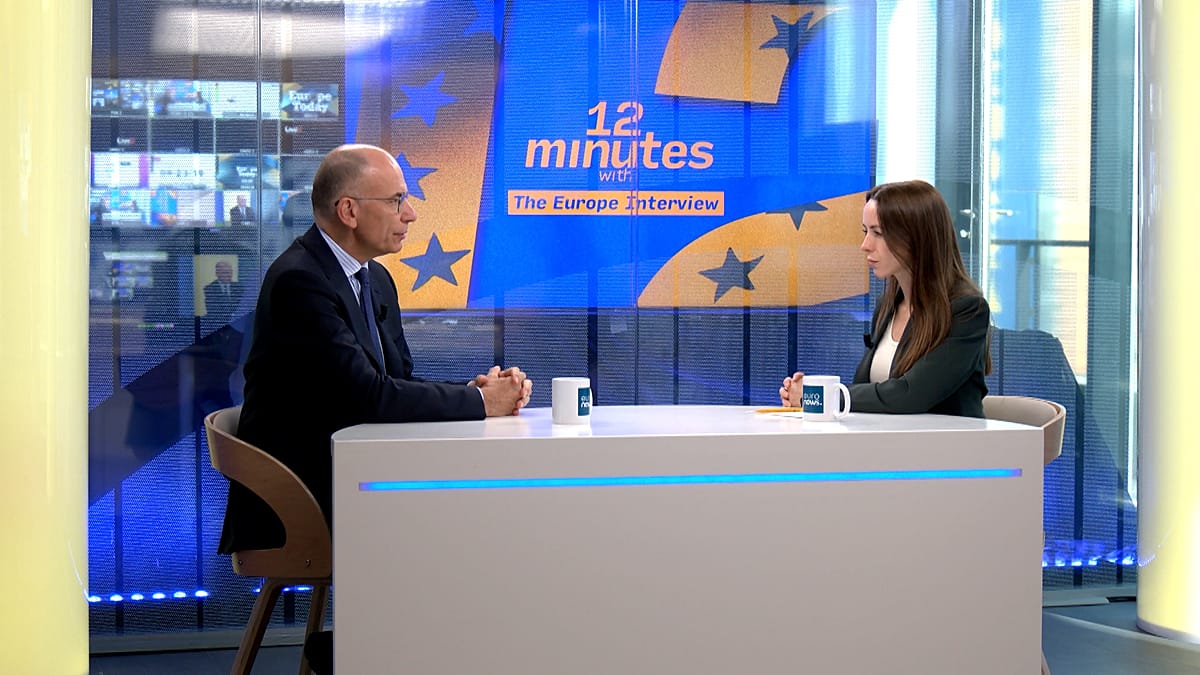
Enrico Letta, the former Italian prime minister and current dean of IE University in Madrid, has issued a stark warning to European Union member states: prioritizing national sovereignty over the bloc's collective strength is tantamount to handing a strategic advantage to the United States and China. In an interview with Euronews, Letta argued that the scale of the global economy demands a unified European response, not fragmented national efforts.
"National sovereignty is like sending a gift to the Americans and the Chinese," Letta said. "We have to be very clear on that, because national sovereignty isn't on the right scale. The correct scale to be competitive with the Americans and Chinese is the European one." He added that "the true battle is for European sovereignty."
Letta's comments come at a politically sensitive moment. With France's presidential elections approaching in 2027, Marine Le Pen's decision to run has raised concerns in Brussels about a potential rupture with Paris. Le Pen, who once campaigned to take France out of the eurozone, has since shifted her rhetoric, now advocating for a Europe of sovereign nations. Letta dismissed this vision as a dangerous illusion.
Drawing a parallel with the introduction of the euro, Letta argued that deeper integration need not come at the cost of national identity. "I remember in my country, Italy, but also in France, or Germany, people were very sceptical, because they were afraid that they would lose their identity when losing the national currency," he recalled. "But today we have the euro, which is an enormous success and thanks to the euro, we are stronger in the world. And the most important point is, we didn't lose our identities, we are still Italians, French, Spanish, German, with the euro."
From Report to Roadmap
Letta's arguments are not merely theoretical. His 2024 report, Much More Than a Market, served as the intellectual foundation for the European Commission's One Europe, One Market roadmap, which was discussed by EU ministers at the General Affairs Council in Brussels on Tuesday. The report calls for integrating key sectors—energy, digital services, and financial markets—to create a more competitive single market.
The bloc has long been criticized for its slow response to global economic challenges, but Letta said he sees a shift in momentum. "The political reason for the acceleration, for me, is linked to the Greenland crisis, which changed everything," he said, referring to President Trump's ambition to seize Greenland, the autonomous Danish territory. "This was a sort of big push for the European leaders to say, 'Now we have to be serious in applying the two reports, in implementing the two reports, and in trying to strengthen the European single market.'"
One of the core proposals in Letta's report is the creation of a Savings and Investments Union (SIU) to mobilize the €33 trillion in private savings held by European households. Currently, around €300 billion of that capital flows out of the EU each year, primarily into the US economy. "We are the continent of savings and savers. We are top in that, but we use our savings very badly," Letta said. "Putting savings in the Savings and Investments accounts, a European label of savings, will give them a better return than what they have today."
He argued that a properly integrated financial market would allow Europe to compete in cutting-edge sectors like artificial intelligence, where the US currently leads thanks to its ability to channel private capital into innovation. "This is not through public money, but through private money and investments, possible thanks to the nature of their financial market," Letta explained.
The former prime minister's vision is one of a Europe that retains its cultural and national diversity while pooling sovereignty where it matters most. As the EU faces pressure from both Washington and Beijing, Letta's message is clear: the only way to compete with giants is to act like one.