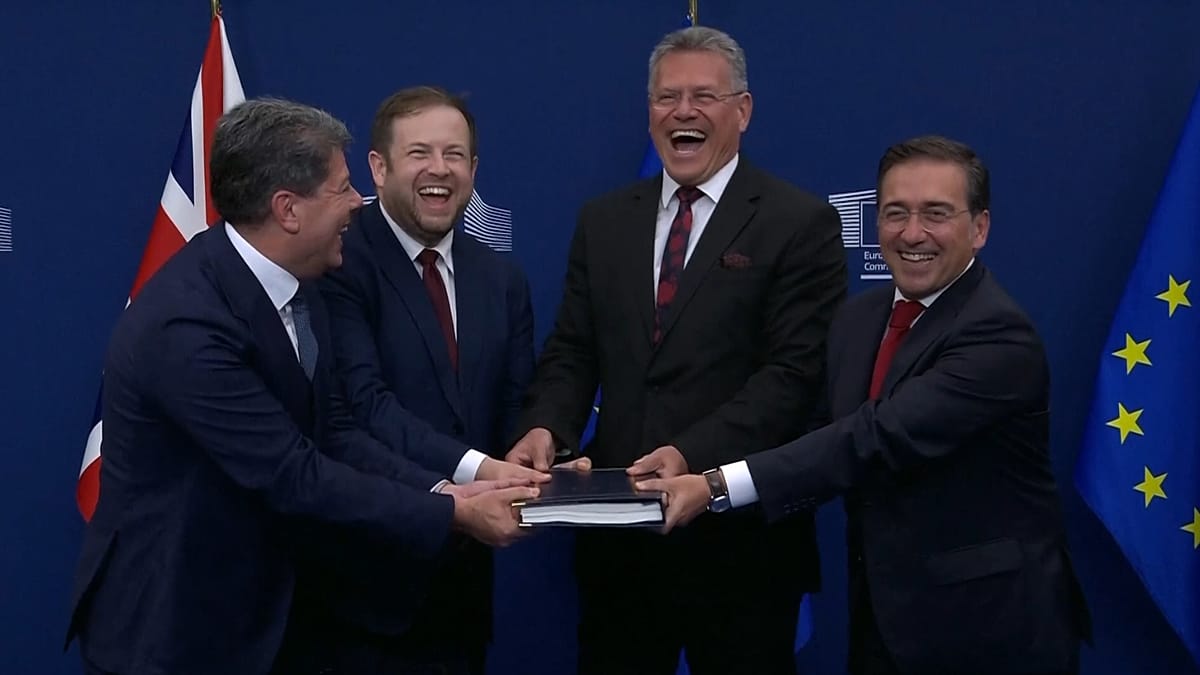
Spain’s Foreign Minister José Manuel Albares signed the EU-UK agreement on Gibraltar in Brussels on Tuesday, marking the formal end of the Brexit process for the disputed territory. Albares stressed that the deal does not alter Spain’s longstanding sovereignty claim over the Rock, stating that “Article 2 makes it very clear that Spain is not changing a single comma of its sovereignty claim.”
The agreement, signed by European Commissioner for Trade Maroš Šefčovič and UK Minister of State for Europe Stephen Doughty, with Albares and Gibraltar’s Chief Minister Fabian Picardo present, will see the demolition of the Verja border fence on Wednesday. Albares described the fence as “the last frontier in continental Europe.”
New Era for Gibraltar and Campo de Gibraltar
Albares argued that the treaty safeguards Spain’s position on sovereignty while enabling progress in daily coexistence. “We protect that claim and, above all, we are making a spectacular leap into the future in terms of cooperation and coexistence,” he said. The deal guarantees freedom of movement for people and goods, prevents past distortions in taxation and environmental standards, and provides new connectivity for the Campo de Gibraltar region in Andalusia.
The agreement closes the final chapter of the UK’s exit from the EU, six years after the actual departure. Albares called it a turning point after more than three centuries of disputes and mistrust. “We are leaving behind three centuries marked by mistrust and confrontation. Those who used to live back-to-back, as Gibraltar and the Campo de Gibraltar did, are moving forward together towards a future full of opportunities,” he added.
The deal has faced domestic criticism from Spain’s opposition Popular Party and Vox. Albares responded that “even if they do not realise it, they too have won,” emphasizing that the agreement benefits the 300,000 Andalusians in the Campo de Gibraltar. “Ultimately, cooperating and investing in coexistence can only be to Spain’s benefit,” he stressed.
The treaty’s signing comes amid broader European discussions on sovereignty and integration. As former Italian Prime Minister Enrico Letta recently argued, national sovereignty can be a “gift” to global competitors like the US and China, and EU unity is the only path forward. The Gibraltar deal exemplifies how bilateral agreements can reconcile sovereignty claims with practical cooperation.
Spain’s rental crisis, where 71% now see mortgages as better value than renting, highlights the economic pressures in regions like Campo de Gibraltar, where the deal aims to boost connectivity and opportunities.
The agreement also underscores the EU’s ability to manage post-Brexit relations with the UK, a key test for the bloc’s external relations. With the Verja fence coming down, the focus shifts to implementing the deal’s provisions on taxation, environment, and movement, which will be monitored by a joint committee.