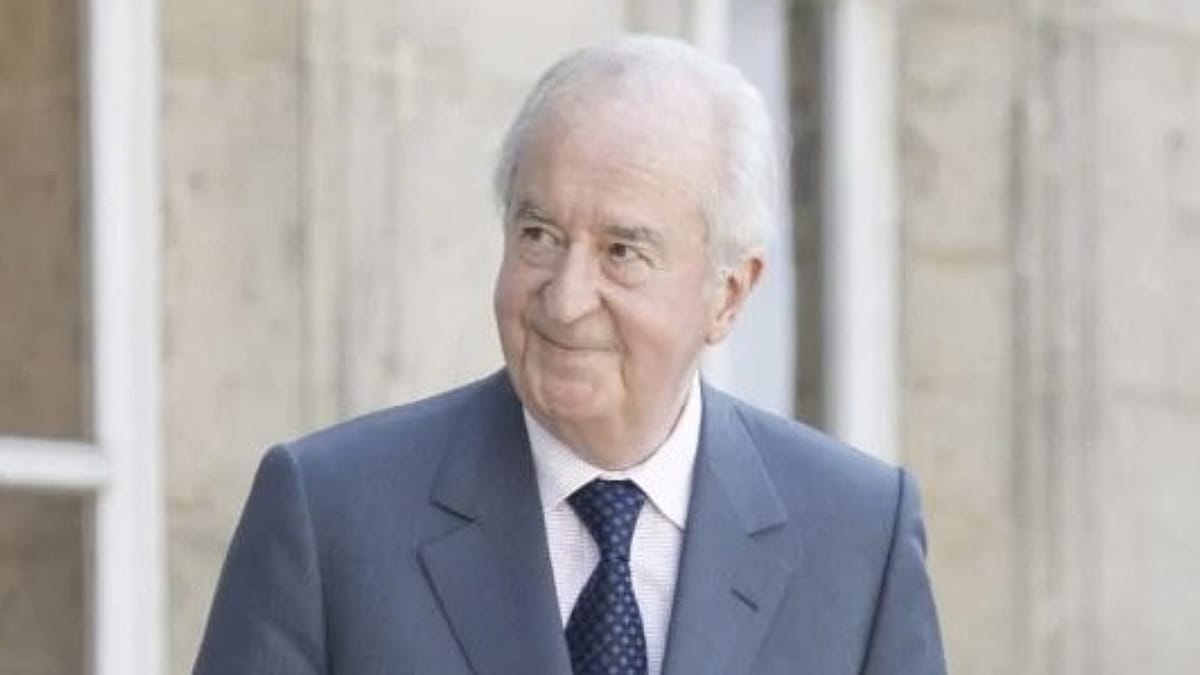
Édouard Balladur, who served as France's prime minister during the turbulent cohabitation of the mid-1990s, has died in Paris at the age of 97. His family confirmed the news to Agence France-Presse, adding that a private funeral mass is planned. No further details were released.
Balladur led the French government from March 1993 to May 1995 under Socialist President François Mitterrand, in what became known as the "second cohabitation." His tenure was marked by a pragmatic, reformist agenda that sought to modernise the French economy while navigating a delicate political balance.
A life in service of the Republic
Born in 1929 in Smyrna, Turkey, to an Armenian family, Balladur moved to Marseille as a child and later studied at Sciences Po and the École Nationale d'Administration in Paris. His career in public life began in earnest as a close adviser to Georges Pompidou, the former president and prime minister, whose political legacy deeply influenced Balladur's own approach to governance.
In 1995, Balladur ran for the presidency, but finished third in the first round behind Lionel Jospin and Jacques Chirac, who went on to win the Élysée. Despite that setback, his influence on French politics remained significant, particularly within the centre-right.
President Emmanuel Macron paid tribute on social media, calling Balladur a "demanding, level-headed, and devoted public servant" who had "dedicated his life to the Fifth Republic." Macron added: "I honour his memory and extend my thoughts to his family and loved ones."
Current Prime Minister Sébastien Lecornu described Balladur as a "statesman with a reformist spirit," noting that he "will remain a role model for many men and women in his political circle." Marine Le Pen, leader of the National Rally, also offered condolences, writing on X: "Setting aside the political disagreements we had with the man who served as Prime Minister from 1993 to 1995, today we should pay tribute to a statesman who left his mark on French public life, who consistently upheld his convictions and his vision of service to the Republic, and who always demonstrated respect for democratic debate."
Balladur's death comes at a time when France is again grappling with questions of political stability and institutional reform. His career, which spanned the Fifth Republic's most testing periods, offers a reminder of the delicate art of cohabitation—a system that has not been used since 2002 but remains a constitutional possibility.
Beyond his political roles, Balladur was known for his intellectual rigour and a certain aristocratic reserve. He authored several books on French politics and economics, and his 1993-95 government introduced measures to curb public spending and liberalise parts of the economy, including the privatisation of several state-owned companies.
His legacy is also tied to the broader European context. During his premiership, France was a driving force behind the Maastricht Treaty's implementation, and Balladur was a vocal advocate for deeper European integration, even as domestic debates over sovereignty intensified.
As tributes continue to pour in from across the political spectrum, Balladur's death marks the end of an era for a generation of French leaders who shaped the country's post-war trajectory. He leaves behind a complex but enduring imprint on the institutions he served.