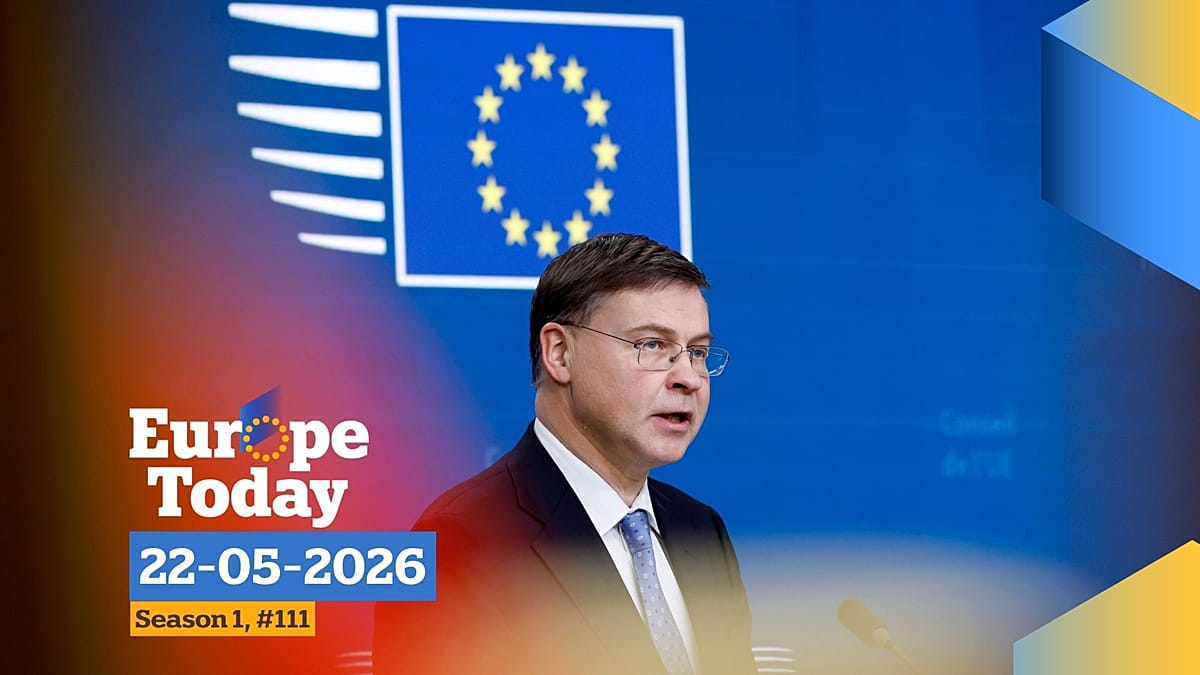
European Union economy commissioner Valdis Dombrovskis has made clear that the bloc will not ease its sanctions regime against Russia, despite growing economic headwinds and calls from some member states to cushion the impact of high energy prices. Speaking on Euronews' Europe Today, Dombrovskis dismissed any parallel with the United States or the United Kingdom, which have recently signalled a more flexible approach.
The European Commission this week downgraded its economic growth projection for 2026, citing persistent inflation and uncertainty stemming from the war in Ukraine. The revised outlook has intensified debate among EU capitals about how to manage the energy crisis, with Italy's Prime Minister Giorgia Meloni and Hungary's new Prime Minister Péter Magyar each proposing alternative strategies to shield consumers and businesses.
Sanctions Remain the Bedrock of EU Policy
Dombrovskis stressed that maintaining pressure on Moscow is essential for European security and for upholding international law. “We see no grounds to ease sanctions,” he said. “The EU's unity on this is our greatest strength, and we will not compromise it for short-term economic relief.” His remarks come amid reports that some European industries are struggling with elevated energy costs, but the commissioner insisted that the long-term costs of yielding would be far higher.
The debate over sanctions has also played out in the European Parliament. Spanish MEP Javi López, Vice-President of the Parliament and a member of the Socialists & Democrats group, told Europe Today that the EU must combine firmness on Russia with targeted support for vulnerable households. “We cannot let the Kremlin dictate our energy policy,” López said. “But we also need a social safety net for those hit hardest by price rises.”
Meanwhile, the EU's external relations remain active. The bloc recently concluded a summit with Mexico, aiming to deepen trade and political ties. López, who participated in the summit, described it as a step toward diversifying Europe's supply chains and reducing dependency on authoritarian regimes.
Can a Post-Orbán Hungary Revive the Visegrád Group?
In a separate segment, Euronews correspondent Jakub Janas explored whether Hungary's new prime minister, Péter Magyar, could breathe new life into the Visegrád Group — the informal alliance of Poland, Czechia, Slovakia, and Hungary. Under Viktor Orbán, Hungary often clashed with Brussels over rule-of-law issues and migration, straining the group's cohesion. Magyar has signalled a more conciliatory tone toward EU institutions, raising hopes in some quarters that the V4 could regain influence in Brussels.
Correspondent Sándor Zsíros reported from Budapest that a shift in Hungary's foreign policy could reshape Central European dynamics. “If Magyar follows through on his promises of closer alignment with EU norms, the Visegrád Group might once again become a constructive force,” Zsíros noted. “But sceptics point to the deep roots of Orbán's system and question how much real change is possible.”
The broader European security landscape remains tense. A Russian drone barrage hit a residential area in Kharkiv this week, underscoring the ongoing threat to Ukrainian civilians. In a related development, Ukraine struck a Russian oil refinery in the Samara region with a drone, part of Kyiv's campaign to disrupt Moscow's energy infrastructure.
Culture and Politics Collide at Cannes
Beyond economics and security, Europe Today also turned to culture. Journalist and writer Jada Yuan reported live from the Cannes Film Festival, which has become a flashpoint for debates over politics, ideology, and artistic freedom. This year's edition features protests by groups such as Pussy Riot and FEMEN against Russia's return to the Venice Biennale, a move they see as legitimising the Kremlin's cultural outreach amid the war. Yuan noted that the festival's red carpet has become a stage for geopolitical statements, with filmmakers and actors using their platforms to speak out on issues from climate change to human rights.
The episode of Europe Today airs across Euronews platforms. Viewers can catch the full discussion on the EU's economic outlook, the Visegrád Group's future, and the cultural battles at Cannes.