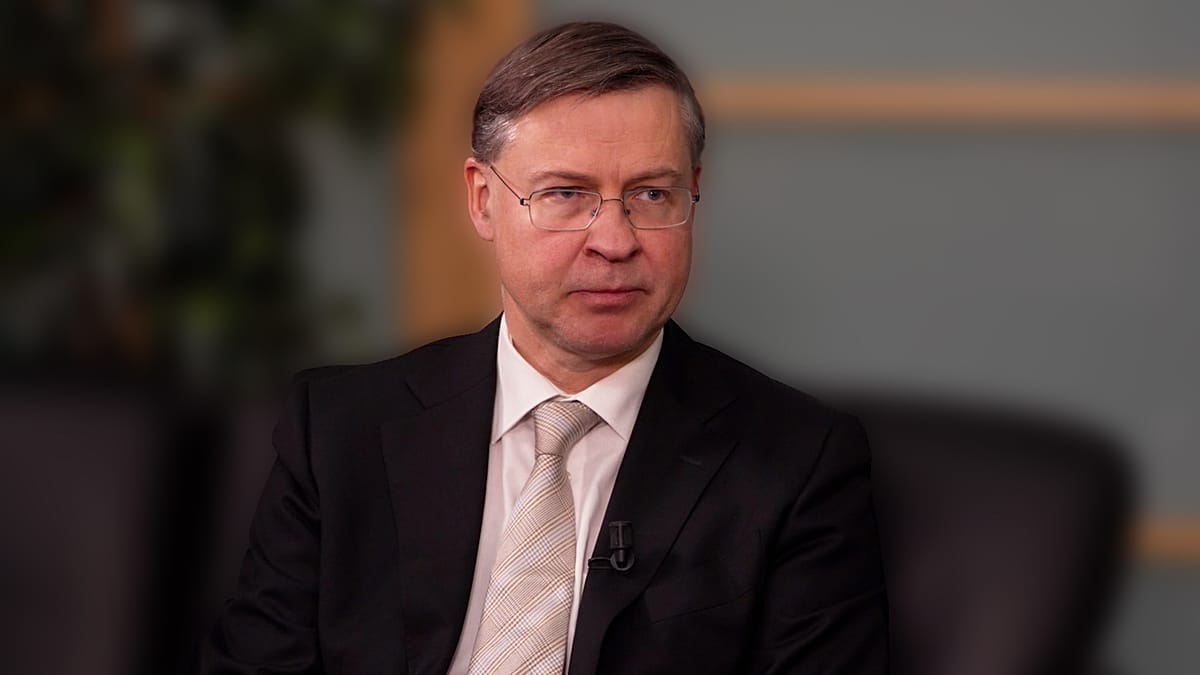
European Commissioner for the Economy Valdis Dombrovskis has firmly stated that the European Union will not revert to importing Russian oil or gas, even as the energy crisis deepens. In an exclusive interview with Euronews, Dombrovskis argued that Moscow is exploiting the conflict in the Middle East to generate windfall profits from elevated energy prices, and that the EU must not facilitate this by easing its sanctions regime.
“If anything, we need to strengthen sanctions against Russia, not ease, because actually Russia is a country benefiting from this conflict in the Middle East and those higher energy prices, getting substantial windfall profits, so we should not facilitate it further,” Dombrovskis said.
The commissioner’s comments come amid growing pressure on European governments to address soaring household energy bills. However, Dombrovskis dismissed any suggestion of backtracking on sanctions, emphasising a “strategic decision” to permanently reduce dependence on Russian energy. He recalled the 2022 crisis when Russia weaponised its fossil fuel supplies, leading to severe economic consequences for the bloc.
“We already saw back in 2022 that Russia tried to use its fossil fuel supplies as a tool for blackmail and manipulation, and we paid a quite dear economic price for having this dependency from Russia, so therefore there's no point of going back to this,” he added.
The UK government recently issued an open-ended licence allowing imports of diesel and jet fuel made from Russian crude oil in third countries like Turkey and India, where the oil is purchased at discounted prices. A separate licence permits short-term service contracts with Russia’s Sakhalin-2 and Yamal LNG projects until January 2027. The move surprised Ukraine and its allies, given Prime Minister Keir Starmer’s strong support for Kyiv. Downing Street downplayed the incident as a communication failure.
Meanwhile, EU lawmakers are pushing to formally ban all remaining Russian gas flows by 2027 and phase out oil imports earlier than initially planned. Dombrovskis assured that there is no risk of Europe facing blackouts, a concern that emerged during the 2022 energy crisis.
Italy’s Push for Fiscal Flexibility
Italian Prime Minister Giorgia Meloni has urged the EU to treat the energy crisis with the same urgency as defence. In a letter to European Commission President Ursula von der Leyen, Meloni called for the activation of the National Escape Clause to relax fiscal rules in light of rising energy costs. “If we rightly consider defence to be such a strategic priority as to justify the activation of the National Escape Clause, then we must have the political courage to recognise that today energy security is also a European strategic priority,” she wrote.
Dombrovskis acknowledged the concerns from Rome, stating that the Commission is “looking at policy options” but stressed that any support must be “temporary and targeted.” He said, “We certainly are listening to the concerns of member states and looking at appropriate policy response.”
The broader European economy is projected to weaken this year, as the war in Iran and ongoing Middle East tensions have sparked the second major energy crisis in five years. The EU’s green economy, however, continues to expand, with solar energy surging and waste management leading profits, as reported in EU Green Economy Doubles Output. German business sentiment has unexpectedly risen despite these strains, as noted in German Business Sentiment Unexpectedly Rises.
Dombrovskis’s firm stance underscores the EU’s commitment to energy independence, even as member states grapple with the economic fallout. The Commission is expected to present further policy options in the coming weeks, balancing fiscal discipline with the need to shield households and businesses from the crisis.