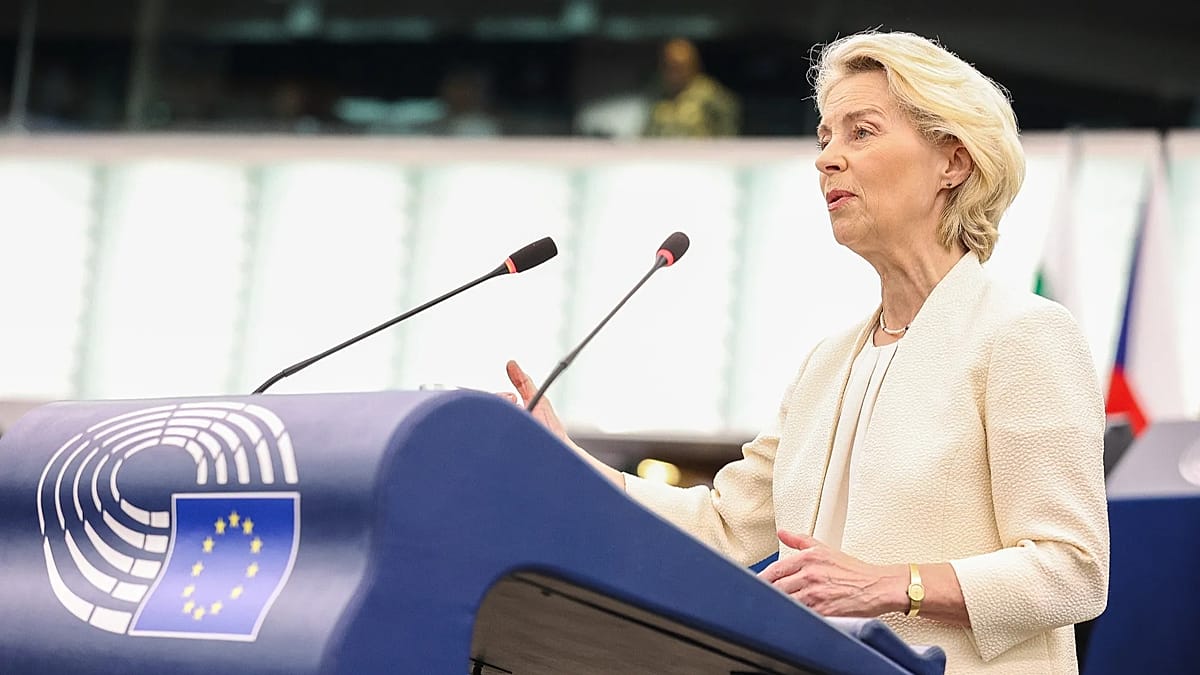
On 17 September, European Commission President Ursula von der Leyen and Executive Vice-President Henna Virkkunen presented the EU Kids Act, a legislative proposal aimed at making the internet safer for children across the Union. The act introduces a uniform minimum age for social media accounts, bans them for children under 13, and requires platforms to eliminate addictive design elements such as infinite scrolling and push notifications.
The proposal follows the recommendations of the Special Panel on child safety, which in July 2026 published a report titled "Child safety online" and called for restricting access to what it termed "social media." The EU aims to replace the current patchwork of national rules with a single set of standards that protect all minors equally, regardless of where they live in the bloc.
Why the EU is acting now
A 2026 Eurobarometer survey highlights the scale of the problem. Children who began using social media before age 10 report an average of 7.5 hours of screen time on weekends, compared with 5.7 hours for those who started after 14. On weekdays, teens aged 13 to 18 spend 4.5 hours on screens, rising to 6.1 hours on weekends.
But the concern goes beyond screen time. "Social media platforms are no longer the services they were when they were first created. Many have evolved from centred spaces on social connection into highly sophisticated systems designed to capture and monetise attention," said Francesca Pisanu, senior policy officer at Eurochild.
The business models of these platforms rely on advertising, recommender systems, and addictive features like autoplay and infinite scroll, which can lead to excessive use and addiction in children. Unrestricted access to harmful content also poses physical and mental health risks. According to the Eurobarometer, about 33% of minors feel stressed or sad, and 90% report negative symptoms such as depression, concentration issues, or eating disorders. Cyberbullying is a growing concern, with about 5% of children aged 9-16 experiencing online bullying every month, making it the top issue in helpline calls to Safer Internet Centres.
What the EU Kids Act proposes
The act sets EU-wide rules for all online services, including social media, video-sharing platforms, video games, app stores, and AI companions. Children aged 3 to 13 cannot have personal accounts but may use parental-managed accounts with access only to age-appropriate content. For adolescents aged 13 to 15, parents can set up "mini accounts" with restrictions on social contacts and a daily screen time limit of one hour.
Parental control tools are central to the proposal. Platforms must provide screen-time management, contact approval, content reporting, and device access controls. However, Eurochild warns that parental controls should not replace automatic protections. "Overreliance on parentals places an unfair burden on caregivers and assumes that every child has access to supportive, digitally skilled and available adults. That is not the reality for all children, including some children in alternative care, children experiencing family conflict or neglect," Pisanu added.
Age verification without compromising privacy
The days of simply ticking a date-of-birth box are over. Platforms will not be allowed to check identity documents or learn users' identities. Instead, they will use the EU Age Verification App, the European Digital Identity Wallet, or approved third-party systems to determine whether a user is above or below the minimum age, without retaining personal information or tracking location.
Within six months of the rules taking effect, providers must verify existing account holders and deactivate accounts of users under 15 or those whose age cannot be confirmed.
Obligations on big tech
All online services must be "safe by design." This means no endless autoplay, infinite scrolling, or reward mechanisms that encourage compulsive use. Platforms must include time limits and usage breaks, and they can no longer track or share minors' real-time location or activate microphones and cameras unless the minor switches them on. Behavioural-based recommender systems are banned for minors.
According to Pisanu, "children should see a significantly safer feed. Engagement-based recommendations would be switched off by default, so platforms could no longer shape children's feed primarily around what keeps them scrolling. Children would be able to choose a non-profiled feed, change their preferences and delete interests inferred about them."
However, Pisanu believes the rules for AI chatbots are not strict enough. "We would like to see the minimum age for autonomous access reconsidered. More specific safeguards may also be necessary, including restrictions on anthropomorphic and sycophantic design, hidden advertising and commercial influence."
Online games and apps must also be age-rated, and providers must prevent children from accessing or buying age-inappropriate content. Very large online platforms (VLOPs) will bear the "burden of proof," having to demonstrate to the EU Commission and independent auditors that their services are safe. Breaches could result in fines of up to 6% of total worldwide annual turnover.
The EU already has a framework through the Digital Services Act (DSA) and the Audiovisual Media Services Directive, but the Kids Act aims to strengthen and harmonise these protections. The proposal now goes to the European Parliament and Council for approval. If adopted, it will mark a significant step in restricting minors' social media use across Europe.