Ukrainian President Volodymyr Zelenskyy announced on Saturday that Ukrainian forces had struck the Progress Rocket and Space Centre in Russia's Samara region, a facility central to the production and operation of space launch vehicles. In a post on X, Zelenskyy said the strike used FP-5 Flamingo cruise missiles, describing the centre as one of Roscosmos' "key enterprises" and noting its role in electronics production.
The attack is part of a broader Ukrainian campaign to hit targets deep inside Russia, aiming to degrade Moscow's military capabilities and pressure the Russian economy. Additional strikes targeted the Savasleyka air base in the Nizhny Novgorod region, which Ukraine says houses MiG-31K fighter jets used to launch Kh-47M2 Kinzhal ballistic missiles, and an oil facility in Ust-Luga, near the Estonian border.
Zelenskyy shared video footage on X appearing to show columns of black smoke and flames rising from the struck sites. "Our plan of long-range sanctions against Russia for this war is being implemented, and it is important that Russia's war potential be reduced," he wrote.
Details from Ukraine's General Staff
The General Staff of the Armed Forces of Ukraine later confirmed hits at both the Progress centre and the Savasleyka air base, reporting that fires had broken out on the facilities' grounds. It added that the launch vehicles produced at the Progress centre are used to "place Russian military, reconnaissance, and communications spacecraft into orbit."
The Savasleyka air base, according to the General Staff, operates MiG-31K fighters, which are adapted to carry the Kinzhal hypersonic missile—a weapon Russia has repeatedly used against Ukrainian cities and infrastructure.
These strikes are the latest in a series of Ukrainian long-range operations that have increasingly focused on Russia's energy sector. Kyiv has targeted oil refineries, terminals, and depots across the country, causing fuel shortages in parts of Russia and Russian-occupied territories. The fuel shortages have become a recurring problem for Moscow, affecting both military logistics and civilian supply chains.
The Ukrainian air force reported that Russian forces launched 152 drones and loitering munitions at Ukraine overnight. "According to preliminary data, as of 9 am, air defences had shot down or neutralised 124 enemy UAVs," it said, adding that strikes were recorded in 16 locations.
The overnight attacks caused casualties across several regions. In the Kherson region in southern Ukraine, 28 people were injured, including a child, according to Oleksandr Prokudin, head of the Kherson Regional Military Administration. In the Dnipropetrovsk region in the southeast, a child was killed and 11 others were injured, per regional governor Oleksandr Hanzha. Four people were also injured in Sumy Oblast in the north.
Ukraine's strategy of "long-range sanctions" is designed to impose costs on Russia's war machine while also demonstrating Kyiv's ability to strike at will. The choice of targets—from a space centre to an air base and an oil terminal—reflects a deliberate effort to hit both military and economic assets.
The Progress Rocket and Space Centre, located in Samara, is one of Russia's most important aerospace facilities. It has been involved in the production of Soyuz rockets, which are used for both civilian and military satellite launches. By striking it, Ukraine aims to disrupt Russia's ability to maintain its orbital reconnaissance and communications infrastructure, which are vital for its military operations.
The attack on the Savasleyka air base is particularly significant given the role of MiG-31K jets in launching Kinzhal missiles. These weapons have been used in strikes on Ukrainian cities, and degrading the base's operational capacity could reduce the threat.
The oil facility in Ust-Luga, located near the Estonian border, is a key export terminal for Russian crude and petroleum products. Strikes on such infrastructure have contributed to fuel shortages in Russia, as well as disruptions to global energy markets.
Ukraine's long-range campaign has drawn attention to the vulnerability of Russian territory to attack, even as Moscow continues its aerial bombardment of Ukrainian cities. The strikes also serve a symbolic purpose, showing that Ukraine can reach targets far beyond the front lines.
Meanwhile, the human cost of the war continues to mount. The overnight drone and missile attacks on Ukraine resulted in civilian casualties, underscoring the relentless nature of the conflict. Ukrainian air defences, bolstered by Western support, have been able to intercept a significant proportion of the incoming drones, but the sheer volume of attacks remains a challenge.
As Ukraine presses its long-range strategy, the international community watches closely. The strikes on Russian soil, while not new, have become more frequent and more ambitious. They raise questions about the potential for escalation, but Kyiv has made clear it sees these operations as essential to its defence.
In a related development, NATO jets downed a Russian-linked drone over eastern Latvia, highlighting the spillover risks of the conflict into neighbouring countries. The incident, which occurred earlier this week, underscores the broader European security implications of the war.
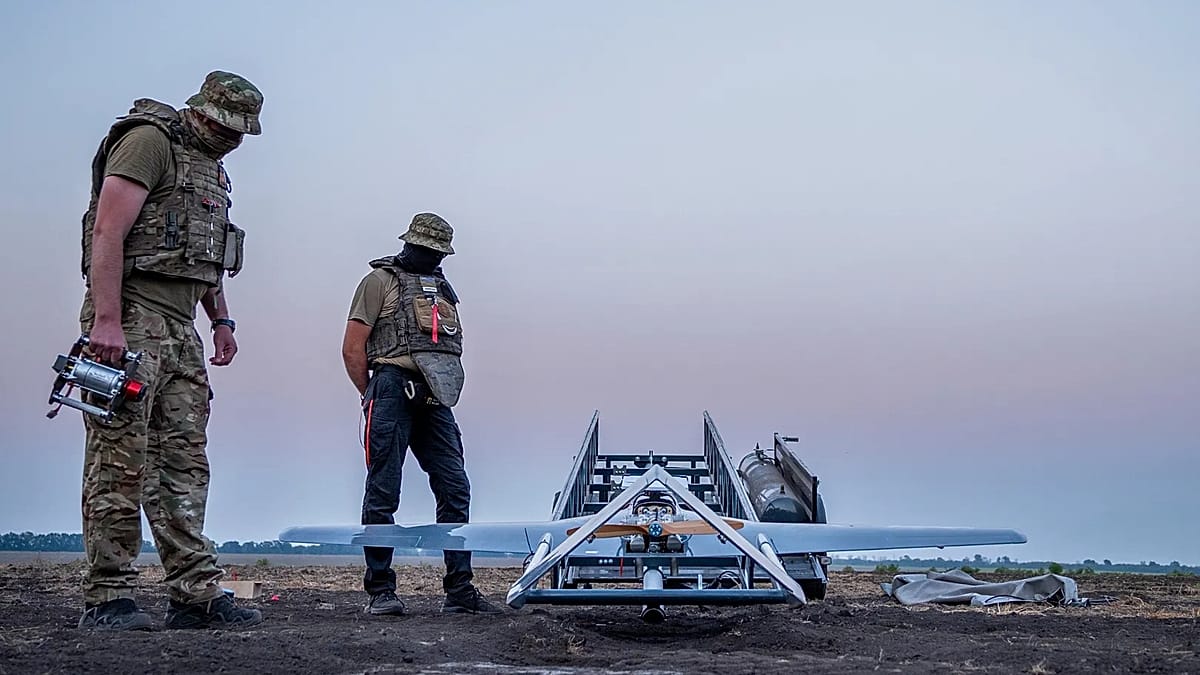
Ukraine's ability to conduct such strikes is a testament to its growing domestic drone and missile capabilities, as well as the support it has received from allies. The use of the FP-5 Flamingo cruise missile, a Ukrainian-designed weapon, indicates that Kyiv is developing its own long-range arsenal rather than relying solely on Western-supplied systems.
The strikes come at a time when Ukraine has also been making progress on the ground, with recent gains in the southeast after months of grinding advances. The combination of territorial recapture and long-range strikes is part of a dual strategy to weaken Russia's military and political position.
For Moscow, the attacks on its space and energy infrastructure are a reminder that the war is not confined to the front lines. The Kremlin has often portrayed the conflict as a defensive struggle against NATO expansion, but the reality of Ukrainian strikes deep inside Russia challenges that narrative.
As the war enters its fourth year, both sides continue to adapt. Ukraine's long-range campaign is likely to persist, with Kyiv seeking to maximise pressure on Moscow ahead of any potential negotiations. The strikes on the Progress centre, Savasleyka air base, and Ust-Luga oil facility are the latest examples of this evolving strategy.