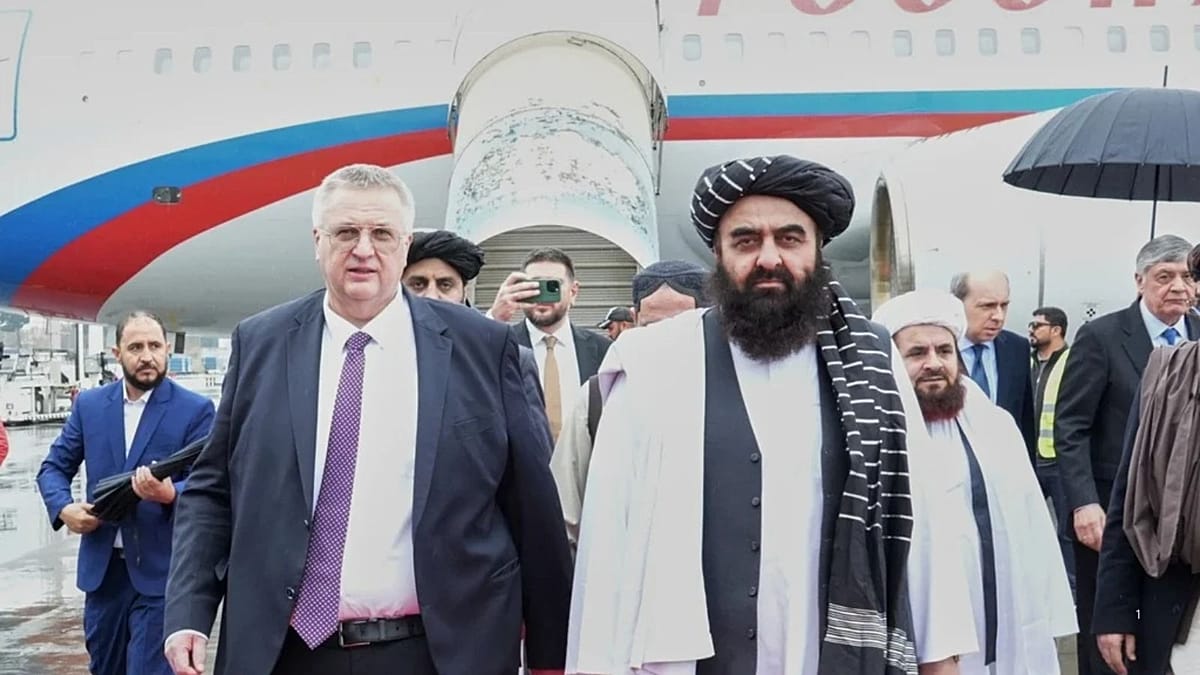
Russia has dispatched a high-level business delegation to Kabul, marking the most significant commercial overture to Afghanistan's Taliban government since Moscow formally recognized it in July 2025. Deputy Prime Minister Alexei Overchuk arrived on Thursday with around 70 Russian business leaders, a move that underscores Russia's growing economic engagement with the Taliban despite international isolation.
Overchuk was received with a guard of honour and held talks with Taliban Prime Minister Mohammad Hassan Akhund, Deputy Prime Minister for Economic Affairs Abdul Ghani Baradar, and Foreign Minister Amir Khan Muttaqi. The discussions focused on trade, transport, logistics, agriculture, and pharmaceuticals, according to Afghan officials.
In a statement posted on X, Baradar highlighted Afghanistan's "strategic location, abundant resources and a workforce of 24 million people" as key assets for potential investors. He invited Russian companies to invest in agriculture, mining, road and railway construction, and factory building, and proposed the creation of a special economic zone in Afghanistan. He also expressed interest in expanding Afghan agricultural exports to Russia and called on Moscow to ease transport and transit costs for Afghan goods.
Overchuk, quoted by Russian news agency TASS, said the delegation included companies already active in Afghanistan and that "many others want to start operating in this country." He noted that the firms represented work in transport, logistics, agriculture, and pharmaceuticals, and that the Afghan government has shown particular interest in Russian chemical fertilisers and in building fertiliser production plants on Afghan soil.
Trade between Russia and Afghanistan has grown sharply, with Overchuk estimating that bilateral trade in the first eight months of 2026 more than doubled to over $349 million. This surge comes as Russia seeks to expand its economic footprint in Central and South Asia, partly in response to Western sanctions that have pushed Moscow to diversify its trade partners.
Russia's recognition of the Taliban
Russia's official recognition of the Taliban government in July 2025 made it the first and only country to take such a step since the Taliban seized power in August 2021, following the withdrawal of US forces. This move has drawn criticism from Western governments and human rights groups, but Moscow has defended it as a pragmatic step to ensure regional stability and counter terrorism threats.
The delegation's visit comes amid broader geopolitical shifts, with Russia increasingly positioning itself as a key player in Afghanistan's future. Moscow has also been active in regional diplomacy, hosting talks on Afghanistan and engaging with neighbouring countries, including Iran and China.
For European observers, the development raises questions about the West's approach to Afghanistan and the potential for Russia to gain economic and political leverage in the region. While the EU has not recognised the Taliban, it has maintained humanitarian aid channels and has called for an inclusive government and respect for human rights.
The visit also highlights the growing economic competition in Central Asia, where Russia, China, and the EU are vying for influence. As Russia deepens its ties with the Taliban, European policymakers may need to reassess their own strategies for engaging with Afghanistan and the wider region.
Overchuk's trip is part of a broader pattern of Russian outreach to countries under international sanctions or isolation, including Iran and North Korea. Moscow has also been criticised for sanctions evasion and has sought to build alternative financial and trade channels.
The business delegation's visit is likely to be followed by more concrete agreements, as both sides have expressed interest in deepening cooperation. However, the Taliban's international isolation and the lack of a clear legal framework for foreign investment remain significant hurdles.
For now, Russia's move signals a pragmatic, if controversial, approach to Afghanistan, one that contrasts sharply with the West's cautious stance. As Moscow continues to expand its influence, the implications for regional stability and for Europe's own interests in Central Asia are likely to grow.