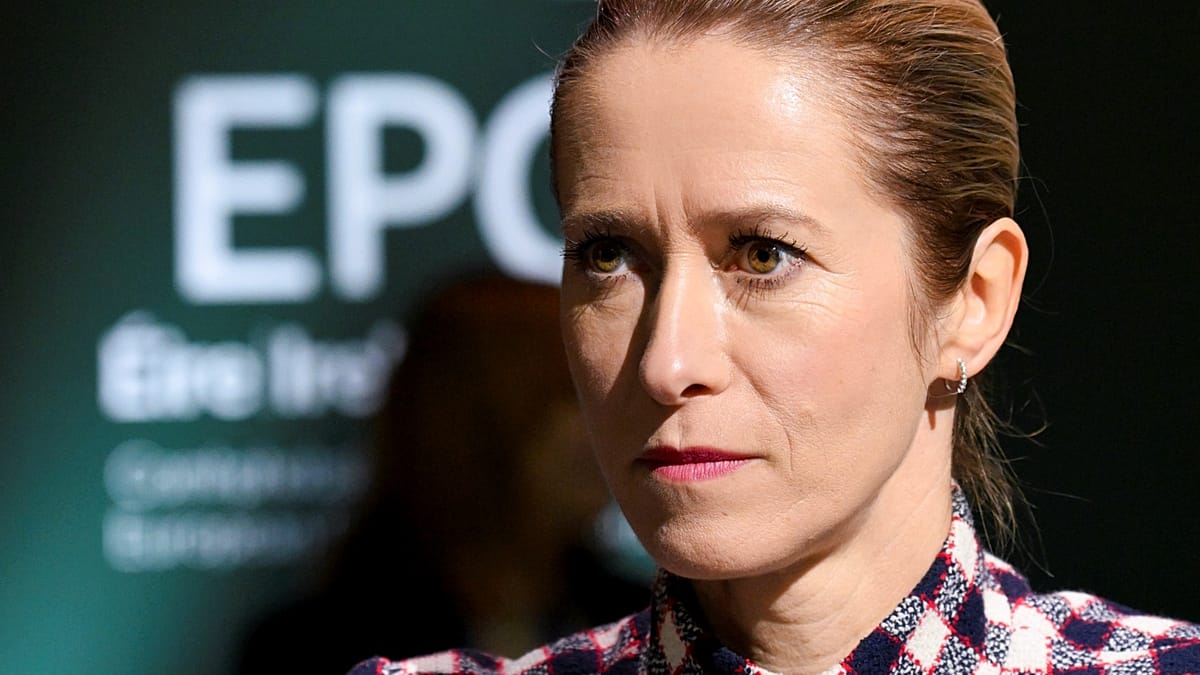
Kaja Kallas, the European Union's High Representative for Foreign Affairs and Security Policy, has formally positioned herself as the bloc's designated negotiator for talks to end Russia's war in Ukraine. Speaking at an informal summit of EU leaders in Dublin, she argued that the role naturally falls to her as the EU's top diplomat, but acknowledged a significant obstacle: Moscow's outright rejection of her candidacy.
"Russians do not want me" at the negotiating table, Kallas said on Friday, attributing this to her "strong" stance on Russia. She dismissed the notion that Russian preferences should carry any weight, asking: "But do we have a say in who is representing Russia? No, we do not." She added, "Really, we have to have a strong team."
Kallas reminded the assembled heads of state and government that they themselves appointed her in June 2024, knowing full well that face-to-face talks with Moscow would eventually be necessary. "In June 2024, there was a decision by the leaders (on) who is representing (the EU) when it comes to security and foreign policy," she said. "And it was the discussion that in these five years there is going to be a negotiation with the Russians."
"If the leaders want to change that agreement, of course, they may, because it is the leaders' decision, but I think we should focus our energy actually on the substance," she added.
A question of institutional role
Kallas also cautioned against replicating the US approach, which has relied on two hand-picked envoys, Steve Witkoff and Jared Kushner. Instead, she argued, the EU should choose someone with a clearly defined "institutional role." The Treaty of Lisbon indeed vests foreign policy coordination and execution in the High Representative, while also giving the president of the European Council, currently António Costa, a representational function. The European Commission, for its part, manages sanctions, financing, and accession—all crucial to the diplomatic track.
Despite Kallas's pitch, Costa has emerged as the frontrunner for the special envoy post, according to multiple reports from Brussels. Kallas is seen as a divisive figure in EU circles and has been increasingly sidelined in top-level discussions. A senior diplomat at the Dublin summit cautioned against letting the debate over candidates overshadow the message, warning that it risks "fuelling divisions among Europeans, which is what Russia wants."
Kallas, however, stressed that she is not acting on her own behalf. "I am bound to what the member states say," she said, referencing the unanimity principle that guides EU foreign policy. "I am not representing myself. I am representing 27, as I have done already for two years."
Asked whether Moscow's opposition stems from her Eastern European background, Kallas suggested that Russia would resist "anybody strong" at the table. "They want to push through their maximum demands, like they have always done," she said, pushing back against "threats and ultimatums." She elaborated: "Of course, if you negotiate with anybody, you want the other side to be as weak as possible so that you can get what you want. That is very clear. But it is not up to them to say. Otherwise, if we give them the right (to) this, we are actually really giving them the leverage that they should not have."
The question of a single European envoy has gained urgency after both Ukraine and the United States asked Europeans to appoint one representative for the talks. So far, negotiations have been conducted at a technical level, and it remains unclear what role the envoy would play or at which table they would sit. The most recent meeting in Abu Dhabi brought together senior officials from France, Germany, the United Kingdom, Italy, the European Commission, the European Council, and NATO.
As the EU seeks a unified voice, the Dublin summit highlighted the internal tensions. Meanwhile, US envoys have pushed for a European role in the talks, but Moscow has downplayed Europe's involvement. The coming weeks will test whether the EU can overcome its internal divisions and present a coherent front in the high-stakes negotiations.